

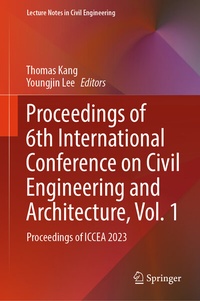
Proceedings of 6th International Conference on Civil Engineering and Architecture, Vol. 1
Description

The book presents the selected and peer reviewed papers of 2023 6th International Conference on Civil Engineering and Architecture (ICCEA 2023), held in Bali Island, Indonesia on December 16-18, 2023. This volume of proceedings includes a lot of smart and green solutions for challenges on civil infrastructure construction and architectural design. The book highlights attempts made by the researchers and practitioners to solve architectural planning issues by using state-of-the-art technologies and engaging in a lot of case studies and practices. This volume provides a valuable and useful reference for the people from both in academia and industry who are working in the field of civil engineering and architecture.
More details
Other editions
Additional editions
Persons
Dr. Thomas Kang is a professor in the Department of Architecture and Architectural Engineering and the Interdisciplinary Program in Artificial Intelligence at Seoul National University, Korea. Prior to that, he was a professor in the School of Civil Engineering and Environmental Science at the University of Oklahoma, Norman, OK, USA. He has held various affiliated positions in the USA and Japan, including an adjunct professor at the University of Oklahoma, an adjunct professor at the University of Illinois at Urbana-Champaign, a visiting professor and lecturer at UCLA, and the lecturer at the University of Hawaii at Manoa, the University of Cape Town and the University of Tokyo. Prof. Kang received his PhD from UCLA, his MS from Michigan State University, and his BS from Seoul National University. Prof. Kang is a Fellow of Post-Tensioning Institute (PTI) and a Fellow of American Concrete Institute (ACI). Prof. Kang received the Kenneth B. Bondy Award for Most Meritorious Technical Paper as Lead Author from PTI twice in 2023 and 2012, the Wason Medal for Most Meritorious Paper as Lead Author from ACI in 2009, and the Martin P. Korn Award as a responsible author from Precast/Prestressed Concrete Institute (PCI) in 2023. Prof. Kang is an editor-in-chief for Wind and Structures and an associate editor for PTI Journal of Post-Tensioning Institute. He has chaired many sessions/symposiums of structural engineering; delivered many keynote/invited speeches; and organized international conferences/workshops as a chair. Additionally, Dr. Kang has done a lot of practice as a consulting engineer in Korea and the US, he had a working experience in California prior to joining the academia, and he was a licensed Professor Engineer (PE) in California.
Prof. Youngjin Lee is a faculty of the Boston Architectural College in Massachusetts, USA, and a co-founder and CEO at D.TO, Inc. in Massachusetts, USA, as a licensed architect with 23 plus years of experience. He received a BS (1998) in Aeronautical Engineering from Seoul National University, Korea, a BS (2000) in Architecture from the same school, and an M.Arch (2007) from School of Architecture at Yale University, U.S. Prof. Lee is a member of the American Institute of Architects (AIA), a member of Boston Society of Architects (BSA), and a member of US Green Building Council (USGBC). He is also a peer reviewer of international journals including Nexus Network Journal and Architectural Research and a research project reviewer of National Research Foundation of Korea. Prof. Lee's research stems from his experience in both academia and practice, and efforts to improve design methodology, which offers design possibilities through integrative design media and generative algorithms. He has published in many journals including Architectural Research, Journal of Asian Architecture and Building Engineering, Automation in Construction, Nexus Network Journal, and Advances in Computational Design, and presented his works at International Conference on Sustainable Building Asia 2016, AIA Conference on Architecture 2017, and ASHRAE 2017 Building Performance Analysis Conference. As a co-founder and CEO at D.TO, he is developing a BIM-integrated collaborative knowledge-sharing platform for carbon-neutral design in the AEC.
Content
- Intro
- Preface
- Committees
- Contents
- Development of a Management System for Digital Construction of Non-standardized Units Design
- 1 Background
- 2 Research Methodology
- 2.1 Analysis of Previous Studies
- 2.2 Conclusion and Discussion of Previous Studies
- 3 Our Developed Digital Construction Management System
- 3.1 Method of Our Developed Management System
- 3.2 Practical Application of the Developed Management System
- 4 Discussion and Conclusion
- 4.1 Discussion
- 4.2 Conclusion
- References
- A Framework of Decision Support System from BIM to Digital Twin Aiming Zero Energy Buildings
- 1 Introduction
- 2 Methodology
- 3 Results
- 3.1 Zero Energy Building Strategies and Parameters
- 3.2 BIM and Building Energy Efficiency
- 3.3 Generative Design on Building Energy Efficiency
- 3.4 Digital Twin in Building Sector and Building Energy Efficiency
- 4 Discussion
- 5 Future Studies
- References
- Application of External Wall Insulation Materials for Residential Buildings in Hot Summer and Cold Winter Area Under Intermittent Operation of Radiant Air Conditioning
- 1 Introduction
- 2 Methods
- 2.1 Physical Models
- 2.2 System Operating Parameters and Exterior Wall Thermal Performance
- 2.3 System Operating Parameters and Exterior Wall Thermal Performance
- 3 Results and Analysis
- 3.1 Effect on Indoor Air Temperature
- 3.2 Effect on Thermal Response Time
- 3.3 Effect on Annual Heat and Cold Load
- 3.4 Comprehensive Evaluation
- 4 Conclusion
- References
- Domoflex: "Structural System for Emergency Shelters with Bamboo Slats in Bending Active, on the Northern Coast of Peru"
- 1 Introduction
- 2 Method
- 2.1 Study Area
- 2.2 Natural Resources
- 3 Results
- 3.1 First Stage - Testing and Creation of the Structural System
- 3.2 Second Stage - Prototypes
- 4 Discussion
- 5 Conclusions
- References
- The Role of Materials in the Design of Extensions for Historic Buildings: Use of Glass
- 1 Introduction
- 2 Refunctioning
- 3 Glass and Its Use in Architecture
- 4 Use of Glass in Extensions
- 5 Results
- 6 Conclusion
- References
- Application of Deep Generative Models in the Design of Buildings and Structures
- 1 Introduction
- 2 Research Methods and Materials
- 3 Image Editing
- 3.1 MidJourney
- 3.2 Dall-E 2
- 3.3 Stable Diffusion
- 4 Working with Text Information
- 5 Developing a VBA Program with ChatGPT
- 6 Conclusion
- References
- The Impact of Different Shapes in Knockdown Construction Interlocking Systems on the Flexural Strength of Longitudinal Half-Lap Wooden Joints with Tongue-and-Groove
- 1 Introduction
- 2 Literature Review
- 2.1 Longitudinal Half-Lap Joint and Tongue-and-Groove Joint
- 2.2 Knockdown Construction and Interlocking System
- 2.3 Physical Properties of Wood
- 2.4 Computation of MoR and MoE Values
- 3 Methods
- 3.1 Preparation
- 3.2 Physical Testing of Wood Samples
- 3.3 Wood Uniformity Testing
- 3.4 Wooden Joint
- 3.5 Mechanical Testing
- 3.6 Analysis of the Effect of Interlocking Form
- 4 Results and Discussion
- 4.1 Physical Properties Testing of Woods
- 4.2 Mechanical Testing of Woods
- 5 Conclusion and Suggestion
- References
- Effect of Layer Thickness in Buckling of Sandwich Plates Subjected to Different Types of In-Plane Loadings
- 1 Introduction
- 2 Material and Methods
- 2.1 In-Plane Loadings
- 2.2 Boundary Conditions
- 2.3 Finite Element Software
- 3 Results and Discussion
- 3.1 Effect of In-Plane Loadings
- 3.2 Effect of Boundary Conditions
- 4 Conclusions
- References
- Employing Virtual Reality for Evaluating Infrastructure Conditions
- 1 Introduction
- 2 Methodology
- 3 Results and Discussion
- 3.1 Current Practice of Site Assessments
- 3.2 Condition Assessment Review
- 3.3 Current Practice of Site Assessments
- 4 Conclusion and Recommendations
- References
- An Experimental Study on Intermissive Fatigue Behaviors of Fiber Cement Beams Based on Viscoelastic Model
- 1 Introduction
- 2 Theoretical Background
- 2.1 The Creep Characteristics of Zener Model
- 2.2 Bending Vibration of the Beam
- 2.3 Vibrational Response of the Beam
- 3 Exemplary Results
- 3.1 Experimental Model
- 3.2 Load Scenarios
- 3.3 Results
- 4 Conclusion
- References
- Parametric Study and Design Formulae for the Tensile Strength of the Doubler-Plate Reinforced Square Hollow Section T-joints
- 1 Introduction
- 2 Summary of the Experimental Test and Finite Element Model
- 2.1 Test Set up
- 2.2 Finite Element Model and Verification
- 3 Parametric Study and Design Formulae
- 3.1 Parametric Study Strategy
- 3.2 Discussion
- 3.3 Design Formulae
- 4 Conclusions
- References
- In-Plane Bending Behavior of Single-Layer Glass Beams in Frameless Glass Structure
- 1 Introduction
- 2 Structure Art Ideology and Patterns of Frameless Glass Structure Configuration
- 2.1 Lap-panels and Crossing-panels
- 2.2 Triple-Connecting
- 2.3 Unite of Pyramid
- 3 Practical Design Approach
- 4 Experimental Approach
- 4.1 Design and Fabrication of the Experimental Setup
- 4.2 Specimens
- 5 Experimental Results
- 5.1 Load-Strain Curve
- 5.2 Displacement Curve
- 6 Numerical Analysis
- 7 Conclusion
- References
- Detecting Damage on Beam-Like Structures Based on Damage Index of Static Displacement
- 1 Introduction
- 2 Theory
- 2.1 Deflection Equation of Beam
- 3 Tested Model
- 3.1 Survey Subjects
- 3.2 Experimental Model
- 3.3 Numerical Model
- 4 Results and Discussion
- 5 Conclusion
- References
- The Spatial Variability of Random Fill Shear Strength Based on In-Situ Large Scale Direct Shear Test in the Kuwil Kawangkoan Dam Construction
- 1 Introduction
- 2 Kuwil Kawangkoan Dam
- 3 Random Material Use in a Dam
- 4 Shear Strength of Random Material Based on Mohr-Coulomb Approach
- 5 In-Situ Large-Scale Direct Shear Test in Kuwil Kawangkoan Dam
- 6 Test Outcome and Discussion
- 7 Summary and Conclusion
- References
- Innovative Design and Structural Behavior of UHPC Composite Cap Foundation Under Ultimate Limit State
- 1 Introduction
- 2 Structural Information and Concept Development
- 2.1 Basic Information
- 3 Finite Element Model
- 3.1 Analysis Model
- 3.2 Analysis Model
- 3.3 Loading
- 4 Structural Analysis Under Ultimate Limit State
- 4.1 Stress of USIP Formwork Concrete
- 4.2 Stress of Core Concrete
- 4.3 Stress of Reinforcement in Core Concrete
- 5 Conclusions
- References
- Smart Structure Technology for Resilient Building and Infrastructures Against Natural Hazards: Past Experiences, Opportunities, and Challenges
- 1 Smart Structure Technology
- 1.1 Brief Historical Developments
- 1.2 Control System Principles
- 2 Past Experiences
- 2.1 Previous Research Topics in Control Systems
- 2.2 Application of Control Systems in Civil Structures
- 3 Opportunities and Challenges
- 3.1 Opportunities for Smart Structure Application
- 3.2 Implementation Challenges
- References
- Research and Application of the New Type of High Formwork Support Combination System
- 1 Introduction
- 2 Floor-Deck and ?-shaped Ground Trackless Sliding Formwork System
- 2.1 Design of Floor Bearing Plate
- 2.2 Design of Back-Shaped Formwork Support System
- 2.3 Checking Conclusion
- 2.4 Design of Trackless Ground Slip System
- 3 Application
- 3.1 Modification of Design Document
- 3.2 Application Process of Combined Formwork Support
- 3.3 Technical Essential
- 4 Application Effect Evaluation
- 4.1 Security of the System
- 4.2 Due to the Reduction of the Amount of Construction Work the Goals Are Achieved.
- 5 Conclusion
- 5.1 A New Type of High Formwork System is Studied and Applied, Which is More Suitable for Large Space Structure Construction
- 5.2 The Application of Technology Greatly Reduces the Amount of Formwork Materials and Manual Consumption is Worth Promoting
- References
- A Framework for Integrated Multi-level Information Modelling and Numerical Analysis of Corrosion-Damaged RC Bridges
- 1 Introduction
- 2 Methodology
- 2.1 Overall Concept
- 2.2 Parametric Multi-level Information and Numerical Modelling
- 2.3 Structural Element and Material Parameters
- 2.4 Damage Parameters
- 2.5 FE Damage Models
- 2.6 Integrated Multi-level Information and Numerical Model
- 3 Example
- 4 Conclusions
- 5 Future Perspective
- References
- Local Damage Evolution Analysis of the Interface Between Prefabricated UHPC Element and Cast-In-Place Concrete
- 1 Introduction
- 2 Finite Element Model
- 2.1 Analysis Model
- 2.2 Material
- 2.3 Loading and Boundary Conditions
- 3 Results and Analysis
- 3.1 Evolution of Local Compression and Tension Damage
- 3.2 Mises Stress Results
- 4 Conclusions
- References
- Experimental Study on Failure Mode of RC Beam Strengthened with Smart Alloy
- 1 Introduction
- 2 Materials and Methods
- 2.1 Experimental Setup
- 3 Result
- 3.1 Load-Deflection
- 3.2 Failure Mode and Cracking Patterns
- 3.3 Load-Strain Results
- 4 Discussions
- 5 Conclusions
- References
- Comparative Analysis of Reinforcement Quantities for Reinforced Concrete Structures Under Crack Control
- 1 Introduction
- 2 Project Overview
- 3 Comparative Analysis
- 3.1 National Standard Calculations
- 3.2 Water Transportation Works
- 3.3 Power Engineering Calculations
- 3.4 Hydraulic Engineering
- 4 Comparison of Calculation Results from Different Codes
- 4.1 Freshwater Environment
- 4.2 Marine Environment
- 5 Conclude
- References
- Numerical Study of a Concrete Beam with Hybrid Composite Material Strengthening
- 1 Introduction
- 2 Variants
- 3 Meshing and Modeling
- 4 Results and Discussion
- 5 Conclusion
- References
- The Effect of Fiber Content on Long-Term Compression Behavior of Tropical Fibrous Peat
- 1 Introduction
- 2 Sample Preparation and Methods
- 2.1 Sample Preparation
- 2.2 Methods
- 3 Result
- 3.1 Short-Term Compression Behavior of Tropical Fibrous Peat
- 3.2 Long-Term Compression Behavior of Tropical Fibrous Peat
- 4 Discussion
- 5 Conclusions
- References
- Machine Learning for Strength Prediction of Ready-Mix Concretes Containing Chemical and Mineral Admixtures and Cured at Different Temperatures
- 1 Introduction
- 2 Research Methodology
- 2.1 Materials and Dataset
- 2.2 Machine Learning
- 3 Results and Discussions
- 4 Conclusions
- References
- Stabilization of Clayey Soils Against Internal Erosion Using Cement-Crushed Glass Mixture
- 1 Introduction
- 2 Experimental Study
- 3 Experimental Results and Discussion
- 3.1 The Effect of Crushed Glass-Cement Mixture on the Erosion Rate Index of Clay Soil
- 3.2 The Effect of Crushed Glass-Mixture on the Critical Shear of the Soils
- 4 Conclusions
- References
- Mix Design of Early-Age Cementitious Treated Clay
- 1 Introduction
- 2 Materials and Methods
- 2.1 Soils
- 2.2 Cementitious Materials
- 2.3 Mix Design and Methods
- 3 Result and Discussions
- 4 Conclusions
- References
- Experimental Analysis of Physical-Mechanical Properties to Hydraulic Concrete with Commercial Portland GU Cement Variations in San Pedro Sula, Honduras, 2023
- 1 Introduction
- 2 Methodology
- 2.1 Phase I
- 2.2 Phase II
- 3 Experimental Process
- 3.1 Phase I Results
- 3.2 Phase II Results
- 4 Conclusions
- 5 Recommendations
- References
- Biodegradable Building Blocks: From Waste to Walls
- 1 Waste Problem and The Need of Alternative Building Material
- 2 The Three Biodegradable Materials for Architecture
- 2.1 Mycelium
- 2.2 Coffee Chaff
- 2.3 Used Cotton Cloth
- 3 Building Block Design Exploration
- 4 The Mycelium, Coffee Chaff, and Cotton B-Block
- 4.1 The Manufacturing Process
- 4.2 The Characteristic
- 4.3 Compressive Strength Test
- 5 Summary and Discussion
- References
- Nanotechnology Under Construction: A Review of Its Application in Peru
- 1 Introduction
- 1.1 History of Nanotechnology and Nanoscience
- 1.2 Definition and Application
- 1.3 The Advancements and Investments in Nanotechnology
- 2 Methodology and Analysis
- 2.1 Nanotechnology in the Construction Industry
- 3 Results and Discussion
- 3.1 Nanotechnology in Peru - Initiatives, Research Groups, and Primary Investigations
- 3.2 Nanomaterials in the Peruvian Construction Sector
- 3.3 Social, Economic, and Environmental Benefits
- 3.4 Health Implications
- 3.5 Legislative Framework for the Use of Nanomaterials
- 4 Conclusions and Recommendations
- References
- Use of Biomass Ash in the Production of Masonry Blocks as a Substitute for Cement in San Pedro Sula, Honduras 2023
- 1 Introduction
- 2 Methodology
- 2.1 Approach and Variable
- 2.2 Techniques and Instruments
- 2.3 Materials
- 2.4 Sample and Population
- 2.5 Resistance to Compression
- 2.6 Absorption
- 2.7 Thermal Conductivity
- 3 Analysis and Results
- 3.1 Procedure on Mix and Block Design
- 3.2 Resistance to Compression
- 3.3 Absorption
- 3.4 Thermal Conductivity
- 3.5 Results of the Comparison of the Conventional Block vs the Blocks of Ash of Biomass
- 4 Conclusions
- References
- Behaviour of Steel Fibre Reinforced Geopolymer Concrete Deep Beams Under the Effect of Elevated Temperatures
- 1 Introduction
- 2 Experimental Program
- 2.1 Material Properties
- 2.2 Test Matrix
- 2.3 Casting, Curing and Heating Procedure
- 2.4 Testing Set-up and Instrumentation
- 3 Results and Discussion
- 3.1 Compressive Strength
- 3.2 Shear Behaviour of Beams after Exposure to the Elevated Temperature
- 3.3 Comparison of the Shear Behaviour of Beams at Ambient and Elevated Temperatures
- 4 Conclusion
- References
- Performance of Corbels Containing SIFCON: Experimental Study
- 1 Introduction
- 2 Experimental Investigation
- 3 Mix Proportions
- 4 Mechanical Properties of Hardened SIFCON
- 5 Load Measurements and Test Setup
- 6 Test Results of SIFCON Corbels
- 6.1 General Behavior
- 7 Energy Absorption
- 8 Conclusions
- 9 Recommendations for Future Researches
- References
- Behavior Analysis of Dense Asphalt Mixtures using Reclaimed Asphalt Pavement (RAP)
- 1 Introduction
- 2 Methodology
- 2.1 Techniques and Instruments
- 2.2 Materials
- 2.3 Sample and Population
- 3 Analysis and Results
- 3.1 RAP Milling Granulometry and Characteristics
- 3.2 Marshall Method
- 3.3 Tensile Strength
- 4 Conclusion
- 5 Recommendation
- References
- Investigation of Nonlinear Behavior of a Metal Rod Using FDM Macro
- 1 Introduction
- 2 Research Methods and Materials
- 2.1 The Suggested Method
- 2.2 The Verification of Calculations in Ansys
- 3 Results and Discussion
- 3.1 Results for the Suggested Method
- 3.2 Results for the Verification Calculation in Ansys
- 4 Conclusion
- References
- Research on Green Roof Design Strategies for High-Density Old Residential Areas Based on Thermal Environment Optimization
- 1 Research Background
- 2 Current Status and Problems of Green Roofs in High-Density Old Residential Areas
- 3 Design Strategies for Green Roofs in Old Residential Areas
- 3.1 Design Strategy Based on Extensive Green Roofs
- 3.2 Greening Design Strategies for Straight-Sloped and Stepped Roofs
- 3.3 Design Strategies for Combining Extensive Green Roofs with Photovoltaic Power Generation
- 4 Application and Effect Simulation of Green Roof Design Strategy in Old Residential Areas
- 4.1 Case Selection of High-Density Old Residential Area
- 4.2 Simulation Analysis of the Application Effect of Green Roofs
- 4.3 Comparative Analysis of Simulation Results Before and After Roof Greening Outdoor Thermal Environment
- 5 Conclusion
- References
- Field Study on Thermal Comfort of Outdoor and Semi-outdoor in Tropical Climate: Case Study of Bangkok, Thailand
- 1 Introduction
- 2 Objective of This Study
- 3 Research Methodology
- 4 Results and Discussions
- 5 Conclusions
- References
- The Photogrammetric Process to Monitor Condensation Risk Inside Laboratory in the Educational Building
- 1 Introduction
- 2 Theoretical Foundation
- 2.1 Condensation
- 2.2 Photogrammetry
- 3 Method
- 3.1 Dataset Collection
- 3.2 Dataset Processing
- 3.3 Output
- 4 Result and Discussion
- 4.1 Dataset Collection
- 4.2 Point Cloud
- 4.3 Mapping Condensation Risk
- 5 Conclusion and Future Recommendation
- References
- Urban Village Regeneration: Improved Outdoor Thermal Comfort Using a Productive Facade
- 1 Introduction
- 2 Methodology
- 2.1 Location and Time
- 2.2 Experimental Methods
- 2.3 Equipment
- 2.4 Materials and Methods
- 3 Results
- 3.1 Existing Microclimate
- 3.2 Potential OTC Improvement Induced by PF
- 4 Discussion
- 5 Conclusions
- References
- A Study on Preschool Architecture in China from a Carbon-Neutral Perspective
- 1 Introduction
- 2 Research Methods
- 2.1 Cases that Representing the Evolution of Preschool Education Buildings
- 2.2 Data Calculation
- 3 Data Analysis
- 4 Discussion
- 5 Conclusion
- References
- Analysis of Natural Lighting in Traditional Homes: Pilahuin Case Study
- 1 Introduction
- 2 Materials and Methodology
- 2.1 Design of the Investigation
- 2.2 Participants
- 2.3 Location
- 2.4 Data Collection
- 2.5 Instruments and Measurement Methods
- 3 Results
- 3.1 Housing Characteristics
- 3.2 Measurements and Simulations
- 4 Conclusions
- References
- Author Index
