

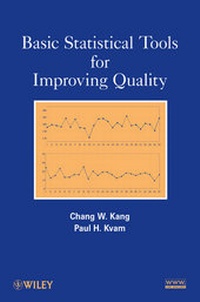
Basic Statistical Tools for Improving Quality
Description

More details
Other editions
Additional editions
Persons
Content
PREFACE
Basic Statistical Tools for Improving Quality is intended for business people and non-business people alike who do not possess a great amount of mathematical training or technical knowledge about quality control, statistics, six sigma, or process control theory. Without relying on mathematical theorems, you will learn helpful quality management techniques through common sense explanation, graphical illustration and various examples of processes from different industries. Unlike most other books written about quality management, you will be learning by doing. Every time we introduce a new tool for improving quality, we will practice it on a real example. Programming skills are not necessary because we will implement a free menu-based and user-friendly software program that was designed with the basic tools and techniques for improving quality.
If you bought this book, you are probably familiar with some kind of production process. By process, we can mean a traditional manufacturing process such as goes on in a Hyundai Motors automobile assembly plant in Korea, but it can also refer to a supply chain that links a Maple tree seedling from an Oregon plant nursery to a Baltimore garden store. In a service industry, a process can be the stages necessary to provide the customer at McDonald’s with an Egg McMuffin.
All organizations have a critical process and strive hard for improving quality of products and/or services through that process. At the end of each process, there always exists some bit of variation in output. For example, in the chocolate chip cookie manufacturing process, the number of chocolate chips in each cookie varies. This is not an exciting prospect for the customer who opens the cookie box with clear idea of what they want and expect in a chocolate chip cookie: not too many chips, and certainly not too few. But some variation between cookies is inevitable, and these variations are difficult to see during the baking and packaging process.
In order to improve quality, it makes sense to reduce this item-to-item variability when we can. But to know about the variability in the process, we have to measure things, and then figure out how to assess this variability by analyzing the resulting data. This can get complicated, even if we are baking chocolate chip cookies, where it is impractical to count the chips in every baked cookie. This is where statistical process control takes over.
Statistical process control refers to the application of statistical tools to measure things in the process in order to detect whether a change has taken place. In the examples we have discussed, the process aims for consistency, so any change in the process output is usually a bad thing. This book describes and illustrates statistical tools to detect changes in a, process, and it also shows how to implement the idea of continuous improvement into process control.
The tools you can implement are both graphical and analytical. Graphical procedures (charts, diagrams) serve as effective tools to communicate intricate details about a complex or dynamic process without having to go into statistical or mathematical detail. Graphical tools are helpful, but not always convincing. Analytical tools, on the other hand, can be more powerful but are more challenging to learn. While we spare the reader of any unnecessary detail about the mathematical machinery of the analytical tools, we certainly do not promote an overly simple “push that button” mentality in this book. That won’t work for the unique problems encountered when applying these tools and techniques to your workplace. The analytical tools need a better level of understanding.
To be an effective process manager, you don’t have to be an expert in statistics. You do need to be knowledgeable about the process you are working on, and you need to be determined enough to learn how these simple tools can be used to understand and control this process. This is the kind of expert that we hope you will become after you have finished reading this book. To avoid unnecessary statistical formulas, we will focus on concepts and show you how to use the free eZ SPC software to understand how data is analyzed. We will learn through examples.
Here are some key skills you should pick up after reading Basic Statistical Tools for Improving Quality:
1. You will perceive and acknowledge that there is always some kind of problem in the process. 2. You will know what kind of problem solving tools or techniques are required to overcome your obstacles. 3. You will know how to collect appropriate data that will make the problem solving as easy as possible. 4. You will know which tools to use and how to use menu commands from the eZ SPC software to complete your data analysis. 5. You will know how to interpret the eZ SPC results to explain how the problem is solved.Outline of Chapters
- Chapter 1: In the first chapter, you will learn how to frame a typical business task or industrial procedure as the kind of process that is appropriate for quality improvement. Examples will be used to illustrate processes we encounter in daily life and we outline how tools and techniques for quality improvement can be learned and exploited.
- Chapter 2: Here, we introduce you to eZ SPC, the free and easy-to-use software that will help you analyze and solve quality management problems in this book and at your job. If you are already comfortable programming with other software packages that are capable of running all the necessary statistical process control procedures listed in this book, you can take advantage of your programming expertise without using the eZ SPC program. However, we devote parts of this book to helping the reader complete quality management tasks using the simple menu-based commands of eZ SPC. Chapter 2 shows you how charts and graphs can be created to help summarize process performance and describe how efficiently a process is working. We include bar graphs, box plots, cause-and-effect diagrams, histograms, Pareto charts, pie graphs, radar charts and scatter plots.
- Chapter 3: In this chapter, we will go over the key features in a set of data. To know which values appear in the data set and how frequently they are found at different values tells us about the data’s distribution. You will learn about statistics that describe the spread of the data as well as where the middle or end-points of the data set are. Using helpful tools in eZ SPC, we will learn how to summarize data and find out about how it is distributed without having to use graphs.
- Chapter 4: As a companion chapter to Chapter 3, here we will present you with an overview of the analytical tools you will rely on in the analysis of process data. Two key concepts in data analysis are confidence intervals and statistical tests of hypotheses. These procedures not only provide a summary and prediction of the process from the features of the data, but they also provide a measure of our uncertainty regarding those predictions. The ability to communicate the uncertainty in statistical results will make our results more objective, informative and scientific.
- Chapter 5: Here we introduce you to a primary method for evaluating and monitoring a process: the control chart. Control charts are simple and varied graphical tools that can be easily generated using the eZ SPC software, and the generated chart helps us to determine if the process is running correctly. The various kinds of charts represent the various goals of the process manager as well as the different kinds of measurements from that process that we can scrape together for data analysis.
- Chapter 6: The control charts in Chapter 5 are constructed to detect the first moment when a process breaks down and goes out of control. In the following chapter, we move from these basic control charts to more advanced charts that are constructed to detect the incremental changes made by a process that is slowly degrading or getting out of control. Also in this chapter, you will learn how charts and statistics can be applied to assess process capability once the control charts have shown that the process is running as planned.
- Chapter 7: Here we will show how you can create process improvement by investigating potential factors (in the environment or in the process itself) that affect the process and/or the process output. Some of these factors are readily identifiable, but there might be other causes and factors that are not obvious. Moreover, these new factors we consider not only affect the process output, but they may affect each other. That can really challenge our ability to understand the process the way we want. To overcome this challenge, statistical methods such as correlation analysis, regression, analysis of variance and factorial design can be implemented using eZ SPC.
- At the end of the book, we include a glossary of terms that are used in the book, and we also include some terms not found elsewhere in the book. These terms generally fall outside the scope of statistical process control, but you might come across them in your work on process improvement.
Examples, Exercises and Test Questions
Examples are featured throughout the book and easy to find. Just look for a gray box followed by the example text. Here is an example from the first chapter:
Example 1–8: General Hospital Emergency Center
Hospitals must always be at the forefront of process improvement. Patient processing at an emergency reception has evolved continuously over…. The example always ends with...
