

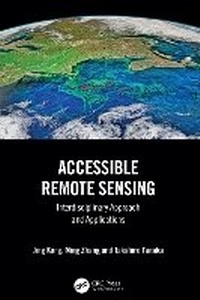
Accessible Remote Sensing
Interdisciplinary Approach and Applications
1st Edition
Will be published approx. on 21. December 2026
192 pages
E-Book
978-1-040-19377-8 (ISBN)
Description

Kang, Zhang, and Tanaka's comprehensive reference work take an interdisciplinary approach to explain the principles of remote sensing, data characteristics and parameters, and data processing tools; describe the many applications of remote sensing; and explore future trends related to this process.
Through this book, readers will gain an understanding of the principles and technologies behind remote sensing. They will be able to determine the most appropriate datasets for their field and analyze the data appropriately. Readers who specialize in remote sensing will gain a deeper understanding of the advances in remote sensing technology and differing approaches and applications taken across multiple disciplines. The book presents chapters on the applications of remote sensing in different contexts and supporting authors who are experts in their respective fields offer insights and case studies to illustrate these applications. Kang's interdisciplinary approach encourages readers to think critically about several key questions, including: (1) What can I learn from other areas or disciplines to enhance my current research and has remote sensing been applied to my research field before, and in what ways; (2) What kind of remotely sensed data do I need, where can I get the data, and what are their strengths and limitations; and (3) What are the appropriate processing or analytical methods and how should my chosen data be prepared before further analysis? By asking these questions, readers will be able to quickly and easily assess and apply remote sensing data without needing prior experience.
This book is an invaluable resource for graduate students in several disciplines including urban planning, agriculture, oceanography, and more; for researchers and scientists in multiple disciplines; and for commercial and governmental practitioners working in multiple fields.
Through this book, readers will gain an understanding of the principles and technologies behind remote sensing. They will be able to determine the most appropriate datasets for their field and analyze the data appropriately. Readers who specialize in remote sensing will gain a deeper understanding of the advances in remote sensing technology and differing approaches and applications taken across multiple disciplines. The book presents chapters on the applications of remote sensing in different contexts and supporting authors who are experts in their respective fields offer insights and case studies to illustrate these applications. Kang's interdisciplinary approach encourages readers to think critically about several key questions, including: (1) What can I learn from other areas or disciplines to enhance my current research and has remote sensing been applied to my research field before, and in what ways; (2) What kind of remotely sensed data do I need, where can I get the data, and what are their strengths and limitations; and (3) What are the appropriate processing or analytical methods and how should my chosen data be prepared before further analysis? By asking these questions, readers will be able to quickly and easily assess and apply remote sensing data without needing prior experience.
This book is an invaluable resource for graduate students in several disciplines including urban planning, agriculture, oceanography, and more; for researchers and scientists in multiple disciplines; and for commercial and governmental practitioners working in multiple fields.
More details
Edition
1. Auflage
Language
English
Place of publication
London
United Kingdom
Publishing group
Taylor & Francis Ltd
Target group
College/higher education
Professional and scholarly
Illustrations
8 Tables, black and white; 20 Line drawings, black and white; 56 Halftones, black and white; 76 Illustrations, black and white
ISBN-13
978-1-040-19377-8 (9781040193778)
Copyright in bibliographic data and cover images is held by Nielsen Book Services Limited or by the publishers or by their respective licensors: all rights reserved.
Schweitzer Classification
Other editions
Additional editions
Jing Kang | Ming Zhang | Takahiro Tanaka
Accessible Remote Sensing
Interdisciplinary Approach and Applications
Book
approx. 12/2026
1st Edition
CRC Press
€111.50
Not yet published
Persons
Jing Kang is an assistant professor at Waseda University. Her interdisciplinary work addresses complex climate-environment-human relations and land surface processes. She obtained her PhD from Beijing Normal University in 2017. She is a member of IEEE Geosciences and Remote Sensing and the GIS Association of Japan.
Ming Zhang is a Professor and the Program Director of Community and Regional Planning in the School of Architecture at the University of Texas at Austin. He obtained his B.E. and M.E. from Tsinghua University, Beijing, China, a master's degree and GIS Certificate from the State University of New York at Albany, and a further M.S. and Ph.D. from MIT.
Takahiro Tanaka is a Professor at the Graduate School of Advanced Science and Engineering, Hiroshima University, Japan. He obtained his master's and PhD degrees from Yokohama National University. He is a member of the Architectural Institute of Japan, The City Planning Institute of Japan, Japanese Institute of Landscape Architecture, GIS Association of Japan, The Society of Heating, Air-Conditioning and Sanitary Engineers of Japan, and Heat Island Institute International.
Ming Zhang is a Professor and the Program Director of Community and Regional Planning in the School of Architecture at the University of Texas at Austin. He obtained his B.E. and M.E. from Tsinghua University, Beijing, China, a master's degree and GIS Certificate from the State University of New York at Albany, and a further M.S. and Ph.D. from MIT.
Takahiro Tanaka is a Professor at the Graduate School of Advanced Science and Engineering, Hiroshima University, Japan. He obtained his master's and PhD degrees from Yokohama National University. He is a member of the Architectural Institute of Japan, The City Planning Institute of Japan, Japanese Institute of Landscape Architecture, GIS Association of Japan, The Society of Heating, Air-Conditioning and Sanitary Engineers of Japan, and Heat Island Institute International.
Content
1. What is Remote Sensing 2. Data Sources and Collection 3. Data Processing and Analysis Tools 4. Terrestrial Applications 5. Atmospheric Monitoring 6. Applications Related to Climate Change 7. Remote Sensing with Cloud Computing
