

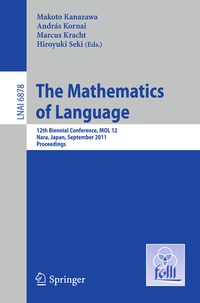
The Mathematics of Language
12th Biennial Conference, MOL 12, Nara, Japan, September 6-8, 2011, Proceedings
Published on 1. October 2011
IV, 227 pages
978-3-642-23211-4 (ISBN)
Description

This book constitutes the proceedings of the 12th Biennial Meeting on Mathematics in Language, MOL 12, held in Nara, Japan, in September 2011.
Presented in this volume are 12 carefully selected papers, as well as the paper of the invited speaker Andreas Maletti. The papers cover such diverse topics as formal languages (string and tree transducers, grammar-independent syntactic structures, probabilistic and weighted context-free grammars, formalization of minimalist syntax), parsing and unification, lexical and compositional semantics, statistical language models, and theories of truth.
More details
Other editions
Additional editions
Makoto Kanazawa | Marcus Kracht | Hiroyuki Seki
The Mathematics of Language
12th Biennial Conference, MOL 12, Nara, Japan, September 6-8, 2011, Proceedings
Book
08/2011
Springer
€53.49
Shipment within 7-9 days
Content
- Title
- Preface
- Organization
- Table of Contents
- Tree Transformations and Dependencies
- Motivation
- Notation
- Extended Top-Down Tree Transducer
- Extended Multi Bottom-Up Tree Transducer
- Synchronous Tree-Sequence Substitution Grammar
- Summary
- References
- A Datalog Recognizer for Almost Affine $\lambda$-CFGs
- Introduction
- Context-Free -Grammars
- Listed Types
- Typing Properties of almost Affine Terms
- Negatively Non-duplicating Typings Are Not Sufficient
- Potentially Negatively Non-duplicating Typings
- Least PN-Typings
- PN-Irrelevant Relabelings
- PN-Potential Relabelings
- The Datalog Recognizer
- Description of the Program
- Completeness and Correctness of the Method
- Example
- Conclusion
- References
- A Language Theoretic Approach to Syntactic Structure
- Introduction
- Distributional Learning
- Notation
- Congruential Representation
- Definition
- Problems
- Multiple Context Free Grammars
- Lattice Approaches
- Discussion
- References
- The Generative Power of Probabilistic and Weighted Context-Free Grammars
- Introduction
- Previous Work
- Weighted and Probabilistic Grammars
- The Weighted Hierarchy
- The Weighted Hierarchy and the Chomsky Hierarchy
- A Characterization of Weighted CFGs with Cut-Points
- Conclusion
- References
- Invariance Properties of Quantifiers and Multiagent Information Exchange
- Introduction
- Generalized Muddy Children PuzzleThis section is an extended discussion of the results published in GS11 and reported on in Gier10.
- Number Triangle Based Modeling of Muddy Children
- Number of Epistemic Iterations
- Characterization
- Various Quantifiers as Public Announcements
- Generalized Top Hat Puzzle
- Solvability
- Conclusions and Outlook
- References
- Insertion Minimalist Grammars: Eliminating Redundancies between Merge and Move
- (Standard) Minimalist Grammars
- Redundancies in MGs
- Two Ways to Create Specifiers
- Two Ways to Create Vacated Positions
- Insertion Minimalist Grammars
- Comparison of IMGs and MGs
- Elimination of Redundancies
- Other Consequences of Adopting IMGs
- Conclusion
- References
- On Type Coercion in Compositional and Lexical Semantics
- Introduction
- Ontological Subtypes of Type e
- Ontological Subtypes and Montagovian Type Theory
- An Ontology of Entity Types
- Ontological Subtypes in Formal Semantics
- Ontological Subtypes and Compositional Analysis
- Ontological Subtypes and Lexicon Structure
- Lexical Transformations and Parameter Lists
- Genitive Constructions and Type Coercion
- The Semantic Representation of the Genitive
- Compositional Analysis with Type Coercion
- An Ontology of Function Types
- Genitives and Type Selection
- -Calculus and Type Selection
- Pre-nominal Genitives and the GL Theory of Type Selection
- Conclusion
- References
- Disentangling Notions of Specifier Impenetrability: Late Adjunction, Islands, and Expressive Power
- Introduction
- Formal Preliminaries
- Minimalist Grammars
- Late Adjunction
- Conditions on Rules
- A Closer Look at the SpIC
- The Relation between the SpICadj and the AIC
- The SpICmv and the SMC
- The SpIC without the SMC
- Late Adjunction and Specifier Impenetrability
- Controlling Late Adjunction by the SpICmv
- Conclusion
- References
- What Is the Basic Semantic Unit of Chinese Language? A Computational Approach Based on Topic Models
- Introduction
- Topic Models
- Topic Models with Chinese Characters and Words
- Experimental Studies
- Data Descriptions
- Language Modeling and Text Classification
- Classification on a Bilingual Corpus
- Semantic Similarity of Documents
- Boosting of Classification Accuracy
- Conclusions
- References
- Approximate Bit Vectors for Fast Unification
- Introduction
- Notation and Definitions
- Bit-Vector Encoding
- Stochastic Local Search
- Evaluation
- Optimization
- Parsing
- Conclusion
- References
- Event Semantics and Abstract Categorial Grammar
- Basic Assumptions of Event Semantics
- Two Compositionality Problems for Event Semantics
- The Event Modification Problem
- The Event Quantification Problem
- Previous Accounts
- Abstract Categorial Grammar
- Davidsonian Verb Signs in ACG
- Neo-Davidsonian Verb Signs in ACG
- Conclusions
- References
- Regular Growth Automata: Properties of a Class of Finitely Induced Infinite Machines
- Introduction
- Linguistic Motivation
- Regular Growth Automata: Definitions
- Recognizing Power
- The Deterministic Case
- The Non-deterministic Case
- Closure Properties
- Boolean Closure
- Homomorphism
- Related Concepts
- Automatic Structures
- Automaticity
- Automaton Growth: Refining Automaticity
- Finite-State Philosophy
- Conclusion and Further Work
- References
- A Co-inductive Language and Truth Degrees
- Introduction
- Motivation: How Do Truth Degrees Relate to Truth?
- A Fuzzy Logic and a Fuzzy Truth Theory
- Analyzing the Relationship between Truth Degrees and Truth
- Suszko's Thesis and Fuzzifying a Meta-theory
- Formalizing ``Truth Degree Theory" in Terms of Truth Theory
- A Counterexample to Truth Degree Theory
- A Counterexample
- Computer Scientific Analysis of the Theorem
- How Serious Is the Counterexample?
- Infinite Processes and the Truth Concept
- Conclusion
- References
- Author Index
