

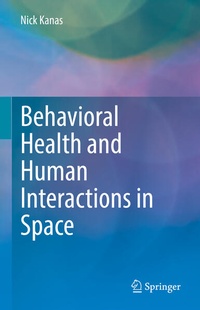
Behavioral Health and Human Interactions in Space
Description

This book is a winner of International Academy of Astronautics 2023 Life Science Book Award.
This textbook covers the range of psychological and interpersonal issues that can affect astronauts living and working in space. It deals with the three major risk areas cited by NASA's Behavioral Health and Performance Element: Behavioral Medicine, Team Risk, and Sleep Risk.
Based on the author's more than 50 years of experience in space-related activities writing, conducting research, and teaching undergraduate and graduate courses, the book follows a comprehensive range of topics that include: cognitive effects; psychiatric issues; cultural influences; salutogenic and positive aspects of space travel; autonomy and delayed communication; current plans to return to the Moon and Mars; analysis of study environments such as the polar regions, submersible habitats, and space simulation facilities; and more. It draws on research, literature, and case studies from the 1950s onward, showing readers in a natural and accessible way how the field has progressed over time.
The book contains ample end-of-chapter summaries and exercises as well as a complete glossary of key terms. As such, it will serve students taking courses in aerospace psychology, psychiatry, sociology, human factors, medicine, and related social sciences, in addition to space industry professionals and others interested in the complexities of people living and working in space.
Reviews / Votes
"For students of aerospace psychiatry, medicine, and psychology, and for other people working in the aerospace industry or the general public, this work amply reviews the field and provides a broad, rich wealth of information in a scholarly fashion. Dr. Kanas's book is a cogent, practical textbook that focuses on the most fragile element of human space exploration: the human element. I highly recommend this book . ." (Charles H. Dukes, Aerospace Medicine and Human Performance, Vol. 94 (8), August, 2023)"This book . is really the guidelines or criteria of healthy behavior for human space travel, either non-commercial or commercial. Writing to be a textbook, the contents are considered to be more than rich, sufficient and exhaustive. More importantly, the book guides students and readers from shallow to deep with the in-depth academic theory as basics and the easy understandable features as phenomena. . Throughout the book, there are enormous amount of statistical data, figures . ." (Acta Astronautica, June 1, 2023)
More details
Other editions
Additional editions
Person
Dr. Kanas is an Emeritus Professor of Psychiatry at the University of California, San Francisco (UCSF). He trained at Stanford University (B.A. Psychology), UCLA Medical School (M.D. 1971), University of Texas Medical Branch in Galveston (Internship), and UCSF (Psychiatry Residency 1975). After serving in the USAF as a psychiatrist from 1975-1977, he joined the faculty at UCSF and the affiliated San Francisco VA Medical Center, where he conducted clinical and research work on people suffering from stressful conditions. He has over 220 professional publications and is the recipient of the Dr. J. Elliott Royer Award for academic psychiatry.
Dr. Kanas has studied and written about psychological and interpersonal issues affecting people working in space for over 50 years and has done space-related research since the late 1980s. For over 15 years thereafter he was an NSBRI and NASA-funded principal investigator, doing psychological research with astronauts and cosmonauts on the Mir and International Space Stations and in space simulators. He is a member and former trustee of the International Academy of Astronautics.In 1999, Dr. Kanas received the Aerospace Medical Association Raymond F. Longacre Award for Outstanding Accomplishment in the Psychological and Psychiatric Aspects of Aerospace Medicine. In 2008, he received the International Academy of Astronautics Life Science Award. Together with Dr. Dietrich Manzey, he is the co-author of the book "Space Psychology and Psychiatry" (now in its 2nd edition), which was given the 2004 International Academy of Astronautics Life Science Book Award. His second book on space psychology, entitled "Humans in Space: The Psychological Hurdles," was given the 2016 International Academy of Astronautics Life Science Book Award.
