

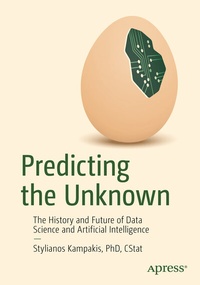
Predicting the Unknown
Description

As a society, we're in a constant struggle to control uncertainty and predict the unknown. Quite often, we think of scientific fields and theories as being separate from each other. But a more careful investigation can uncover the common thread that ties many of those together. From ChatGPT, to Amazon's Alexa, to Apple's Siri, data science, and computer science have become part of our lives. In the meantime, the demand for data scientists has grown, as the field has been increasingly called the "sexiest profession."
This book attempts to specifically cover this gap in literature between data science, machine learning and artificial intelligence (AI). How was uncertainty approached historically, and how has it evolved since? What schools of thought exist in philosophy, mathematics, and engineering, and what role did they play in the development of data science? It uses the history of data science as a stepping stone to explain what the future might hold.
Predicting the Unknown provides the framework that will help you understand where AI is headed, and how to best prepare for the world that's coming in the next few years, both as a society and within a business. It is not technical and avoids equations or technical explanations, yet is written for the intellectually curious reader, and the technical expert interested in the historical details that can help contextualize how we got here.
What You'll Learn
- Explore the bigger picture of data science and see how to best anticipate future changes in that field
- Understand machine learning, AI, and data science
- Examine data science and AI through engaging historical and human-centric narratives
Who is This Book For
Business leaders and technology enthusiasts who are trying to understand how to think about data science and AI
Reviews / Votes
"Kampakis' book clearly and readably covers the essence of uncertainty and the human efforts to address it, written for both professional data scientists and anyone attempting to predict life's unknowable and unexpected outcomes." (Harry J. Foxwell, Computing Reviews, November 29, 2023)More details
Other editions
Additional editions
Person
Dr. Stylianos (Stelios) Kampakis is a data scientist, data science educator and blockchain expert with more than 10 years of experience. He has worked with decision makers from companies of all sizes: from startups to organizations like the US Navy, Vodafone ad British Land. His work expands multiple sectors including fintech (fraud detection and valuation models), sports analytics, health-tech, general AI, medical statistics, predictive maintenance and others. He has worked with many different types of technologies, from statistical models, to deep learning to blockchain and he has two patents pending to his name. He has also helped many people follow a career in data science and technology.
He is a member of the Royal Statistical Society, honorary research fellow at the UCL Centre for Blockchain Technologies, a data science advisor for London Business School, and CEO of The Tesseract Academy and tokenomics auditor at Hacken. As a well-known data-science educator, he has published two books, both of them getting 5 stars on Amazon. His personal website gets more than 10k visitors per month, and he is also a data science influencer on LinkedIn.
Content
1. Where Are We Now? A Brief History of Uncertainty.- 2. Truth, Logic and the Problem of Induction.- 3. Swans and Space Invaders.- 4. Probability: To Bayes, or not to Bayes?.- 5. What's Maths Got to Do With It? The Power of Probability Distributions.- 6. Alternative Ideas: Fuzzy Logic and Information Theory.- 7. Statistics: the Oldest Kid on the Block.- 8. Machine Learning: Inside the Black Box.- 9. Causality: Understanding the 'Why'.- 10. Forecasting, and Predicting the Future: The Fox and the Trump.- 11. The Limits of Prediction (Part A): A Futile Pursuit?.- 12. The Limits of Prediction (Part B): Game Theory, Agent-based Modelling and Complexity (Actions and Reactions).- 13. Uncertainty in Us: How the Human Mind Handles Uncertainty.- 14. Blockchain: Uncertainty in transactions.- 15. Economies of Prediction: A New Industrial Revolution.- Epilogue: The Certainty of Uncertainty.
