

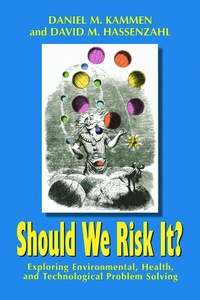
Should We Risk It?
Exploring Environmental, Health, and Technological Problem Solving
1st Edition
Published on 19. November 2018
424 pages
978-0-691-18831-7 (ISBN)
Description

How dangerous is smoking? What are the risks of nuclear power or of climate change? What are the chances of dying on an airplane? More importantly, how do we use this information once we have it? The demand for risk analysts who are able to answer such questions has grown exponentially in recent years. Yet programs to train these analysts have not kept pace. In this book, Daniel Kammen and David Hassenzahl address that problem. They draw together, organize, and seek to unify previously disparate theories and methodologies connected with risk analysis for health, environmental, and technological problems. They also provide a rich variety of case studies and worked problems, meeting the growing need for an up-to-date book suitable for teaching and individual learning.
The specific problems addressed in the book include order-of-magnitude estimation, dose-response calculations, exposure assessment, extrapolations and forecasts based on experimental or natural data, modeling and the problems of complexity in models, fault-tree analysis, managing and estimating uncertainty, and social theories of risk and risk communication. The authors cover basic and intermediate statistics, as well as Monte Carlo methods, Bayesian analysis, and various techniques of uncertainty and forecast evaluation. The volume's unique approach will appeal to a wide range of people in environmental science and studies, health care, and engineering, as well as to policy makers confronted by the increasing number of decisions requiring risk and cost/benefit analysis. Should We Risk It? will become a standard text in courses involving risk and decision analysis and in courses of applied statistics with a focus on environmental and technological issues.
The specific problems addressed in the book include order-of-magnitude estimation, dose-response calculations, exposure assessment, extrapolations and forecasts based on experimental or natural data, modeling and the problems of complexity in models, fault-tree analysis, managing and estimating uncertainty, and social theories of risk and risk communication. The authors cover basic and intermediate statistics, as well as Monte Carlo methods, Bayesian analysis, and various techniques of uncertainty and forecast evaluation. The volume's unique approach will appeal to a wide range of people in environmental science and studies, health care, and engineering, as well as to policy makers confronted by the increasing number of decisions requiring risk and cost/benefit analysis. Should We Risk It? will become a standard text in courses involving risk and decision analysis and in courses of applied statistics with a focus on environmental and technological issues.
More details
Other editions
Additional editions
Daniel M. Kammen | David M. Hassenzahl
Should We Risk It?
Exploring Environmental, Health, and Technological Problem Solving
Book
04/2001
Princeton University Press
€54.50
Article not available at the moment

Daniel M. Kammen | David M. Hassenzahl
Should We Risk It?
Exploring Environmental, Health, and Technological Problem Solving
Book
05/1999
Princeton University Press
€68.09
Article exhausted; check different version
Persons
Daniel M. Kammen is Associate Professor of Energy and Society and director of the Renewable and Appropriate Energy Laboratory at the University of California, Berkeley. He has received international awards for his work on renewable energy and development and for his work on risk analysis and forecasting. David M. Hassenzahl is Assistant Professor of Environmental Studies at the University of Nevada, Las Vegas. He has been an environmental risk professional in both the public and private sectors.School of Public and International Affairs, Princeton University, where his research is focused on the role of risk analysis in policy making. He has been an environmental risk professional in both the public and private sectors.
Content
- Cover
- Title Page
- Copyright Page
- Contents
- Preface
- Acknowledgments
- 1 Introduction
- Defining Risk
- Structure of the Book
- Risk Analysis and Public Policy
- Problem 1-1. Getting Started
- Problem 1-2. Data Needs
- Problem 1-3. Using Data
- Problem I-A. Additional Cases
- Problem I-B. Additional Curves
- Problem l-C. Does the Dose Make the Poison?
- Problem I-D. One in a Million Risks
- Problem I-E. Surfing and Smoking
- Problem I-F. Risks of Nuclear Power
- References
- 2 Basic Models and Risk Problems
- Introduction
- Basic Modeling
- Problem 2-1. Volatile Organic Emissions from Household Materials: Wallpaper Glue
- Problem 2-2. Indoor Radon Exposure
- Problem 2-A. Problem 2-2 Revisited
- Problem 2-B. Equilibrium Concentration
- Problem 2-3. Simple PBPK Model-Continuous Dose
- Problem 2-C. Alternative Depictions
- Problem 2-4. PBPK-Finite Dose of Barium
- Problem 2-D. How Much Resolution Is Too Much?
- Problem 2-E. How Much Information Is Needed?
- Problem 2-F. Sensitivity Analysis
- Cause and Effect Relationships
- Problem 2-5. Radon and Cancer
- Mechanistic Models and Curve Fitting
- Problem 2-6. Conceiving "Mechanistic" Models
- Problem 2-7. Using the Wrong Mode~ Getting the Model Wrong
- Problem 2-8. Empirically Derived Dose Response
- Problem 2-9. Earthquakes versus Traffic Risks
- Conclusion
- References
- 3 Review of Statistics for Risk Analysis
- Introduction: Statistics and the Philosophy of Risk Assessment
- Problem 3-1. Average Radon Exposure
- Problem 3-A. Radon Exposures in Different Regions
- Problem 3-2. Working with Data
- Problem 3-3. Mean and Median: Why Wony?
- Problem 3-4. Sample Data Revisited
- Problem 3-5. Hypothesis Testing and Confidence Intervals
- Problem 3-6. Making Decisions
- Distributions
- Problem 3-7. Moving Away from Ignorance
- Problem 3-8. Fitting a Model
- Problem 3-B. R2 Versus x2
- Problem 3-C. How Many Bins?
- Problem 3-9. Distributional Models
- Problem 3-D. Fitting the Lognormal Distribution
- Problem 3-E. Dealing with Grouped Data
- References
- 4 Uncertainty, Monte Carlo Methods, and Bayesian Analysis
- Introduction
- Problem 4-1. Measuring the Speed of Light
- Problem 4-A. Energy Forecasts
- Problem 4-B. Forecasting the Impacts of Climate Change
- Bayesian Statistics
- Problem 4-2. Interpreting Test Results
- Problem 4-C. Bayesian Experts
- Problem 4-3. Bayesian Analysis of Radon Concentrations
- Monte Carlo Analysis
- Problem 4-4. Exposure to Tap Water in the Home
- Problem 4-D. Uncertainty or Incommensurability?
- References
- 5 Toxicology
- Introduction
- Critical Assumptions for Modeling Disease
- Assumptions Specific to Toxicology
- Assumptions Specific to Epidemiology
- Problem 5-1. Test Data and Carcinogenesis: The Kil-EZ Example
- Problem 5-A. Calculating LED10
- Problem 5-B. Maximum Tolerated Dose
- Problem 5-C. 1,3-Butadiene
- Problem 5-2. Fitting Data to Mechanistic Models: One-Hit, Two-Hit, Two-Stage Problem
- Problem 5-D. The Cost of Better Data
- Problem 5-E. Model-Free Extrapolation
- Problem 5-F. Variation in Cancer Susceptibility
- Problem 5-G. Variation in Sensitivity and Exposure
- Problem 5-H. Additional Data Set
- Problem 5-L Exact Two-Stage Formulation
- Problem 5-3. Noncarcinogenic Effects: The EPA Approach
- Problem 5-J. Additional Noncancer End Points
- Problem 5-K Formaldehyde
- References
- 6 Epidemiology
- Introduction
- Problem 6-1. Cigarette Smoking and Cancer
- Problem 6-A. The Heavy Smoker
- Problem 6-B. All Deaths in the United States
- Problem 6-2. Risk in a Time of Cholera
- Problem 6-C. Pooled Data
- Problem 6-D. What Might Be Missing?
- Problem 6-E. Measurement Error
- Problem 6-3. Benzene Revisited: The Plio film Cohort Study
- Problem 6-F. Additional Data
- Problem 6-G. One-Hit Model and Epidemiological Data
- Problem 6-H Additional Data
- Problem 6-4. Catching Cold: Exponential Spread of Disease
- Problem 6-J. Graphical Presentation
- Problem 6-J. Small Groups
- Problem 6-5. The Spread of AIDS: An Empirical Analysis, or, Does the Model Fit the Data?
- Problem 6-6. Double-Blind Study
- Problem 6-K Side Effects: Test for Safety
- Problem 6-L. Low-Probability Effects
- Problem 6-M. Death by Cheese?
- Problem 6-N. Cancer Clusters-Real or Not?
- References
- 7 Exposure Assessment
- Introduction
- Problem 7-1. Assessment of Exposures and Risks: The ChemLawn Claim
- Problem 7-A. Can Adults and Children Be Treated the Same?
- Problem 7-2. Contaminated Milk
- Problem 7-3. Biomass Fuels and Childhood Disease
- Problem 7-4. Bioaccumulation of Heptachlor in Beef
- Problem 7-B. Sensitive Receptors: Exposure to Children
- Problem 7-C. Exposure via Breast Milk
- Problem 7-5. Tricholoroethylene Exposure at Woburn, Massachusetts
- Problem 7-D. TCE at Woburn: The Big Picture
- Problem 7-E. Probability Distribution for Radon Exposures (or Risks)
- Problem 7-F. PBPK Models and Gender Differences in the Uptake of Benzene
- Problem 7-G. Acme Landfill
- References
- 8 Technological Risk
- Introduction
- Problem 8-1. Lethality of Plutonium
- Problem 8-A. Cassini Spacecraft Reentry Risk
- Event Trees and Fault Trees
- Problem 8-2. Simple Pressure Relief System
- Problem 8-B. Additional Fault Tree
- Problem 8-C. Calculations from Fault Trees
- Problem 8-3. Missing Components, Common-Mode Failures, and the Human Element
- Problem 8-D. AdditionalFault Trees
- Problem 8-E. Identifying Problems
- Problem 8-F. Anticipating the Unknown
- Problem 8-G. Oleum and the "Clever-Proofing" Problem
- Problem 8-4. Coal-Burning Power Plant Emissions
- Problem 8-5. Commercial Nuclear Power Safety: An EmpiricalAnalysis
- Problem 8-H. The Risk from Nuclear Accidents
- Problem 8-6. Long-Term Risks from High-Level Nuclear Waste: A Case of Extreme Uncertainty
- Problem 8-7. Military Fighter Aircraft
- Problem 8-I. Who Decides What's Important?
- Problem 8-8. Risk of Domestic Airplane Flight
- Problem 8-J. Verifast Airlines
- Problem 8-K. Risk of International Airplane Flight
- References
- 9 Decision Making
- Introduction
- Problem 9-1. Comparing Risk Reduction Measures By Dollar Values
- Problem 9-A. Cost Per Life-Year versus One in a Million
- Problem 9-B. Too Much or Too Little Spending?
- Problem 9-C. Mandatory Helmet Laws
- Problem 9-D. Discussion
- Problem 9-E. Is It Worth It?
- Problem 9-F. High-Level Nuclear Waste
- Organizing Processes
- Problem 9-2. Event Trees and Decision Analysis
- Problem 9-G. Who Lives There (and Does It Matter)?
- Problem 9-H. Additional Calculations
- Problem 9-I. Additional Uncertainty
- Problem 9-3. Analysis or Abuse? Transmission of Hoof Blister
- Problem 9-J. Dollars and Decisions
- Problem 9-4. Health and Environmental Technology Policy: Superfund Remediation
- Problem 9-K Discounting or Dodging?
- Problem 9-L. Taking a Viewpoint
- Problem 9-M. Event-Decision Tree
- Problem 9-N. Regulatory Impact Analysis: Where the Rubber Meets the Road
- References
- 10 Risk Perception and Communication
- Introduction
- Problem 10-1. Same Numbers, Different Stories
- Problem 10-A. Opening Dialogue
- Problem 10-B. Explaining Numbers
- Problem 10-2. Framing a Question: Loss or Gain?
- Problem 10-C. A Project to "Restore" or "Improve" a Wetland
- Problem 10-D. A Little Bit or a Lot? Violent Agreement on the Numbers
- Problem 10-3. Risk Level, Risk Perceptions, and Psychometric Models
- Problem 10-E. Cognitive Maps
- Problem 10-F. Radiation By Any Other Name
- Problem 10-G. Surfers and the Sun Revisited
- Problem 10-4. Ranking the Risks: Are the Experts Right?
- Problem 10-H. Implications of Differing Perspectives
- Problem 10-I. Risk, Trust, and Rationality
- Problem 10-J. Who Is More Concerned?
- Problem 10-5. The Availability Bias
- Problem 10-K. Aggregation
- Problem 10-6. How Intuitive Are Statistics? The Case of Electromagnetic Fields and Cancer
- Problem 10-L. Alternative Interpretations
- Problem 10-7. Use of Point Estimates versus Distributions
- Problem 10-M. Alternative Options
- Problem 10-N. When Is the New Leaf Turned?
- Problem 10-8. What Will They Think It Means?
- Problem 10-O. What To Tell Them?
- Problem 10-P. Alternative Labeling
- Problem 10-Q. Situational Differences
- Problem 10-9. Saccharin and Alar: Why the Difference?
- Problem 10-R. When To Spin?
- Problem 10-10. Can or Should "Zero Risk" Be a Goal?
- Wrapping Up: Putting the Pieces Together
- References
- Appendix A. Z-Scores
- Appendix B. Stndent's T-test
- Appendix C. Chi-Squared Distribution
- Index
