

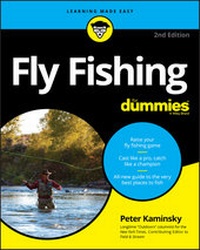
Fly Fishing For Dummies
Description

Some say successful fly fishing requires supreme athleticism, a surgeon's delicate touch, and the serene spirit of a Zen master. But forget the hype: The updated edition of Fly Fishing for Dummies shows that all you need to get the hang of this enjoyable sport are the right tools, a disciplined technique, and a positive attitude. Whether you're an old salt or dipping your toes in for the first time, you'll find everything you need to learn, improve, and keep your casting sharp and fresh!
Longtime fishing writer Peter Kaminsky wades right in, taking you from choosing a rod and tying flies all the way through to staying dry with the right wardrobe and cooking up a delicious catch. You'll also find out how you can get by with just 20 flies, a half dozen casts, and three knots. And, if you want to plunge deeper into the sport, he suggests some bucket-list destination rivers and streams to keep you agreeably hooked and learning for life--proving that the father of fishing writers Izaak Walton was right when, three centuries ago, he said: "No life is so pleasant and happy as that of a well-governed angler."
* Study your quarry--from rainbow trout to fashionable "glamour" fish
* Get the best rod, reel, and gear for success--including the smartest tech
* Know where to fish (land or sea) and how to read the water
* Follow visual examples to sharpen your casting
Whatever your fly-fishing aims or skill level, the proven advice and 150+ illustrations in this friendly guide are your path to a lifetime of happy and productive trips: Don't let it be the one that got away!
More details
Other editions
Additional editions
Person
Content
Chapter 1
What Every Fly Rodder Needs to Know
IN THIS CHAPTER
Finding out what fish really want
Discovering what information you need (and where you can find it)
Getting a license (and why you need one)
If you're reading this book, you probably have some interest in catching fish. Perhaps you have never tried to catch one, or you may have caught many and would like to improve your skills. Either way, whether you're a newcomer or a veteran angler, the equation remains the same - catching a fish requires three things:
- A fish
- An angler
- Some fishing gear
What Is a Fish?
A fish is a cold-blooded animal that lives underwater, has fins, and breathes through gills. Some fish, such as eels, may not look as if they have fins, but they do. Other fish, such as manta rays, may look more like the design of a B-1 bomber, but they, too, live in the water, navigate with fins, and breathe through gills.
As far as the angler (that's you) is concerned, fish eat other fish, insects, and the occasional unlucky mammal, reptile, or other animal that finds itself in the water. Although some fish subsist on a diet of plants, fishing is the art of convincing a fish that the thing at the end of your line is an edible animal.
Whether you use a bait, a lure, or a fly, a fish usually strikes because it thinks that your offering is an easy meal. At other times, a fish, like any protective parent, may strike because it may think that your imitation animal is going to eat its babies - and no creature responds agreeably to that threat (although it needs to be pointed out that some fish will eat the young of their own kind).
How do I know it's a fish?
A biologist may need to know hundreds of parts of the anatomy of a fish. As an angler, you're only interested in a few of these parts (see Figure 1-1).
© John Wiley & Sons, Inc.
FIGURE 1-1: Your average fish.
The torpedo shapes of most game fish allow them to move easily through tides and currents. The fins propel and guide their movements. Gills enable fish to breathe by extracting oxygen from the water. The lateral line is a special sensory organ that enables fish to detect vibrations in the water (like the kind of vibrations that are made when you clank an oar on the bottom of a rowboat or when you tramp along the rocks in the bottom of a stream).
What does a fish want out of life?
On most days, a fish has only two requirements:
- Finding something to eat
- Avoiding being eaten
In other words, food and shelter are at the top of the priority list of every fish. At certain times of the year, making babies also goes on the to-do list. But by and large, in looking at any fishing situation, you should ask yourself these two questions:
- What will the fish be looking for in the way of food?
- How will the fish avoid predators while it is looking for food?
Figuring out the food
Knowing what fish like to eat can tell you a great deal about what kind of fly to use to seduce a fish into biting down on your not-very-good-tasting hook. Often, when you a see a fish feeding, a close look at the water can tell you what food is available. After you have figured that out, your job is to tie something on your line that looks like that food. If a fish is taking something big, such as herring or shrimp, guessing the right food isn't very hard. However, as any frustrated angler can tell you, four or five kinds of food - little insects, bait fish, crawfish, worms, and the like - are often in the water at any given time. In these cases, some close observation is called for.
Be prepared to be stymied, because I often think fish have agreed on this unwritten rule: If there's a choice between large food and tiny food, eat something that is so small that it is just about invisible to the angler. Or at least, they have defiantly agreed to do that when I'm around.
Staying alive is important too
All other things being equal, a fish would spend all of its time in a safe place, where predators can't see it or reach it. But to get food, fish, like people, need to get out of the house and go shopping; and the time that a fish spends away from home is when the angler has an opportunity to catch the unwary fish. Although a fish in pursuit of a juicy meal may be a little less cautious than a fish lying under a rock, safety is always a prime concern; and no fish worth its fins ever chases food without having some kind of escape route close at hand. After you know what and where these escape routes are, you are well on the way to knowing where - and, more importantly, where not - to fish.
TWENTY THOUSAND YEARS OF FISHING
Although no one is sure exactly when people started to use fishing rods, we do know that Stone Age people used pieces of flint, bone, or wood to make fishing implements. Jumping ahead a few hundred centuries, the first real proof we have of people actually fishing with rods comes from drawings of the ancient Assyrians and Egyptians. Whether the Phishing Pharaohs used bait, lures, or flies is an open question.
Those ancient anglers used a wooden rod with a line attached to the end. It was very much like today's cane poles that many young anglers first use to fish for panfish at every lake and dock. We know that people were using reels a thousand years ago because pictures of rods and reels appear in China shortly before Marco Polo visited there. And the art of fly fishing was already well advanced in England when, in the 15th century, the most famous fisherwoman of all time, Dame Juliana Berners (an English nun), wrote her Treatise on Fishing With an Angle during this time.
By the time that Izaak Walton wrote The Compleat Angler in the 17th century, knowledge about the fish that lived in the rivers of Europe was well advanced, but Walton never saw a rainbow trout, largemouth bass, bonefish, bluefish, or golden dorado. As fly fishing has grown around the world, more and more types of fish have expanded the possibilities of the sport.
A fish can use one of three ways to escape being caught:
- Hide in the dark. Look for fish to hang out in or near shadows. Also, expect them to be feeding when the light is low (at dawn and dusk - and sometimes at night).
- Hide under something. If food is around, expect to find fish under nearby rocks, fallen trees, and undercut banks.
- Get down. If you are a bear or an eagle, chances are you are not going to go very deep to chase a fish. So, even on a bright sunny day with no tree limbs or rocks to crawl under, a fish may stay in plain view, but in deep water.
Fishing versus Angling
People catch fish by using all kinds of gear (from spear guns to nets to bare hands). An angler is someone who angles (an Old English word for fishing) with a rod. This book is about angling. Figure 1-2 shows a fly rodder on the right, someone who angles with a fly rod.
© John Wiley & Sons, Inc.
FIGURE 1-2: The complete fly rodder.
Your main tool as an angler is, of course, a fishing rod. Rods come in all sizes, and they are made from many different materials. Some rods are made from graphite or other space-age composites. Some rods are made of fiberglass. Other rods are made of bamboo. Which rod is best for you?
Your choice of rod depends on the type of fishing you do. Figure 1-3 shows the three basic types of rods. Like everything else these days, you can spend a little, or you can break your piggy bank on the purchase of your rod. Take my word for it: If you're a novice, you don't need to reach too deep in your pockets to get started. Buying the most expensive rod would be like buying the Secretariat so that he could pull a milk wagon: You'd wind up with more horse than you need, and you probably wouldn't know how to get the most out of Secretariat anyway. Save the expert gear for the experts and start off with a good, serviceable starter kit. Reputable manufacturers such as Sage and Hardy make affordable choices, and Orvis can get you in the game with a perfectly fine rod even more economically.
© John Wiley & Sons, Inc.
FIGURE 1-3: Some standard rods.
How Do I Learn? Who Do I Ask?
If you've never fished at all, don't worry. I didn't really start to fish until I was in my 20s. Still, the best time to begin to fish is when you are a little kid and a parent, grandparent, uncle, aunt or sib gets you started with a simple rod and a worm or some balled-up bread on a hook.
But if you weren't lucky enough to begin fishing as a youngster, you can become an angler (or a better angler) in any number of ways.
Parents
Fishing with Mom and Dad is a good place to start, but Mom and Dad need to be patient. Type-A parents who hover over their children, correcting and criticizing, are not very good fishing instructors. Parents who stop teaching and start fishing the minute that they see a catchable fish are better off not teaching. Jack Hemingway, oldest son of Ernest Hemingway, was a fishing fanatic. Jack's dad,...
