

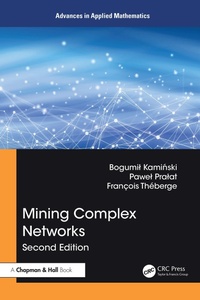
Mining Complex Networks
2nd Edition
Published on 15. May 2026
326 pages
978-1-040-86908-6 (ISBN)
Description

This book concentrates on mining networks, a subfield within data science. Many data science problems can be viewed as a study of some properties of complex networks in which nodes represent the entities that are being investigated, and edges represent relations between these entities.
In these networks (for example, the Instagram and Facebook online social networks), nodes not only contain some useful information (such as the user's profile, photos, and tags) but are also internally connected to other nodes (relations based on follower requests, similar users' behaviour, age, and geographic location). Such networks are often large-scale, decentralized, and evolve dynamically over time.
Mining complex networks to understand the principles governing the organization and the behaviour of such networks is crucial for a broad range of fields of study, including information and social sciences, economics, biology, and neuroscience.
The field has seen significant advancements since the first edition was published. Changes and updates to this edition include:
New material and examples on random geometric graphs.
The chapter on node embeddings was augmented in several places including a discussion on classical vs. structural embeddings, more details on graph neural networks (GNNs), as well as other directions.
Several new tools and techniques are introduced on mining hypergraphs.
New material on post-processing for overlapping communities.
A new focus on a framework for embedding graphs codeveloped by the authors.
A short chapter on fairness in network mining models.
This book is aimed at being suitable for an upper-year undergraduate course or a graduate course.
In these networks (for example, the Instagram and Facebook online social networks), nodes not only contain some useful information (such as the user's profile, photos, and tags) but are also internally connected to other nodes (relations based on follower requests, similar users' behaviour, age, and geographic location). Such networks are often large-scale, decentralized, and evolve dynamically over time.
Mining complex networks to understand the principles governing the organization and the behaviour of such networks is crucial for a broad range of fields of study, including information and social sciences, economics, biology, and neuroscience.
The field has seen significant advancements since the first edition was published. Changes and updates to this edition include:
New material and examples on random geometric graphs.
The chapter on node embeddings was augmented in several places including a discussion on classical vs. structural embeddings, more details on graph neural networks (GNNs), as well as other directions.
Several new tools and techniques are introduced on mining hypergraphs.
New material on post-processing for overlapping communities.
A new focus on a framework for embedding graphs codeveloped by the authors.
A short chapter on fairness in network mining models.
This book is aimed at being suitable for an upper-year undergraduate course or a graduate course.
More details
Series
Edition
2nd edition
Language
English
Place of publication
London
United Kingdom
Publishing group
Taylor & Francis Ltd
Target group
College/higher education
Illustrations
28 Tables, black and white; 95 Line drawings, black and white; 95 Illustrations, black and white
File size
10,67 MB
ISBN-13
978-1-040-86908-6 (9781040869086)
Copyright in bibliographic data and cover images is held by Nielsen Book Services Limited or by the publishers or by their respective licensors: all rights reserved.
Schweitzer Classification
Other editions
Additional editions
Bogumil Kaminski | Pawel Pralat | Francois Theberge
Mining Complex Networks
Book
05/2026
2nd Edition
CRC Press
€234.50
Shipment within 15-20 days
Bogumil Kaminski | Pawel Pralat | Francois Theberge
Mining Complex Networks
Book
05/2026
2nd Edition
CRC Press
€78.50
Shipment within 15-20 days
Persons
Bogumil Kaminski is the Chairman of the Scientific Council for the Discipline of Economics and Finance at SGH Warsaw School of Economics. He is an expert in applications of mathematical modelling and artificial intelligence models to solve complex real-life problems. He is also a substantial opensource contributor to the development of the Julia language and its package ecosystem.
Pawel Pralat is a Professor of Mathematics at Toronto Metropolitan University, whose main research interests are in random graph theory, especially in modelling and mining complex networks. He has pursued collaborations with various industry partners as well as the Government of Canada. He has written more than 230 papers and 4 books with more than 170 collaborators.
Francois Theberge holds a BSc degree in applied mathematics from the University of Ottawa, an MSc in telecommunications from INRS, and a PhD in electrical engineering from McGill University. He has been employed by the Government of Canada since 1996 during which he was involved in the creation of the data science team as well as the research group now known as the Tutte Institute for Mathematics and Computing. He also holds an adjunct professorial position in the Department of Mathematics and Statistics at the University of Ottawa.
Pawel Pralat is a Professor of Mathematics at Toronto Metropolitan University, whose main research interests are in random graph theory, especially in modelling and mining complex networks. He has pursued collaborations with various industry partners as well as the Government of Canada. He has written more than 230 papers and 4 books with more than 170 collaborators.
Francois Theberge holds a BSc degree in applied mathematics from the University of Ottawa, an MSc in telecommunications from INRS, and a PhD in electrical engineering from McGill University. He has been employed by the Government of Canada since 1996 during which he was involved in the creation of the data science team as well as the research group now known as the Tutte Institute for Mathematics and Computing. He also holds an adjunct professorial position in the Department of Mathematics and Statistics at the University of Ottawa.
Content
Part 1. Core Material 1. Graph Theory 2. Random Graph Models 3. Centrality Measures 4. Degree Correlations 5. Community Detection 6. Graph Embeddings 7. Hypergraphs Part 2. Additional Material 8. Detecting Overlapping Communities 9. Embedding Graphs 10. Network Robustness 11. Road Networks 12. Fairness in Graph Mining
