

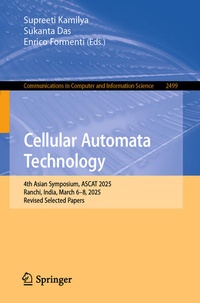
Cellular Automata Technology
Description

This book constitutes the refereed conference proceedings of the 4th Asian Symposium on Cellular Automata Technology, ASCAT 2025, held in Ranchi, India, during March 6-8, 2025.
The 16 full papers included in this book were carefully reviewed and selected from 35 submissions. This symposium aims to explore the latest insights and innovations in multiple theoretical aspects of Cellular Automata Technology and their applications across various domains.
More details
Other editions
Additional editions
Content
.- Self-synchronization of Temporally Stochastic Cellular Automata.
.- Modeling of Crack Propagation in Composite Materials using Cellular Automata.
.- Diabetes Prediction Enhancement via Cellular Automata and Machine Learning.
.- Empirical study on reversibility of rotation-symmetric rules of 2D cellular automata - Finite Triangular lattice.
.- An Elementary Cellular Automata Based Two-Class Data Imbalance Problem: Initial Study and Observations.
.- Search of 3-State Cellular Automata for Clustering.
.- Use of $5$-neighborhood Cellular Automata for Pattern Classification.
.- A Study on Role of Distant neighbor over Elementary Cellular Automata.
.- Tracking Rule Evolution in 2D Cellular Automata: Analyzing State Changes and Image Transformation Dynamics.
.- Exploring Opinion Dynamics through Social Influence, Online Communication, and Leadership: A Fuzzy Cellular Automaton Approach.
.- Cellular Automata-based Toxicity Analysis for Social Media Comments.
.- Touching Loops and Worms Formed by Cellular Automata.
.- First experiments on chaotic k non-uniform cellular automata.
.- Despeckling Images using Elementary Cellular Automata.
.- Information Propagation based Data Classification with Reversible Non-Uniform Elementary Cellular Automata.
.- Synthesis and Analysis of Regular Clocking-based Full Subtractor in QCA.
