

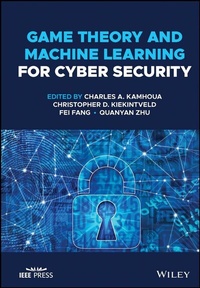
Game Theory and Machine Learning for Cyber Security
Description

Move beyond the foundations of machine learning and game theory in cyber security to the latest research in this cutting-edge field
In Game Theory and Machine Learning for Cyber Security, a team of expert security researchers delivers a collection of central research contributions from both machine learning and game theory applicable to cybersecurity. The distinguished editors have included resources that address open research questions in game theory and machine learning applied to cyber security systems and examine the strengths and limitations of current game theoretic models for cyber security.
Readers will explore the vulnerabilities of traditional machine learning algorithms and how they can be mitigated in an adversarial machine learning approach. The book offers a comprehensive suite of solutions to a broad range of technical issues in applying game theory and machine learning to solve cyber security challenges.
Beginning with an introduction to foundational concepts in game theory, machine learning, cyber security, and cyber deception, the editors provide readers with resources that discuss the latest in hypergames, behavioral game theory, adversarial machine learning, generative adversarial networks, and multi-agent reinforcement learning.
Readers will also enjoy:
* A thorough introduction to game theory for cyber deception, including scalable algorithms for identifying stealthy attackers in a game theoretic framework, honeypot allocation over attack graphs, and behavioral games for cyber deception
* An exploration of game theory for cyber security, including actionable game-theoretic adversarial intervention detection against advanced persistent threats
* Practical discussions of adversarial machine learning for cyber security, including adversarial machine learning in 5G security and machine learning-driven fault injection in cyber-physical systems
* In-depth examinations of generative models for cyber security
Perfect for researchers, students, and experts in the fields of computer science and engineering, Game Theory and Machine Learning for Cyber Security is also an indispensable resource for industry professionals, military personnel, researchers, faculty, and students with an interest in cyber security.
More details
Other editions
Additional editions
Persons
Charles A. Kamhoua, PhD, is a researcher at the United States Army Research Laboratory's Network Security Branch. He is co-editor of Assured Cloud Computing (2018) and Blockchain for Distributed Systems Security (2019), and Modeling and Design of Secure Internet of Things (2020).
Christopher D. Kiekintveld, PhD, is Associate Professor at the University of Texas at El Paso. He is Director of Graduate Programs with the Computer Science Department.
Fei Fang, PhD, is Assistant Professor in the Institute for Software Research at the School of Computer Science at Carnegie Mellon University.
Quanyan Zhu, PhD, is Associate Professor in the Department of Electrical and Computer Engineering at New York University.
Content
Editor biographies
Contributors
Foreword
Preface
Chapter 1: Introduction
Christopher D. Kiekintveld, Charles A. Kamhoua, Fei Fang, Quanyan Zhu
Part 1: Game Theory for Cyber Deception
Chapter 2: Introduction to Game Theory
Fei Fang, Shutian Liu, Anjon Basak, Quanyan Zhu, Christopher Kiekintveld, Charles A. Kamhoua
Chapter 3: Scalable Algorithms for Identifying Stealthy Attackers in a Game Theoretic Framework Using Deception
Anjon Basak, Charles Kamhoua, Sridhar Venkatesan, Marcus Gutierrez, Ahmed H. Anwar, Christopher Kiekintveld
Chapter 4: Honeypot Allocation Game over Attack Graphs for Cyber Deception
Ahmed H. Anwar, Charles Kamhoua, Nandi Leslie, Christopher Kiekintveld
Chapter 5: Evaluating Adaptive Deception Strategies for Cyber Defense with Human Experimentation
Palvi Aggarwal, Marcus Gutierrez, Christopher Kiekintveld, Branislav Bosansky, Cleotilde Gonzalez
Chapter 6: A Theory of Hypergames on Graphs for Synthesizing Dynamic Cyber Defense with Deception
Jie Fu, Abhishek N. Kulkarni
Part 2: Game Theory for Cyber Security
Chapter 7: Minimax Detection (MAD) for Computer Security: A Dynamic Program Characterization
Muhammed O. Sayin, Dinuka Sahabandu, Muhammad Aneeq uz Zaman, Radha Poovendran, Tamer Basar
Chapter 8: Sensor Manipulation Games in Cyber Security
João P. Hespanha
Chapter 9: Adversarial Gaussian Process Regression in Sensor Networks
Yi Li, Xenofon Koutsoukos, Yevgeniy Vorobeychik
Chapter 10: Moving Target Defense Games for Cyber Security: Theory and Applications Abdelrahman Eldosouky, Shamik Sengupta
Chapter 11: Continuous Authentication Security Games
Serkan Saritas, Ezzeldin Shereen, Henrik Sandberg, Gyorgy Dan
Chapter 12: Cyber Autonomy in Software Security: Techniques and Tactics
Tiffany Bao, Yan Shoshitaishvili
Part 3: Adversarial Machine Learning for Cyber Security
Chapter 13: A Game Theoretic Perspective on Adversarial Machine Learning and Related Cybersecurity Applications
Yan Zhou, Murat Kantarcioglu, Bowei Xi
Chapter 14: Adversarial Machine Learning in 5G Communications Security
Yalin Sagduyu, Tugba Erpek, Yi Shi
Chapter 15: Machine Learning in the Hands of a Malicious Adversary: A Near Future If Not Reality Keywhan Chung, Xiao Li, Peicheng Tang, Zeran Zhu, Zbigniew T. Kalbarczyk, Thenkurussi Kesavadas, Ravishankar K. Iyer
Chapter 16: Trinity: Trust, Resilience and Interpretability of Machine Learning Models
Susmit Jha, Anirban Roy, Brian Jalaian, Gunjan Verma
Part 4: Generative Models for Cyber Security
Chapter 17: Evading Machine Learning based Network Intrusion Detection Systems with GANs Bolor-Erdene Zolbayar, Ryan Sheatsley, Patrick McDaniel, Mike Weisman
Chapter 18: Concealment Charm (ConcealGAN): Automatic Generation of Steganographic Text using Generative Models to Bypass Censorship
Nurpeiis Baimukan, Quanyan Zhu
Part 5: Reinforcement Learning for Cyber Security
Chapter 19: Manipulating Reinforcement Learning: Stealthy Attacks on Cost Signals
Yunhan Huang, Quanyan Zhu
Chapter 20: Resource-Aware Intrusion Response based on Deep Reinforcement Learning for Software-Defined Internet-of-Battle-Things
Seunghyun Yoon, Jin-Hee Cho, Gaurav Dixit, Ing-Ray Chen
Part 6: Other Machine Learning approach to Cyber Security
Chapter 21: Smart Internet Probing: Scanning Using Adaptive Machine Learning
Armin Sarabi, Kun Jin, Mingyan Liu
Chapter 22: Semi-automated Parameterization of a Probabilistic Model using Logistic Regression - A Tutorial
Stefan Rass, Sandra König, Stefan Schauer
Chapter 23: Resilient Distributed Adaptive Cyber-Defense using Blockchain
George Cybenko, Roger A. Hallman
Chapter 24: Summary and Future Work
Quanyan Zhu, Fei Fang
Contributors
Palvi Aggarwal
Department of Social and Decision Sciences
Carnegie Mellon University
Pittsburgh
PA
USA
Muhammad Aneeq uz Zaman
Coordinated Science Laboratory
University of Illinois at Urbana-Champaign
Urbana
IL
USA
Ahmed H. Anwar
Network Security Branch
Combat Capabilities Development Command
US Army Research Laboratory
Adelphi
MD
USA
Nurpeiis Baimukan
New York University Abu Dhabi
Abu Dhabi
United Arab Emirates
Tiffany Bao
School of Computing, Informatics, and Decision Systems Engineering
Arizona State University
Tempe
AZ
USA
Anjon Basak
Network Security Branch
Combat Capabilities Development Command
US Army Research Laboratory
Adelphi
MD
USA
Tamer Basar
Coordinated Science Laboratory
University of Illinois at Urbana-Champaign
Urbana
IL
USA
Branislav Bosanský
Department of Computer Science
Czech Technical University in Prague
Prague
Czechia
Ing-Ray Chen
Department of Computer Science
Virginia Tech
Falls Church
VA
USA
Jin-Hee Cho
Department of Computer Science
Virginia Tech
Falls Church
VA
USA
Keywhan Chung
Coordinated Science Laboratory
University of Illinois at Urbana-Champaign
Urbana
IL
USA
George Cybenko
Thayer School of Engineering
Dartmouth College
Hanover
NH
USA
György Dán
Division of Network and Systems Engineering
KTH Royal Institute of Technology
Stockholm
Sweden
Gaurav Dixit
Department of Computer Science
Virginia Tech
Falls Church
VA
USA
Abdelrahman Eldosouky
Computer Science and Engineering Department
University of Nevada, Reno
Reno
USA
Tugba Erpek
Intelligent Automation, Inc.
Rockville
MD
USA
and
Hume Center
Virginia Tech
Arlington
VA
USA
Fei Fang
School of Computer Science and Institute for Software Research
Carnegie Mellon University
Pittsburgh
PA
USA
Jie Fu
Department of Electrical and Computer Engineering
Robotics Engineering Program
Worcester Polytechnic Institute
Worcester
MA
USA
Cleotilde Gonzalez
Department of Social and Decision Sciences
Carnegie Mellon University
Pittsburgh
PA
USA
Marcus Gutierrez
Department of Computer Science
The University of Texas at El Paso
El Paso
TX
USA
Roger Hallman
Thayer School of Engineering
Dartmouth College
Hanover
NH
USA
and
Naval Information Warfare Center Pacific
San Diego
CA
USA
João P. Hespanha
Center for Control Dynamical-Systems, and Computation
University of California
Santa Barbara
CA
USA
Yunhan Huang
Department of Electrical and Computer Engineering
New York University
Brooklyn
New York
USA
Ravishankar K. Iyer
Coordinated Science Laboratory
University of Illinois at Urbana-Champaign
Urbana
IL
USA
Brian Jalaian
US Army Futures Command
US Army Research Laboratory
Adelphi
MD
USA
Susmit Jha
Computer Science Laboratory
SRI International
Menlo Park
CA
USA
Kun Jin
Department of Electrical Engineering and Computer Science
University of Michigan
Ann Arbor
MI
USA
Zbigniew T. Kalbarczyk
Coordinated Science Laboratory
University of Illinois at Urbana-Champaign
Urbana
IL
USA
Charles A. Kamhoua
Network Security Branch
Combat Capabilities Development Command
US Army Research Laboratory
Adelphi
MD
USA
Murat Kantarcioglu
Computer Science Department
University of Texas at Dallas
Richardson
TX
USA
Thenkurussi Kesavadas
Healthcare Engineering Systems Center
University of Illinois at Urbana-Champaign
Urbana
IL
USA
Christopher D. Kiekintveld
Department of Computer Science
The University of Texas at El Paso
El Paso
TX
USA
Sandra König
Center for Digital Safety & Security
Austrian Institute of Technology
Vienna
Austria
Xenofon Koutsoukos
Electrical Engineering and Computer Science
Vanderbilt University
Nashville
TN
USA
Abhishek N. Kulkarni
Robotics Engineering Program
Worcester Polytechnic Institute
Worcester
MA
USA
Nandi Leslie
Network Security Branch
Combat Capabilities Development Command
US Army Research Laboratory
Adelphi
MD
USA
Yi Li
Electrical Engineering and Computer Science
Vanderbilt University
Nashville
TN
USA
Xiao Li
Healthcare Engineering Systems Center
University of Illinois at Urbana-Champaign
Urbana
IL
USA
Mingyan Liu
Department of Electrical Engineering and Computer Science
University of Michigan
Ann Arbor
MI
USA
Shutian Liu
Department of Electrical and Computer Engineering
NYU Tandon School of Engineering
New York University
Brooklyn
New York
USA
Patrick McDaniel
Pennsylvania State University
Computer Science and Engineering Department
University Park
Pennsylvania
USA
Radha Poovendran
Department of Electrical and Computer Engineering
University of Washington
Seattle
WA
USA
Stefan Rass
Institute for Artificial Intelligence and Cybersecurity
Universitaet Klagenfurt
Klagenfurt
Austria
Anirban Roy
Computer Science Laboratory
SRI International
Menlo Park
CA
USA
Yalin E. Sagduyu
Intelligent Automation, Inc.
Rockville
MD
USA
Dinuka Sahabandu
Department of Electrical and Computer Engineering
University of Washington
Seattle
WA
USA
Henrik Sandberg
Division of Decision and Control Systems
KTH Royal Institute of Technology
Stockholm
Sweden
Armin Sarabi
Department of Electrical Engineering and Computer Science
University of Michigan
Ann Arbor
MI
USA
Serkan Sarıtas
Division of Network and Systems Engineering
KTH Royal Institute of Technology
Stockholm
Sweden
Muhammed O. Sayin
Laboratory for Information and Decision Systems
Massachusetts Institute of Technology
Cambridge
MA
USA
Stefan Schauer
Center for Digital Safety & Security
Austrian Institute of Technology
Vienna
Austria
Shamik Sengupta
Computer Science and Engineering Department
University of Nevada, Reno
Reno
USA
Ryan Sheatsley
Pennsylvania State University
Computer Science and Engineering Department
University Park
Pennsylvania
USA
Ezzeldin Shereen
Division of Network and Systems Engineering
KTH Royal Institute of Technology
Stockholm
Sweden
Yi Shi
Intelligent Automation, Inc.
Rockville
MD
USA
and
ECE Department
Virginia Tech
Blacksburg
VA
USA
Yan Shoshitaishvili
School of Computing, Informatics, and Decision Systems Engineering
Arizona State University
Tempe
AZ
USA
Peicheng Tang
Department of Electrical and Computer Engineering
Rose-Hulman Institute of Technology
Terra Haute
IN
USA
Sridhar Venkatesan
Perspecta Labs Inc.
Basking Ridge
NJ
USA
Gunjan Verma
US Army Futures Command
US Army Research...
