

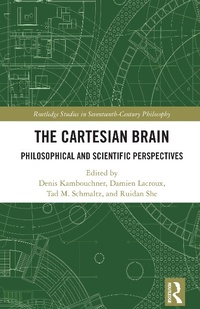
The Cartesian Brain
Philosophical and Scientific Perspectives
1st Edition
Published on 23. September 2024
292 pages
978-1-040-14495-4 (ISBN)
Description

This volume presents new research on Cartesian psychophysiology that combines historical and textual analysis with a consideration of recent advances in contemporary neuroscience research. It seeks to explain why the Cartesian theory of the brain and its communication with the mind still offer a remarkable model for cognitive studies.
New research in the philosophy of mind and cognitive science has reignited interest in the role and the structure of the "Cartesian brain" among scholars of Descartes. This volume rethinks Cartesian psychology from the perspective of physiology, with the aim of redetermining the contributions of the brain and central nervous system to mental phenomena. The first part of the volume concerns the details of Descartes's own physiological account of the brain. The discussion covers his treatment not only of the anatomy of the brain but also of the mode of interaction between mind and body, in which the pineal gland plays a central role, and of the relation between the brain and the rest of the body. The second part considers the reception and legacy of the Cartesian brain. The focus here is on understanding how Cartesian psychophysiology was received by Descartes's early modern contemporaries and immediate successors, as well as on the relevance of the Cartesian brain for contemporary neurophysiology and cognitive science.
The Cartesian Brain is an essential resource for scholars and advanced students interested in Descartes, history of philosophy, history of science, philosophy of mind, and cognitive science.
New research in the philosophy of mind and cognitive science has reignited interest in the role and the structure of the "Cartesian brain" among scholars of Descartes. This volume rethinks Cartesian psychology from the perspective of physiology, with the aim of redetermining the contributions of the brain and central nervous system to mental phenomena. The first part of the volume concerns the details of Descartes's own physiological account of the brain. The discussion covers his treatment not only of the anatomy of the brain but also of the mode of interaction between mind and body, in which the pineal gland plays a central role, and of the relation between the brain and the rest of the body. The second part considers the reception and legacy of the Cartesian brain. The focus here is on understanding how Cartesian psychophysiology was received by Descartes's early modern contemporaries and immediate successors, as well as on the relevance of the Cartesian brain for contemporary neurophysiology and cognitive science.
The Cartesian Brain is an essential resource for scholars and advanced students interested in Descartes, history of philosophy, history of science, philosophy of mind, and cognitive science.
More details
Series
Edition
1. Auflage
Language
English
Place of publication
London
United Kingdom
Publishing group
Taylor & Francis Ltd
Target group
College/higher education
Illustrations
8 Tables, black and white; 4 Line drawings, black and white; 22 Halftones, black and white; 26 Illustrations, black and white
ISBN-13
978-1-040-14495-4 (9781040144954)
Copyright in bibliographic data and cover images is held by Nielsen Book Services Limited or by the publishers or by their respective licensors: all rights reserved.
Schweitzer Classification
Other editions
Additional editions
Denis Kambouchner | Damien Lacroux | Tad M. Schmaltz
The Cartesian Brain
Philosophical and Scientific Perspectives
Book
05/2026
1st Edition
Routledge
€57.00
Shipment within 10-20 days

Denis Kambouchner | Damien Lacroux | Tad M. Schmaltz
The Cartesian Brain
Philosophical and Scientific Perspectives
Book
10/2024
Taylor & Francis
Unfortunately, price unknown
Available (delivery time upon request)
Denis Kambouchner | Damien Lacroux | Tad M. Schmaltz
The Cartesian Brain
Philosophical and Scientific Perspectives
Book
09/2024
1st Edition
Routledge
€232.10
Shipment within 10-20 days
Persons
Denis Kambouchner is Emeritus Professor of History of Early Modern Philosophy at Paris 1 Pantheon-Sorbonne University. His major publications are devoted to Descartes, and he has also published a number of studies of educational issues.
Damien Lacroux is a post-doctoral researcher in philosophy, currently working at the UNESCO Chair in the Ethics of the Living and the Artificial. He has published several articles in French on Cartesian philosophy and the philosophy of cognitive science.
Tad M. Schmaltz is Professor of Philosophy and James B. and Grace J. Nelson Fellow at the University of Michigan, Ann Arbor. He has published several books, book chapters, and articles on various topics in early modern philosophy and the history and philosophy of science.
Ruidan She is a permanent research fellow of the Institute of Philosophy, Chinese Academy of Social Sciences. She works on early modern philosophy and contemporary philosophy of action, and is a codirector of the national project, "The Study of the Self and Subjectivity in Western Philosophy."
Damien Lacroux is a post-doctoral researcher in philosophy, currently working at the UNESCO Chair in the Ethics of the Living and the Artificial. He has published several articles in French on Cartesian philosophy and the philosophy of cognitive science.
Tad M. Schmaltz is Professor of Philosophy and James B. and Grace J. Nelson Fellow at the University of Michigan, Ann Arbor. He has published several books, book chapters, and articles on various topics in early modern philosophy and the history and philosophy of science.
Ruidan She is a permanent research fellow of the Institute of Philosophy, Chinese Academy of Social Sciences. She works on early modern philosophy and contemporary philosophy of action, and is a codirector of the national project, "The Study of the Self and Subjectivity in Western Philosophy."
Content
Foreword Denis Kambouchner 1. Introducing the Cartesian Brain Damien Lacroux, Tad M. Schmaltz, and Ruidan She Part 1: Descartes and His System 2. The Doctrine of the Pineal Gland: A Cryptic Doctrine Franco A. Meschini 3. "Power of the Soul" and Imagination: A Psychophysiological Hypothesis Denis Kambouchner 4. Attribution and Determination: Some Remarks on Voluntary Motion Frederic de Buzon 5. Descartes's Corporeal Ideas of Distance: Information Processing or Mechanical Correlation? Gary Hatfield 6. The Easiness of Habits: Brain, Freedom, and Conduct of Life in Descartes Louis Rouquayrol 7. Beyond the Brain: Descartes on the Initiation of the Passions and Passionate Responses Ruidan She Part 2: Cartesianism and Its Legacy 8. Descartes's Cardiovascular Science of the Brain Gideon Manning 9. The Pineal Gland in Cartesianism Tad M. Schmaltz 10. The Figure of Descartes in Neuroscience: Relating the Histories of Nerve Physiology, Reflex Action, and Emotions Jean-Gael Barbara 11. Intellectual Emotion, Passion, and the Relevance of Cartesianism to Cognitive Science Damien Lacroux 12. The Cartesian Brain and the History of Memory Traces Jean-Claude Dupont
