


Reinforcement Learning in Action
From Foundations to Frontier AI
Will be published approx. on 14. October 2026
352 pages
E-Book
978-1-040-58933-5 (ISBN)
Description

Reinforcement learning (RL) has become the engine behind some of the most significant advances in modern artificial intelligence, from defeating world champions in Go to aligning large language models with human preferences. Yet despite its central role, RL remains poorly understood by many practitioners who work with these systems daily. Reinforcement Learning in Action: From Foundations to Frontiers bridges the gap between classical RL theory and the cutting-edge techniques driving today's AI breakthroughs. The book traces a complete path from Markov Decision Processes and Bellman equations through deep RL methods (DQN, REINFORCE, Actor-Critic, PPO) to the modern landscape of LLM alignment (RLHF, DPO, SimPO, KTO), reasoning optimization (GRPO, VinePPO, MCTS), and agentic systems with tool use, memory, and multi-turn planning. A distinguishing feature is the book's consistent five-layer pedagogical structure: each algorithm is presented with its key characteristics, a full mathematical derivation, an honest assessment of its advantages and limitations, a complete from-scratch Python/PyTorch implementation in which variable names match the equations, and a hands-on case study with reproducible experiments. Case studies progress from Grid World navigation and CartPole control to fine-tuning language models with DPO on the HuggingFace ecosystem, training reasoning models with GRPO on mathematical benchmarks, and building a full agentic customer support system. Written for ML engineers, researchers, and advanced students, this book provides both the conceptual depth and implementation fluency needed to understand, build, and extend the RL systems shaping the future of AI.
More details
Language
English
Place of publication
London
United Kingdom
Publishing group
Taylor & Francis Ltd
Target group
College/higher education
Professional and scholarly
Illustrations
13 Tables, black and white; 43 Line drawings, color; 2 Line drawings, black and white; 43 Illustrations, color; 2 Illustrations, black and white
ISBN-13
978-1-040-58933-5 (9781040589335)
Copyright in bibliographic data is held by Nielsen Book Services Limited or its licensors: all rights reserved.
Schweitzer Classification
Other editions
Additional editions
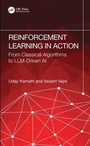
Book
approx. 10/2026
1st Edition
CRC Press
€62.00
Not yet published
Book
approx. 10/2026
1st Edition
CRC Press
€148.50
Not yet published
Persons
Uday Kamath has over 25 years of experience in AI product development with a Ph.D. in scalable machine learning. His significant contributions span numerous journals, conferences, books, and patents. Notable books include Large Language Models: A Deep Dive, Applied Causal Inference, Explainable Artificial Intelligence, Transformers for Machine Learning, Deep Learning for NLP and Speech Recognition, Mastering Java Machine Learning, and Machine Learning: End-to-End Guide for Java Developers. Currently serving as the Chief Analytics Officer at Smarsh, he spearheads data science and research in communications AI for regulated industries. He is also an active member of the Board of Advisors for entities, including commercial companies and academic institutions.
Vedant Vajre is an aspiring AI researcher with a strong interest in reinforcement learning and intelligent decision-making systems. He is graduating from Penn State University and intends to pursue doctoral research in artificial intelligence. He has authored two peer-reviewed research publications with IEEE and continues to pursue active research in machine learning. Having worked at organizations including NASA, IBM, and early-stage startups, he has gained experience applying machine learning and AI in both research and production settings. Outside of research, he loves spending time with his two Shih Tzus (Pinot and Buzz), playing tennis, and solving Sudoku puzzles.
Vedant Vajre is an aspiring AI researcher with a strong interest in reinforcement learning and intelligent decision-making systems. He is graduating from Penn State University and intends to pursue doctoral research in artificial intelligence. He has authored two peer-reviewed research publications with IEEE and continues to pursue active research in machine learning. Having worked at organizations including NASA, IBM, and early-stage startups, he has gained experience applying machine learning and AI in both research and production settings. Outside of research, he loves spending time with his two Shih Tzus (Pinot and Buzz), playing tennis, and solving Sudoku puzzles.
Content
List of Figures. List of Tables. Foreword. Preface. Author Bios. Contributors. Notation. Chapter 1: Introduction to Reinforcement Learning. Section I: Basics of Reinforcement Learning. Chapter 2: Fundamentals of Reinforcement Learning. Section II: Classical Reinforcement Learning. Chapter 3: Classical Reinforcement Learning Algorithms. Section III: Deep Reinforcement Learning. Chapter 4: Scaling Reinforcement Learning: Function Approximation and Deep Methods. Section IV: LLMs and Reinforcement Learning. Chapter 5: Preference-Based Alignment: Reward Modeling and Reinforcement Learning for LLMs. Chapter 6: Reinforcement Learning for Reasoning Models. Section V: Agentic and Reinforcement Learning. Chapter 7: Reinforcement Learning Enabled Agentic AI. Appendix A: Mathematical Proofs and Derivations. Bibliography. Index.
