

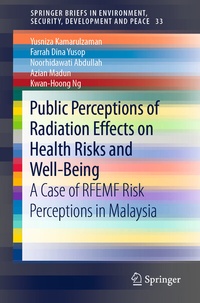
Public Perceptions of Radiation Effects on Health Risks and Well-Being
A Case of RFEMF Risk Perceptions in Malaysia
1st Edition
Published on 1. January 2020
XIII, 73 pages
978-981-329-894-1 (ISBN)
Description

This book reports on the investigation of the public's perception of Radio Frequency Electromagnetic Field (RF-EMF) radiation effects on health and well-being, in Malaysia. It elaborates on how understanding the impact of perceived risk is essential in order to investigate the explanatory value and effectiveness of interventions influencing these beliefs. The book expands on the knowledge and understanding of different risk perception related to radiation in order to explain the gap in literature regarding the relationship between risk perceptions that lead to public behaviors. In doing so, the book presents empirical findings of a national study that unveils two key factors affecting public risk perceptions: psycho-graphic and personal factors. It offers a more collective and cultural understanding of public perceptions on radiation risks via a systematic mixed-method research approach. Research in the book also show that while the radiation risk is recognizable and unavoidable, the relevant stakeholders should be more proactive and committed to communicate and rectify the perception of radiation. The book thus serves as a valuable source of reference to understand the debate and to invite more participatory dialogues on radiation risk perceptions among public.
More details
Series
Language
English
Place of publication
Singapore
Singapore
Publishing group
Springer Singapore
Target group
Professional and scholarly
Product notice
Reflowable
Illustrations
XIII, 73 p. 15 illus., 10 illus. in color.
File size
2,50 MB
ISBN-13
978-981-329-894-1 (9789813298941)
DOI
10.1007/978-981-32-9894-1
Schweitzer Classification
Other editions
Additional editions
Yusniza Kamarulzaman | Farrah Dina Yusop | Noorhidawati Abdullah
Public Perceptions of Radiation Effects on Health Risks and Well-Being
A Case of RFEMF Risk Perceptions in Malaysia
Book
01/2020
Springer
€58.84
Shipment within 3-4 weeks
Persons
Dr. Yusniza Kamarulzaman is a Senior Lecturer and also serves as Head of the Marketing Department at the Faculty of Business and Accountancy, University of Malaya. She is the former Director of the University Malaya Centre of Innovation and Commercialisation and also a Visiting Scholar at the Western Michigan University, U.S. She received her Ph.D. in Marketing in 2006, Postgraduate Diploma in Research Methodology in 2003, both from Cardiff University, United Kingdom followed by Postgraduate Diploma in Entrepreneurship from Cambridge University in 2013. She holds an MBA (Marketing) from UKM, Malaysia and obtained her BBA (Marketing), from UiTM, Malaysia.
Dr. Farrah Dina Yusop is an Associate Professor and concurrently the Director of UM's Academic Enhancement and Leadership Development Centre (ADeC). She holds a PhD in two fields: Curriculum and Instructional Technology (CIT) and Human Computer Interaction (HCI) from Iowa State University (ISU), USA. Dr. Farrah actively researches and publishes in the areas of higher education, Web 2.0, social media, educational games and mobile learning. She is especially known for her Civic-Minded Instructional Designer (CMID) conceptual framework which has reframed current ways of educating professionals for the purpose of improving public life.
Dr. Noorhidawati Abdullah is an Associate Professor at Department of Library & Information Science in the Faculty of Computer Science & Information Technology, University of Malaya. Her research interests include digital library, information management, electronic library and information seeking behavior. She is at present the editorial board member of the Malaysian Journal of Library & Information Science (JIF 0.423 JCR 2012). She is regularly serves as a scientific committee of several reputable International Conferences (such as IColis) and also a reviewer for a number of international and local conference papers.
Dr. Azian bin Madun is a Senior Lecturer at the Department of Sharia and Management, University of Malaya. He received his Phd in Finance from the University of Bath, United Kingdom in 2009. He has vast experience in the financial industry, particularly investment and capital market, after serving the Malaysian Stock Exchange for ten years in the areas of finance and management research. Since 2009 he has been teaching and undertaking research in the areas of finance and management as well as Islamic finance.
Prof. Dr. Ng Kwan-Hoong (FIPM, MIPEM (UK), Board Certified ABMP (USA) CSci, AM) is a Professor of Medical Physics at the Department of Radiology, University of Malaya, Kuala Lumpur. His research areas have been focused in radiation measurement, biological effects of radiation, computer applications in medicine and medical imaging. Professor Ng has served in several committees of the Ministry of Health and the Atomic Energy Licensing Board. He has also served with international organizations, the International Atomic Energy Agency, World Health Organization, and International Organization for Medical Physics, International Union of Physical and Engineering Science in Medicine.
Dr. Farrah Dina Yusop is an Associate Professor and concurrently the Director of UM's Academic Enhancement and Leadership Development Centre (ADeC). She holds a PhD in two fields: Curriculum and Instructional Technology (CIT) and Human Computer Interaction (HCI) from Iowa State University (ISU), USA. Dr. Farrah actively researches and publishes in the areas of higher education, Web 2.0, social media, educational games and mobile learning. She is especially known for her Civic-Minded Instructional Designer (CMID) conceptual framework which has reframed current ways of educating professionals for the purpose of improving public life.
Dr. Noorhidawati Abdullah is an Associate Professor at Department of Library & Information Science in the Faculty of Computer Science & Information Technology, University of Malaya. Her research interests include digital library, information management, electronic library and information seeking behavior. She is at present the editorial board member of the Malaysian Journal of Library & Information Science (JIF 0.423 JCR 2012). She is regularly serves as a scientific committee of several reputable International Conferences (such as IColis) and also a reviewer for a number of international and local conference papers.
Dr. Azian bin Madun is a Senior Lecturer at the Department of Sharia and Management, University of Malaya. He received his Phd in Finance from the University of Bath, United Kingdom in 2009. He has vast experience in the financial industry, particularly investment and capital market, after serving the Malaysian Stock Exchange for ten years in the areas of finance and management research. Since 2009 he has been teaching and undertaking research in the areas of finance and management as well as Islamic finance.
Prof. Dr. Ng Kwan-Hoong (FIPM, MIPEM (UK), Board Certified ABMP (USA) CSci, AM) is a Professor of Medical Physics at the Department of Radiology, University of Malaya, Kuala Lumpur. His research areas have been focused in radiation measurement, biological effects of radiation, computer applications in medicine and medical imaging. Professor Ng has served in several committees of the Ministry of Health and the Atomic Energy Licensing Board. He has also served with international organizations, the International Atomic Energy Agency, World Health Organization, and International Organization for Medical Physics, International Union of Physical and Engineering Science in Medicine.
Content
Introduction and Background.- Radiation and RF-EMF.- Risk Perception.- Risk Communication.- Perceived Risk and Public Behavior.- Issues and Gaps.- Research Methodology.- Research Approach.- Research Sample.- Data Sources.- Data Analyses Findings.- Public Profiles.- Research Outputs.- Discussion and Conclusion.- Discussion on Findings.- Recommendations.- Implications.- Limitations and Future Research.- Appendix References.
