

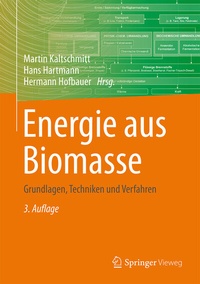
Energie aus Biomasse
Description

Univ.-Prof. Dr.-Ing. Martin Kaltschmitt ; Institut für Umwelttechnik und Energiewirtschaft (IUE), Technische Universität Hamburg-Harburg (TUHH), Deutschland
Dr. Hans Hartmann ; Technologie- und Förderzentrum im Kompetenzzentrum für Nachwachsende Rohstoffe (TFZ), Straubing, Deutschland
Univ.-Prof. Dipl.-Ing. Dr. techn. Hermann Hofbauer ; Institut für Verfahrenstechnik, Umwelttechnik und Technische Biowissenschaften, Technische Universität Wien, Österreich
Reviews / Votes
"... sowohl theoretische Grundlagen als auch anwendungsorientierte Informationen abgedeckt. Somit eignet sich die Ausgabe sowohl als Lehrbuch als auch zur Anwendung bei praxisbezogenen konkreten Fragestellungen. Durch das gut strukturierte und detaillierte Inhaltsverzeichnis sowie das umfangreiche Schlagwortverzeichnis stellen gezielte Recherchen zu einem speziellen Aspekt kein Problem dar. Die elektronische Fassung des Buches eignet sich für diesen Zweck natürlich noch besser ... einem empfehlenswerten Werk für aIle, die sich mit der Erzeugung von Energie aus Biomasse beschäftigen ..." (Dipl.-Ing. Peter Plegnière, in: Gefahrstoffe - Reinhaltung der luft, Jg. 76, Heft 10, Oktober 2016)More details
Other editions
Additional editions
Previous edition
Persons
Univ.-Prof. Dr.-Ing. Martin Kaltschmitt; Institut für Umwelttechnik und Energiewirtschaft (IUE), Technische Universität Hamburg-Harburg (TUHH), Deutschland
Dr. Hans Hartmann; Technologie- und Förderzentrum im Kompetenzzentrum für Nachwachsende Rohstoffe (TFZ), Straubing, Deutschland
Univ.-Prof. Dipl.-Ing. Dr. techn. Hermann Hofbauer; Institut für Verfahrenstechnik, Umwelttechnik und Technische Biowissenschaften, Technische Universität Wien, Österreich
Content
Einleitung und Zielsetzung.- Biomasseentstehung.- Forstwirtschaftlich produzierte Biomasse.- Landwirtschaftlich produzierte Biomasse.- Aquatische Biomasse.- Nebenprodukte, Rückstände und Abfälle.- Bereitstellungskonzepte.- Ernte.- Mechanische Aufbereitung.- Transport, Trocknung, Konservierung und Lagerung.- Grundlagen der thermo-chemischen Umwandlung biogener Festbrennstoffe.- Direkte thermo-chemische Umwandlung (Verbrennung).- Vergasung in der Gasatmosphäre.- Pyrolyse.- Hydrothermale Verfahren.- Produktion und Nutzung von Pflanzenölkraftstoffen.- Grundlagen der biochemischen Umwandlung.- Fermentative Alkoholerzeugung und -nutzung.- Biogaserzeugung und -nutzung.
