

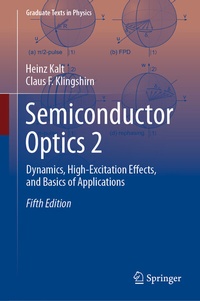
Semiconductor Optics 2
Dynamics, High-Excitation Effects, and Basics of Applications
5th Edition
Published on 16. March 2024
XVII, 564 pages
978-3-031-51296-4 (ISBN)
Description

This book provides an introduction to and an overview of the multifaceted area of dynamics and nonlinearities related to optical excitations in semiconductors. It is a revised and significantly extended edition of the well-established book by C. Klingshirn split into two volumes and restructured to make it more concise. Inserts on important experimental techniques, reference to topical research and novel materials, as well as consideration of photonic applications support research-oriented teaching and learning.
This book reviews nonlinear optical properties and many-body phenomena evoked by high densities of quasi-particles in semiconductors. Coherent dynamics and relaxation of optical excitations (carriers, excitons, electron-hole plasmas, etc.) as well as condensation phenomena are elucidated in these materials. A broad overview is provided of seminal research results augmented by detailed descriptions of the relevant experimental techniques, e.g., ultrafastspectroscopy, four-wave mixing, and the Hanbury-Brown and Twiss experiment. Offering a comprehensive introduction to hot topics in current research - polariton condensates, valley coherence, and single photons, to name a few, it also discusses applications of the described physical concepts in topical areas, such as quantum information, photonics, spintronics, and optoelectronics.
Covering subjects ranging from physics to materials science and optoelectronics, the book provides a lively and comprehensive introduction to semiconductor optics beyond the linear regime.
With many problems, chapter introductions, schematic depictions of physical phenomena, as well as boxed inserts and a detailed index, it is suitable for use in graduate courses in physics and neighboring sciences like material science and optical communication. It is also a valuable reference resource for doctoral and advanced researchers.
This book reviews nonlinear optical properties and many-body phenomena evoked by high densities of quasi-particles in semiconductors. Coherent dynamics and relaxation of optical excitations (carriers, excitons, electron-hole plasmas, etc.) as well as condensation phenomena are elucidated in these materials. A broad overview is provided of seminal research results augmented by detailed descriptions of the relevant experimental techniques, e.g., ultrafastspectroscopy, four-wave mixing, and the Hanbury-Brown and Twiss experiment. Offering a comprehensive introduction to hot topics in current research - polariton condensates, valley coherence, and single photons, to name a few, it also discusses applications of the described physical concepts in topical areas, such as quantum information, photonics, spintronics, and optoelectronics.
Covering subjects ranging from physics to materials science and optoelectronics, the book provides a lively and comprehensive introduction to semiconductor optics beyond the linear regime.
With many problems, chapter introductions, schematic depictions of physical phenomena, as well as boxed inserts and a detailed index, it is suitable for use in graduate courses in physics and neighboring sciences like material science and optical communication. It is also a valuable reference resource for doctoral and advanced researchers.
More details
Series
Edition
Fifth Edition 2024
Language
English
Place of publication
Cham
Switzerland
Publishing group
Springer International Publishing
Target group
Primary & secondary/elementary & high school
Product notice
Reflowable
Illustrations
XVII, 564 p. 245 illus., 131 illus. in color.
File size
28,23 MB
ISBN-13
978-3-031-51296-4 (9783031512964)
DOI
10.1007/978-3-031-51296-4
Schweitzer Classification
Other editions
Additional editions
Heinz Kalt | Claus F. Klingshirn
Semiconductor Optics 2
Dynamics, High-Excitation Effects, and Basics of Applications
Book
03/2024
5th Edition
Springer
€106.99
Shipment within 15-20 days
Persons
Heinz Kalt
studied Physics at the Universities of Bielefeld and Bonn and earned his doctoral degree in Physics from J.W. Goethe University in Frankfurt/Main in 1985. He stayed two years as a postdoc and visiting professor at Center for Applied Quantum Electronics of North Texas State University in Denton (USA). Studies of high-excitation phenomena and carrier dynamics in III-V multi-valley semiconductors commenced there were continued at Max Planck Institute for Solid-State Research and at University Kaiserslautern. These investigations formed the basis of his Habilitation Thesis (1993) which was also published in Springer Series in Solid-State Sciences. A second research focus at this time were fundamental excitonic processes in the search for laser materials for the blue and visible spectral range.
In 1994 Heinz Kalt was appointed Professor of Applied Physics at Universität Karlsruhe (TH) (now Karlsruhe Institute of Technology, KIT). Since then hisresearch interest included temporally and spatially resolved optical spectroscopy of semiconductor nano-structures, relaxation and transport dynamics of excitons, high-excitation effects, excitonic spin injection, storage and dynamics, ZnO nano-rods, random lasing, semiconductor micro-cavities, artificial organic light-harvesting complexes, optical whispering-gallery resonators, optical bio-sensing, polymer-based flexible photonics, spectroscopy of novel solar-cell absorber materials. H. Kalt has (co-)authored about 450 publications mainly in the field of semiconductor optics.
Heinz Kalt served the academic community by holding various offices like Dean of the Physics Department at KIT, Dean of Studies of Karlsruhe School of Optics and Photonics (KSOP), Ombudsperson for good scientific praxis, as well as speaker and long-time elected member of the KIT Senate. He was a committed and well-respected lecturer mainly in the areas of solid-state optics, semiconductor physics and optoelectronics and supervised related thesis work of numerous students and doctoral candidates. Heinz Kalt retired in April 2023.
Claus Klingshirn obtained his Diplom (1971) and Doctoral degrees (1975) at the university in Erlangen, with E. Mollwo. In 1975/76 he was postdoc in Strasbourg (S. Nikitine and B. Grun). From there he went to the University at Karlsruhe for his Habilitation, which he obtained in 1980. In the following he accepted various professorships: 1981 an associate professorship in Frankfurt/Main, 1987 full professorships at Kaiserslautern and from 1993 to his retirement in 2010 at Karlsruhe. He spent sabbaticals for a few months at Bell Labs, Holmdel (1986) and at Harvard (1996) with D. S. Chemla and E. Mazur, respectively.
The "backbone" of his scientific career was centred around the (non-)linear optical of (bi-) excitons in semiconductors, their behaviour at high densities, the transition to an electron hole plasma, their laser processes or dynamics, starting with ZnO in Erlangen, continuing with cuprous halides in Strasbourg and extending to other II-VI compounds at Karlsruhe, on III-V quantum structures in Holmdel. In the early 80ies he installed a subgroup on magnetooptical properties at the High Field Facility in Grenoble. In Frankfurt and Kaiserslautern he headed a subgroup growing epitaxial II-VI quantum wells and quantum dots in glasses. At both places he supervised also a subgroup on optical bistability, self-oscillations and chaos. In Karlsruhe he supervised with Heinz Kalt a subgroup growing ZnO nanorods and investigating their laser properties.
Claus Klingshirn supervised about 120 Diplom-, 60 Doctorate- and a few Habilitation Theses. He (co-)authored more than 480 publications in refereed journals, conference proceedings or book chapters. He wrote the first four eds. of Semiconductor Optics, which isnow continued by H. Kalt. He is editor and coauthor of a book on Zinc Oxide, Springer Ser. in Mate. 120 (2010), of subvolumes of Landolt Börnstein (New Series 34) and contributed to Römpp Chemie Lexikon. He had fruitful cooperations with theoretical and experimental groups. He hosted guest scientists mainly from eastern Europe and Asia. He served as referee for various scientific journals, funding agencies and in conference boards. He served as dean (2000- 2020) and dean of studies (2004-2006). After his retirement he engaged himself in social activities e.g. as honorary, ambulant coworker of "Hospice in Karlsruhe" from 2010 to 2022.
In 1994 Heinz Kalt was appointed Professor of Applied Physics at Universität Karlsruhe (TH) (now Karlsruhe Institute of Technology, KIT). Since then hisresearch interest included temporally and spatially resolved optical spectroscopy of semiconductor nano-structures, relaxation and transport dynamics of excitons, high-excitation effects, excitonic spin injection, storage and dynamics, ZnO nano-rods, random lasing, semiconductor micro-cavities, artificial organic light-harvesting complexes, optical whispering-gallery resonators, optical bio-sensing, polymer-based flexible photonics, spectroscopy of novel solar-cell absorber materials. H. Kalt has (co-)authored about 450 publications mainly in the field of semiconductor optics.
Heinz Kalt served the academic community by holding various offices like Dean of the Physics Department at KIT, Dean of Studies of Karlsruhe School of Optics and Photonics (KSOP), Ombudsperson for good scientific praxis, as well as speaker and long-time elected member of the KIT Senate. He was a committed and well-respected lecturer mainly in the areas of solid-state optics, semiconductor physics and optoelectronics and supervised related thesis work of numerous students and doctoral candidates. Heinz Kalt retired in April 2023.
Claus Klingshirn obtained his Diplom (1971) and Doctoral degrees (1975) at the university in Erlangen, with E. Mollwo. In 1975/76 he was postdoc in Strasbourg (S. Nikitine and B. Grun). From there he went to the University at Karlsruhe for his Habilitation, which he obtained in 1980. In the following he accepted various professorships: 1981 an associate professorship in Frankfurt/Main, 1987 full professorships at Kaiserslautern and from 1993 to his retirement in 2010 at Karlsruhe. He spent sabbaticals for a few months at Bell Labs, Holmdel (1986) and at Harvard (1996) with D. S. Chemla and E. Mazur, respectively.
The "backbone" of his scientific career was centred around the (non-)linear optical of (bi-) excitons in semiconductors, their behaviour at high densities, the transition to an electron hole plasma, their laser processes or dynamics, starting with ZnO in Erlangen, continuing with cuprous halides in Strasbourg and extending to other II-VI compounds at Karlsruhe, on III-V quantum structures in Holmdel. In the early 80ies he installed a subgroup on magnetooptical properties at the High Field Facility in Grenoble. In Frankfurt and Kaiserslautern he headed a subgroup growing epitaxial II-VI quantum wells and quantum dots in glasses. At both places he supervised also a subgroup on optical bistability, self-oscillations and chaos. In Karlsruhe he supervised with Heinz Kalt a subgroup growing ZnO nanorods and investigating their laser properties.
Claus Klingshirn supervised about 120 Diplom-, 60 Doctorate- and a few Habilitation Theses. He (co-)authored more than 480 publications in refereed journals, conference proceedings or book chapters. He wrote the first four eds. of Semiconductor Optics, which isnow continued by H. Kalt. He is editor and coauthor of a book on Zinc Oxide, Springer Ser. in Mate. 120 (2010), of subvolumes of Landolt Börnstein (New Series 34) and contributed to Römpp Chemie Lexikon. He had fruitful cooperations with theoretical and experimental groups. He hosted guest scientists mainly from eastern Europe and Asia. He served as referee for various scientific journals, funding agencies and in conference boards. He served as dean (2000- 2020) and dean of studies (2004-2006). After his retirement he engaged himself in social activities e.g. as honorary, ambulant coworker of "Hospice in Karlsruhe" from 2010 to 2022.
Content
Introduction.- Introduction to Nonlinear Optics and High Excitation.- The Basic Regimes of Dynamics.- Semiconductor Bloch Equations.- Exciton Interactions and Dynamics.- Relaxation Dynamics of Free Carriers.- Excitonic Complexes.
