

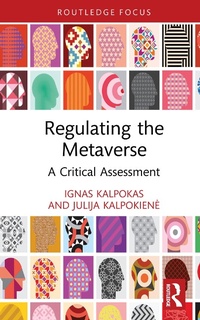
Regulating the Metaverse
A Critical Assessment
1st Edition
Published on 26. January 2023
126 pages
978-1-000-85923-2 (ISBN)
Description

The metaverse seems to be on everybody's lips - and yet, very few people can actually explain what it means or why it is important. This book aims to fill the gap from an interdisciplinary perspective informed by law and media and communications studies. Going beyond the optimism emanating from technology companies and venture capitalists, the authors critically evaluate the antecedents and the building blocks of the metaverse, the design and regulatory challenges that need to be solved, and commercial opportunities that are yet to be fully realised. While the metaverse is poised to open new possibilities and perspectives, it will also be a dangerous place - one ripe with threats ranging from disinformation to intellectual property theft to sexual harassment. Hence, the book offers a useful guide to the legal and political governance issues ahead while also contextualising them within the broader domain of governance and regulation of digital technologies.
More details
Series
Edition
1. Auflage
Language
English
Place of publication
London
United Kingdom
Publishing group
Taylor & Francis Ltd
Target group
College/higher education
Professional and scholarly
ISBN-13
978-1-000-85923-2 (9781000859232)
Copyright in bibliographic data and cover images is held by Nielsen Book Services Limited or by the publishers or by their respective licensors: all rights reserved.
Schweitzer Classification
Other editions
Additional editions
Book
08/2024
1st Edition
Routledge
€32.90
Shipment within 10-20 days
Book
01/2023
1st Edition
Routledge
€71.70
Shipment within 10-20 days
Persons
Ignas Kalpokas is Associate Professor in the Department of Public Communication, Vytautas Magnus University, Kaunus, Lithuania, where he also heads the MA programme Future Media and Journalism. His research focuses on the social and political impact of digital technologies, fake news and information warfare, and media theory. Ignas's teaching stretches across the domains of journalism and media studies, disinformation and propaganda studies, and geopolitics of the internet. He is the author of Creativity and Limitation in Political Communities: Spinoza, Schmitt, and Ordering (Routledge, 2018), A Political Theory of Post-Truth (Palgrave Macmillan, 2019), Algorithmic Governance: Politics and Law in the Post-Human Era (Palgrave Macmillan, 2019), and Malleable, Digital, and Posthuman: A Permanently Beta Life (Emerald, 2021), and co-author of Deepfakes: A Realistic Assessment of Potentials, Risks, and Policy Regulation (Springer, 2022).
Julija Kalpokiene is a qualified Lithuanian attorney specialising in commercial law and dispute resolution with a particular interest in intellectual property, data protection, and IT law. She is a PhD candidate at Vytautas Magnus University, Kaunus, Lithuania, where she is a Junior Research Fellow, teaches Technology Law, and is course leader for An Interdisciplinary Introduction to AI. Julija also has experience in internet governance and policy work. Her research focuses on internet regulation, cybercrime, technology regulation, with a particular focus on AI and creativity, and more generally intellectual property and privacy law. Julija is also an active member of the Lithuanian Young Bar Association where she is Vice-Chair of the Kaunas Chapter and a member of the Information Committee. She is co-author of Deepfakes: A Realistic Assessment of Potentials, Risks, and Policy Regulation (Springer, 2022).
Julija Kalpokiene is a qualified Lithuanian attorney specialising in commercial law and dispute resolution with a particular interest in intellectual property, data protection, and IT law. She is a PhD candidate at Vytautas Magnus University, Kaunus, Lithuania, where she is a Junior Research Fellow, teaches Technology Law, and is course leader for An Interdisciplinary Introduction to AI. Julija also has experience in internet governance and policy work. Her research focuses on internet regulation, cybercrime, technology regulation, with a particular focus on AI and creativity, and more generally intellectual property and privacy law. Julija is also an active member of the Lithuanian Young Bar Association where she is Vice-Chair of the Kaunas Chapter and a member of the Information Committee. She is co-author of Deepfakes: A Realistic Assessment of Potentials, Risks, and Policy Regulation (Springer, 2022).
Content
1 Introduction
Bibliography
2 Why Now?: From Mediatisation to Virtualisation
2.1 Mediatisation and the Immersed Individual
2.2 Platformisation, Datafication, and the Technology-Experience Nexus
Bibliography
3 Understanding the Metaverse: Beyond the Hype
3.1 Building the Metaverse: Key Opportunities and Challenges
3.2 Experiencing the Metaverse: Enhancements and Limitations
Bibliography
4 Doing Things: From Work to Sex
4.1 The Economic Side of the Metaverse
4.2 Acting and Feeling in the Metaverse
Bibliography
5 Law, Life, and Governance
5.1 Conceptualising Life
5.2 Conceptualising Governance
Bibliography
6 Security, Regulation, and Other Challenges
6.1 Old Wine in New Bottles
6.2 New Wine in Old Bottles
Bibliography
7 Concluding Thoughts
Bibliography
Index
Bibliography
2 Why Now?: From Mediatisation to Virtualisation
2.1 Mediatisation and the Immersed Individual
2.2 Platformisation, Datafication, and the Technology-Experience Nexus
Bibliography
3 Understanding the Metaverse: Beyond the Hype
3.1 Building the Metaverse: Key Opportunities and Challenges
3.2 Experiencing the Metaverse: Enhancements and Limitations
Bibliography
4 Doing Things: From Work to Sex
4.1 The Economic Side of the Metaverse
4.2 Acting and Feeling in the Metaverse
Bibliography
5 Law, Life, and Governance
5.1 Conceptualising Life
5.2 Conceptualising Governance
Bibliography
6 Security, Regulation, and Other Challenges
6.1 Old Wine in New Bottles
6.2 New Wine in Old Bottles
Bibliography
7 Concluding Thoughts
Bibliography
Index
