

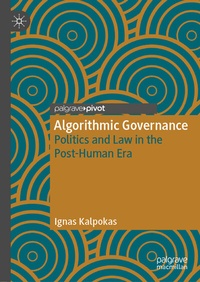
Algorithmic Governance
Description

This book analyses the changes to the regulation of everyday life that have taken place as a result of datafication, the ever-growing analytical, predictive, and structuring role of algorithms, and the prominence of the platform economy. This new form of regulation - algorithmic governance - ranges from nudging individuals towards predefined outcomes to outright structuration of behaviour through digital architecture. The author reveals the strength and pervasiveness of algorithmic politics through a comparison with the main traditional form of regulation: law. These changes are subsequently demonstrated to reflect a broader shift away from anthropocentric accounts of the world. In doing so, the book adopts a posthumanist framework which focuses on deep embeddedness and interactions between humans, the natural environment, technology, and code.
Reviews / Votes
"This original and timely book guides us with great mastery through the algorithmic conditions in which we find ourselves increasingly immersed. It raises important questions about the agency of the individual within our new relational assemblages, and identifies the need for a post-anthropocentric politics in order to deal with this new human-digital complexity. A must-read for all who are grappling with this brave new world." (Matt York, Department of Government and Politics, University College Cork, Ireland)"A substantial contribution to the field of digitalisation which highlights profoundly startling transformations that will be seen more in governance, coding, the formation of law. Apart from meticulously drawing attention to the predominant function of algorithms, Kalpokas strikingly presents a premonition about a grim future in a critical way, where observation and control will prevail even more strongly in our lives." (Seda Mengü, Department of Public Relations and Advertising, Istanbul University, Turkey)
"In his extraordinarily timely book, Ignas Kalpokas provides us with an insightful perspective on the relation between algorithmic governance and individual agency. Embedded within a posthumanist framework, the study compares that new form of regulation - code, with the one we are all familiar with - law. This is a must-read for anyone interested in learning how the algorithms steer our everyday lives." (Maria Burczynska, Department of History, Politics and War Studies, University of Wolverhampton, UK)
More details
Other editions
Additional editions
Person
Ignas Kalpokas is Senior Lecturer of Public Communication at Vytautas Magnus University and Assistant Professor of International Relations and Development at LCC International University, Lithuania. He is the author of Creativity and Limitation in Political Communities (2017) and A Political Theory of Post-Truth (2019).
Content
1. Introduction: I'll Be Watching You.- 2. The Premise of New Governance.- 3. The Code that Is Law.- 4. Personalisation, Emotion, and Nudging.- 5. Agency and The Posthuman Shape of Law.- 6. Dis-Imagining Rights, Legitimacy, and the Foundations of Politics.- 7. Conclusion/Manifesto: Just Another Brick in The Wall? (Hint: No).
