

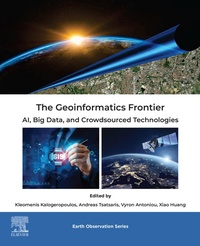
The Geoinformatics Frontier
AI, Big Data, and Crowdsourced Technologies
Published on 8. June 2026
360 pages
978-0-443-31575-6 (ISBN)
Description

The Geoinformatics Frontier: AI, Big Data, and Crowdsourced Technologies tackles the critical challenge of integrating Geoinformatics, AI, Big Data, and VGI; offering a comprehensive introduction to these pivotal concepts, the book elucidates their foundations and relevance to Geoinformatics. It approaches builds on the theory discussed with practical guidance, examples, and detailed case studies; equipping readers with the knowledge needed to effectively implement them. The book presents case studies spanning various sectors, showcasing how the technologies can be successfully employed to address intricate spatial issues and facilitate well-informed decision-making for the complexities of managing large-scale spatial datasets. It also provides indispensable insights into data collection, storage, quality control, and fusion techniques, offering practical solutions to the challenges of data storage, processing, and analysis. The Geoinformatics Frontier serves as an indispensable guide, bridging the gap in understanding and practice for geospatial scientists, empowering readers to harness the transformative potential of Geoinformatics and advanced computer technologies.
- Provides comprehensive of the integration of AI, Big Data, and Volunteered Geographic Information (VGI) in Geoinformatics, providing a solid foundation of knowledge and practical insights
- Incorportates practical examples and detailed case studies throughout the chapters, allowing readers to see successful implementations, understand the challenges faced, and identify opportunities for their own projects
- Includes considerations for ethics and responsible implementation of AI, Big Data, and VGI, fostering a deeper understanding of the implications of these technologies and tools needed to ensure responsible practices
More details
Other editions
Additional editions
Kleomenis Kalogeropoulos | Andreas Tsatsaris | Vyron Antoniou
The Geoinformatics Frontier
AI, Big Data, and Crowdsourced Technologies
Book
06/2026
Elsevier
€167.50
Shipment within 15-20 days
Content
Section I: Foundations of geoinformatics1. The new era in geoinformatics2. A geospatial moisture change detection after Ianos medicane using Sentinel-2 imagery in Central Thessaly, Greece3. Combining cartography and mythology: An educational approach via Web-GIS4. Travel cartography in the age of geoinformatics: The Kazantzakis example5. Archaeological surface survey and spatial analysis: Unlocking efficiency and accuracy using geographic information system technologySection II: Artificial intelligence in spatial practice6. Revealing the contribution of conditioning factors to landslide activity in terms of machine learning and fuzzy logic-based susceptibility assessment7. UAVS in urban air pollution monitoring: State-of-the-art and future pathways8. Study and implementation of visual SLAM algorithms in photogrammetry and computer vision9.Heuristic and optimal viewshed algorithms for forest monitoring and observation post allocation10. Radar remote sensing: Fundamentals, data, and AI-powered processing techniques11. Study and evaluation of modern SLAM algorithms using LiDAR sensor data12. A deep learning framework for building outline and footprint extraction in historical cartographic data13. Digital heritage in action: Geoinformatics and photogrammetry for managing archaeological landscapes14. GeoAI techniques in flood detection: A comprehensive review15. GIS-based modeling techniques and Geospatial-Artificial Intelligence (Geo-AI) model in assessing the spatial-temporal variation of air pollution16. Advancing unmanned aerial vehicles technology for a sustainable environment: The contribution of the ACCELERATE research project17. Improving thunderstorm prediction with neural networks using numerical weather and satellite data: A novel data fusion and validation approach18. Land use/cover mapping at high spatial resolution from unmanned aerial vehicle data and machine learning19. The geometric shape of a spatial network20. Delineation of site-specific soil management zones using multivariate analysis and geospatial techniques21. Advancing earth observation applications: Synthetic aperture radar and artificial intelligence in the era of new space22. LULC mapping from hyperspectral data using machine learning: State-of-the-art, challenges, and future outlook23. Designing and creating a noise prediction model in urban and semi-urban areas using machine learning techniques24. Use of unmanned aerial vehicles for retrieving key state variables of Earth's surface energy budgetSection III: Big earth data in geoinformatics25. Assessment of vegetation moisture stress using EO-based spectral indices within a cloud computing framework26. Spatiotemporal multidimensional data cubes for EO big data: Analysis and visualizationSection IV: Crowdsourced technologies in the new geoinformatics era27. Volunteered geographic information and crowdsourcing in geographic practice: A unifying conceptual framework28. Crowdsourced spatial data in human observation: Opportunities, challenges, and future directions29. Conclusions-Geoinformatics in the 21st century
