

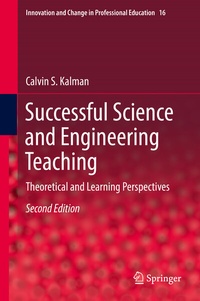
Successful Science and Engineering Teaching
Description

This second edition goes beyond the question of whether or not a pedagogical technique is effective, towards more of a focus on answering the question of why a particular technique or class of techniques is effective. In particular it is shown that students' epistemological beliefs could become more expert-like with a combination of appropriate instructional activities. The debate in the science education community between those who believe that students come in to the classroom with a theory about the subject which is different from that described by the teacher and their textbooks and those who feel that students' knowledge consists of isolated structures is elaborated especially in the light of the work by M.J. Lattery. Discussion of the stages in epistemic development in students beginning with the Perry model and continuing through later developments is now included. In this edition there is a discussion of how an instructor can enable the student to resolve cognitive dissonance in the difficulties students have in transcending their misconceptions. The second edition includes research comparing Peer Instruction with the Conceptual Conflict Collaborative Group Activity that had been described in the first edition. Much better instructions are available for students on how to use Reflective Writing including a rubric that simplifies the marking of Reflective Writing.
More details
Other editions
Additional editions
Content
Part I: How Students Learn Science .- 1. Introduction.- 2. Intellectual Development and Psychological Types.- 3. Students Alternative Scientific Conceptions.- 4. Writing to Learn: Reflective Writing.- 5. What is the students' Worldview?.- Part II: Theoretical and Learning Perspectives .- 6. Educational Models Based upon Philosophy of Science.- 7. Critical Thinking.- 8. Constructing an Epistemology.- 9. Changing How Students Learn.- Part III: Final Thoughts .- 10. Courses for Non-science Students.- 11. Computer Assisted Instruction. - 12. Summing Up.
