

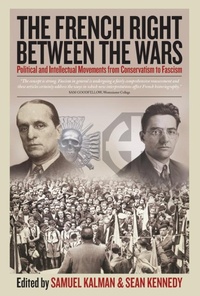
The French Right Between the Wars
Description

During the interwar years France experienced severe political polarization. At the time many observers, particularly on the left, feared that the French right had embraced fascism, generating a fierce debate that has engaged scholars for decades, but has also obscured critical changes in French society and culture during the 1920s and 1930s. This collection of essays shifts the focus away from long-standing controversies in order to examine various elements of the French right, from writers to politicians, social workers to street fighters, in their broader social, cultural, and political contexts. It offers a wide-ranging reassessment of the structures, mentalities, and significance of various conservative and extremist organizations, deepening our understanding of French and European history in a troubled yet fascinating era.
More details
Other editions
Additional editions
Persons
Samuel Kalman is Associate Professor at St. Francis Xavier University. He is the author of French Colonial Fascism: The Extreme Right in Algeria, 1919-1939 (Palgrave, 2013), The Extreme Right in Interwar France: The Faisceau and the Croix de Feu (Asghate, 2008), numerous book chapters and journal articles, and editor of the 2010 special issue of the journal Historical Reflections/Réflexions historiques devoted to the theme of colonial violence.
Content
Acknowledgements
List of Abbreviations
Notes on the Contributors
Introduction
PART 1: Political Movements
Chapter 1. Collective Psychology, anti-Southern Prejudice and Constitutional Reform in 1930s France: The Stavisky Affair and the Riots of 6 February 1934
Kevin Passmore
Chapter 2. Avec une brutalité toute particulière: Fascist Sympathies, Racial Violence, and the Municipal Police and Gendarmerie in Oran, 1936-37
Samuel Kalman
Chapter 3. The Veterans and the Extreme Right: The Union nationale des combattants, 1927-1936
Chris Millington
Chapter 4. Pacifism, the Fascist Temptation and the Ligue des droits de l'homme
Norman Ingram
PART 2: Gender and the Right
Chapter 5. Right-Wing Feminism and Conservative Women's Militancy in Interwar France
Magali Della Sudda
Chapter 6. Gender, the Family, and the Fascist Temptation: Visions of Masculinity in the Natalist-Familialist Movement, 1922-1940
Cheryl A. Koos
Chapter 7. Was there a Fascist Femininity? Gender and French Fascism in Political Context
Geoff Read
Chapter 8. An Overview of Women and Gender in French Fascism
Daniella Sarnoff
PART 3: Intellectual and Cultural Trends
Chapter 9. "Our Body Doesn't Have to be Ugly": Physical Culture, Gender, and Racial Rejuvenation in the Croix de feu/Parti social français
Caroline Campbell
Chapter 10. Defending Christian Civilization: The Evolving Message of the Parti social français, 1936-1939
Sean Kennedy
Chapter 11. Were French Elites Allergic to Fascism? A Study of the Reception of the 1930s Dictatorships in Three French Periodicals
Laurent Kestel
Chapter 12. Salvation, Satire, and Solidarity: Right-Wing Culture in Interwar France
Jessica Wardhaugh
PART 4: Historiography
Chapter 13. Beyond Left and Right, and the Politics of the Third Republic: A Conversation
William D. Irvine
Select Bibliography
Index
