

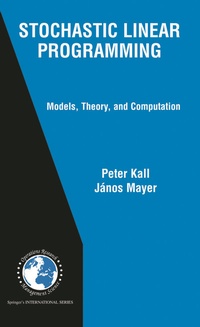
Stochastic Linear Programming
Description

Peter Kall and János Mayer are distinguished scholars and professors of Operations Research and their research interest is particularly devoted to the area of stochastic optimization. Stochastic Linear Programming: Models, Theory, and Computation is a definitive presentation and discussion of the theoretical properties of the models, the conceptual algorithmic approaches, and the computational issues relating to the implementation of these methods to solve problems that are stochastic in nature. The application area of stochastic programming includes portfolio analysis, financial optimization, energy problems, random yields in manufacturing, risk analysis, etc. In this book, models in financial optimization and risk analysis are discussed as examples, including solution methods and their implementation.
Stochastic programming is a fast developing area of optimization and mathematical programming. Numerous papers and conference volumes, and several monographs have been published in the area; however, the Kall and Mayer book will be particularly useful in presenting solution methods including their solid theoretical basis and their computational issues, based in many cases on implementations by the authors. The book is also suitable for advanced courses in stochastic optimization.
Reviews / Votes
From the reviews:
"The book presents a comprehensive study of stochastic linear optimization problems and their applications. . The presentation includes geometric interpretation, linear programming duality, and the simplex method in its primal and dual forms. . The authors have made an effort to collect . the most useful recent ideas and algorithms in this area. . A guide to the existing software is included as well." (Darinka Dentcheva, Mathematical Reviews, Issue 2006 c)
"This is a graduate text in optimisation whose main emphasis is in stochastic programming. The book is clearly written. . This is a good book for providing mathematicians, economists and engineers with an almost complete start up information for working in the field. I heartily welcome its publication. . It is evident that this book will constitute an obligatory reference source for the specialists of the field." (Carlos Narciso Bouza Herrera, Zentralblatt MATH, Vol. 1104 (6), 2007)
More details
Other editions
Additional editions
Content
Basics.- Introduction.- Linear Programming Prerequisites.- Nonlinear Programming Prerequisites.- Single-stage SLP Models.- Introduction.- Models involving Probability Functions.- Quantile Functions, Value at Risk.- Models Based on Expectation.- Models Built with Deviation Measures.- Modeling Risk and Opportunity.- Risk Measures.- Multi-stage SLP Models.- The General SLP with Recourse.- The Two-stage SLP.- The Multi-stage SLP.- Algorithms.- Models with Probability Functions.- Models with Quantile Functions.- Models Based on Expectation.- Models with Deviation Measures.- Two-stage Recourse Problems.- Multi-stage Recourse Problems.- Modeling Systems for SLP.- Bibliography.
