

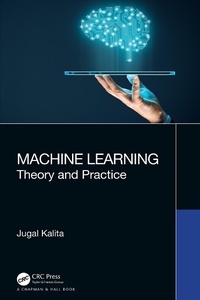
Machine Learning
Theory and Practice
1st Edition
Published on 21. December 2022
298 pages
978-1-000-81822-2 (ISBN)
Description

Machine Learning: Theory and Practice provides an introduction to the most popular methods in machine learning. The book covers regression including regularization, tree-based methods including Random Forests and Boosted Trees, Artificial Neural Networks including Convolutional Neural Networks (CNNs), reinforcement learning, and unsupervised learning focused on clustering. Topics are introduced in a conceptual manner along with necessary mathematical details. The explanations are lucid, illustrated with figures and examples. For each machine learning method discussed, the book presents appropriate libraries in the R programming language along with programming examples.
Features:
Provides an easy-to-read presentation of commonly used machine learning algorithms in a manner suitable for advanced undergraduate or beginning graduate students, and mathematically and/or programming-oriented individuals who want to learn machine learning on their own.
Covers mathematical details of the machine learning algorithms discussed to ensure firm understanding, enabling further exploration
Presents worked out suitable programming examples, thus ensuring conceptual, theoretical and practical understanding of the machine learning methods.
This book is aimed primarily at introducing essential topics in Machine Learning to advanced undergraduates and beginning graduate students. The number of topics has been kept deliberately small so that it can all be covered in a semester or a quarter. The topics are covered in depth, within limits of what can be taught in a short period of time. Thus, the book can provide foundations that will empower a student to read advanced books and research papers.
Features:
Provides an easy-to-read presentation of commonly used machine learning algorithms in a manner suitable for advanced undergraduate or beginning graduate students, and mathematically and/or programming-oriented individuals who want to learn machine learning on their own.
Covers mathematical details of the machine learning algorithms discussed to ensure firm understanding, enabling further exploration
Presents worked out suitable programming examples, thus ensuring conceptual, theoretical and practical understanding of the machine learning methods.
This book is aimed primarily at introducing essential topics in Machine Learning to advanced undergraduates and beginning graduate students. The number of topics has been kept deliberately small so that it can all be covered in a semester or a quarter. The topics are covered in depth, within limits of what can be taught in a short period of time. Thus, the book can provide foundations that will empower a student to read advanced books and research papers.
More details
Edition
1. Auflage
Language
English
Place of publication
London
United Kingdom
Publishing group
Taylor & Francis Ltd
Target group
College/higher education
Professional and scholarly
Illustrations
19 Tables, black and white; 92 Line drawings, black and white; 4 Halftones, black and white; 96 Illustrations, black and white
ISBN-13
978-1-000-81822-2 (9781000818222)
Copyright in bibliographic data and cover images is held by Nielsen Book Services Limited or by the publishers or by their respective licensors: all rights reserved.
Schweitzer Classification
Other editions
Additional editions
Book
12/2024
1st Edition
Chapman & Hall/CRC
€69.80
Shipment within 15-20 days
Book
12/2022
1st Edition
Chapman & Hall/CRC
€142.37
Shipment within 15-20 days
Person
Dr. Jugal Kalita teaches Computer Science at the University of Colorado, Colorado Springs, where he has been a professor since 1990. He received M.S. and Ph.D. degrees in Computer and Information Science from the University of Pennsylvania in Philadelphia in 1988 and 1990, respectively. Prior to that, he had received an M.Sc. in Computational Science from the University of Saskatchewan in Saskatoon, Canada in 1984; and a B.Tech. in Computer Science and Engineering from the Indian Institute of Technology, Kharagpur in 1982.
Dr. Jugal Kalita's expertise is in the areas of Artificial Intelligence and Machine Learning, and the application of techniques in Machine Learning to Natural Language Processing, Network Security, and Bioinformatics. At the University of Colorado, Colorado Springs, and Tezpur University, Assam, India, where he is an adjunct professor, Dr. Kalita has supervised 15 Ph.D. and 125 M.S. students to graduation, and has mentored 100 undergraduates in independent research. He has published 250 papers in journals and refereed conferences, including prestigious conferences such as International Conference on Machine Learning (ICML), Association for Advancement of Artificial Intelligence (AAAI), North American Chapter of the Association for Computational Linguistics (NAACL), International Conference on Computational Linguistics (COLING) and Empirical Methods in Natural Language Processing (EMNLP). Dr. Kalita is the author of On Perl: Perl for Students and Professionals, Universal Press, 2003. He is also a co-author of Network Anomaly Detection: A Machine Learning Perspective, CRC Press, 2013; DDOS Attacks: Evolution, Detection, Prevention, Reaction and Tolerance, CRC Press, 2016; Network Traffic Anomaly Detection and Prevention: Concepts, Techniques, and Tools, Springer Nature, 2017; and Gene Expression Data Analysis, A Statistical and Machine Learning Perspective, CRC Press, 2021.
Dr. Kalita has received several teaching, research and service awards at the University of Colorado, Colorado Springs, in the Department of Computer Science, and the College of Engineering and Applied Science. He received the prestigious Chancellor's Award at the University of Colorado, Colorado Springs, in 2011, in recognition of lifelong excellence in teaching, research and service. More details about Dr. Kalita can be found at http://www.cs.uccs.edu/~kalita.
Dr. Jugal Kalita's expertise is in the areas of Artificial Intelligence and Machine Learning, and the application of techniques in Machine Learning to Natural Language Processing, Network Security, and Bioinformatics. At the University of Colorado, Colorado Springs, and Tezpur University, Assam, India, where he is an adjunct professor, Dr. Kalita has supervised 15 Ph.D. and 125 M.S. students to graduation, and has mentored 100 undergraduates in independent research. He has published 250 papers in journals and refereed conferences, including prestigious conferences such as International Conference on Machine Learning (ICML), Association for Advancement of Artificial Intelligence (AAAI), North American Chapter of the Association for Computational Linguistics (NAACL), International Conference on Computational Linguistics (COLING) and Empirical Methods in Natural Language Processing (EMNLP). Dr. Kalita is the author of On Perl: Perl for Students and Professionals, Universal Press, 2003. He is also a co-author of Network Anomaly Detection: A Machine Learning Perspective, CRC Press, 2013; DDOS Attacks: Evolution, Detection, Prevention, Reaction and Tolerance, CRC Press, 2016; Network Traffic Anomaly Detection and Prevention: Concepts, Techniques, and Tools, Springer Nature, 2017; and Gene Expression Data Analysis, A Statistical and Machine Learning Perspective, CRC Press, 2021.
Dr. Kalita has received several teaching, research and service awards at the University of Colorado, Colorado Springs, in the Department of Computer Science, and the College of Engineering and Applied Science. He received the prestigious Chancellor's Award at the University of Colorado, Colorado Springs, in 2011, in recognition of lifelong excellence in teaching, research and service. More details about Dr. Kalita can be found at http://www.cs.uccs.edu/~kalita.
Content
1. Introduction. 2. Regression. 3. Tree-Based Classi cation and Regression. 4. Arti cial Neural Networks. 5. Reinforcement Learning. 6. Unsupervised Learning. 7. Conclusions.
