

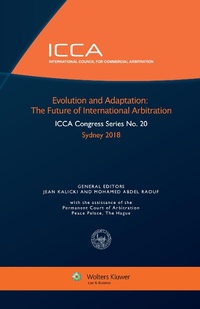
Evolution and Adaptation
The Future of International Arbitration
Published on 17. December 2019
1184 pages
978-94-035-2043-8 (ISBN)
Description

What is it about international arbitration that makes it so open to evolution and adaptation? What are the main pressure points today and the unmet needs of stakeholders? What are the opportunities for expansion to new sectors and new audiences? What are the drivers for change, the obstacles and the risks? And equally important, what are the core principles that should never be lost? These were the topics of the Twenty-Fourth ICCA Congress, held in Sydney, Australia, in April 2018, the proceedings of which are collected in this volume. The volume highlights arbitration as a ';living organism' that has adapted in the past to various challenges, and that today under attack from various quarters might need to demonstrate its adaptability again. Accordingly, the contributions address the evolving needs of users, the impact of the rapidly changing face of technology, the expectations of the public, and the convergence and divergence of different aspects of legal traditions and cultures. Topical issues of interest for practitioners, academics, and students of arbitration include the following: legitimacy and authority of arbitrators, institutions and professional organizations to act as lawmakers; investment treaty reform, with particular reference to the definition of ';investment,' the evolution of substantive treaty standards, and sustainable development obligations; commercial arbitration reform, including issues of public and private interest, the development of common law, and cost, delay and transparency concerns; revisiting party autonomy in choosing decision-makers, including through institutional appointments or investment courts; equality of arms, the economics of access, and the role of costs and third-party funding; public-private disputes and special issues that arise when State entities arbitrate; public participation and transparency, and their effect on both ISDS and commercial arbitration; revisiting conventional wisdom in organizing arbitral proceedings; lessons to be learned from other dispute resolution frameworks; technology as friend and enemy, including new tools, new threats, and cybersecurity; arbitration of disputes in conflict and post-conflict zones; inter-generational blame and praise in investment arbitration; and the emergence of sovereign wealth funds as arbitration participants. A special section on ';New Frontiers in Arbitration' offers enlightening perspectives on new types of claims and new types of stakeholders likely to affect the future of international arbitration, including the potential for climate change disputes and enlarged participation.
More details
Other editions
Additional editions
Book
12/2019
Kluwer Law International
€315.47
Shipment within 15-20 days
Content
- Intro
- Halftitle Page
- Title Page
- Copyright Page
- Preface
- ICCA CONGRESS 2020
- Table of Contents
- Opening Keynote Address
- Commercial and Investor-State Arbitration: The Importance of Recognizing Their Differences
- Plenary Session Lawmaking in International Arbitration: What Legitimacy Challenges Lie Ahead?
- Legitimacy Pragmatism in International Arbitration: A Framework for Analysis
- Lawmaking by Arbitrators
- Arbitral Institutions and Professional Organizations as Lawmakers
- The Influence of Public Actors on Lawmaking in International Arbitration: Domestic Legislatures, Domestic Courts and International Organizations
- Luncheon Panel: Personal Reflections of Leading Arbitrators
- Personal Reflections from Leading Arbitrators: Transcript of Luncheon Panelists' Remarks
- Arbitration Challenged Part I
- Reforming Substantive Obligations in Investment Treaties and Conditions of Access to Investment Arbitration
- The Definition of "Investment": Recent Developments and Lingering Issues
- Fair and Equitable Treatment - Ten Years On
- The Evolution of the Expropriation Obligation in Investment Arbitration and Its Adaptation in Treaties to Reflect State Rights
- Reforming Substantive Obligations in Investment Treaties: Most Favoured Nation Clauses
- Sustainable Development Obligations and Access to Treaty Remedies in Contemporary Investment Treaties and Models
- Reforming Commercial Arbitration in Response to Legitimacy Concerns
- Private and Public Interest in International Commercial Arbitration
- Commercial Arbitration and the Development of Common Law
- Costs, Delay and Transparency - A Comment on Continued Legitimacy Concerns from the User's Perspective
- Allocation of Competence Between a National Court and an Arbitral Tribunal: Striking a Balance Between Efficiency and Legitimacy of Arbitration - Asian Perspectives
- Arbitration Challenged Part II
- Party Autonomy in Choosing Decision-Makers: Advantages and Drawbacks - Should It Be Revisited?
- A Special Role of Party-Appointed Arbitrators?
- Institutional Appointment of Arbitrators
- The T(h)reat of Party Autonomy in ISDS Arbitrator Selection: Any Options for Preservation?
- The Risk of Groupthink in a Multilateral Investment Court
- The Realities of Arbitration Economics: Who Gets to Play, and What Are the Implications?
- Costs in International Arbitration: Navigating Through the Devil's Sea
- A Thought-Experiment Regarding Access to Justice in International Arbitration
- The Economics of Access: Systemic Imbalances in ISDS
- The Pandora's Box of Third-Party Funding: Some Practical Suggestions for Arbitrators in Light of Recent Developments
- Arbitration Involving Public Bodies and Public Interests: Salient Issues
- Part I: The Increasing Participation of Public Entities in International Arbitration
- Arbitration Clauses and Disputes from the Central European Perspective: Blurring the Public-Private Divide
- Challenges for Counsel in the Representation of States and State-Owned Entities in International Arbitration: A Practitioner's Perspective
- Protecting the Legitimacy of the Arbitral Process: Jurisdictional and Procedural Challenges in Public-Private Disputes
- Public-Private Arbitrations: The Substantive Issues of Arbitrability, Mandatory Rules and Public Policy -The Latin American Experience
- Part II: Confidentiality, Transparency and Public Participation: Too Far or Not Far Enough?
- The Contribution of Non-State Actors to the Development of Transparency Regimes in Investment Treaty Arbitration
- The ISDS Trinity and Early State Practice in Investor-State Arbitration
- Transparency in International Investor-State Arbitration: Commendable in Theory, Complicated in Practice
- What Has Been the "Spillover" Effect of the Transparency Debate on Commercial Arbitrations?
- Building Better Arbitration Proceedings: Practical Suggestions
- Part I: Revisiting Conventional Wisdom in the Organization of Arbitral Proceedings
- Prayers for Relief - The Focus for Organization
- What Is Conventional Wisdom in the Organization of Arbitral Proceedings?
- Revisiting Conventional Wisdom in the Organization of Arbitral Proceedings: Perspectives from Chinese Users and Institutions
- When Does the Use of an Arbitral Secretary Detract from the "Intuitu Personae" Principle?
- Part II: Efficiency and the Lessons to Be Learned from Other Dispute Resolution Frameworks
- Building Better Arbitration Proceedings
- The Future of Arbitration - Identifying Processes That Could Usefully Be Adopted in International Commercial Arbitration
- The Moving Face of Technology
- Part I: Technology as Facilitation
- Technology as Facilitation: Transcript of the Session
- Part II: Technology as Disruption
- Cybersecurity and Cyber Insurance
- Cyber Intrusion as the Guerrilla Tactic: An Appraisal of Historical Challenges in an Age of Technology and Big Data
- Hot Topics and New Voices
- Part I: Hot Topics
- Report of the Rapporteur for the "Hot Topics" Panel
- Part II: New Voices
- Arbitration of Disputes Arising in Conflict and Post-Conflict Zones: Managing the Risks
- Date of Breach, Contributory Fault, and Mitigation of Damages in Investment Arbitration
- Sovereign Wealth Funds: The New Kids on the Block
- The Excessive Scope for "the Individual" in Decision-Making in Investment Arbitration: Views from Younger Practitioners
- Plenary: New Frontiers in International Arbitration
- Part I: Potential of Arbitration Involving New Types of Claims
- Arbitration of Internal Trust Disputes: The Next Frontier for International Commercial Arbitration?
- International Arbitration of Corporate Disputes: A Workable Balance Between Two Dimensions of Party Autonomy
- New Arbitration Frontiers: Climate Change
- What Can Arbitration and Human Rights as Mechanisms of Dispute Resolution Learn from Each Other in Order to Meet the Challenges of Climate Change?
- Part II: Potential of Arbitration Involving New Stakeholders
- Scope for Enlarged Participation in International Arbitration
- Closing Keynote Address
- Closing Keynote Address
- ICCA-ASIL Task Force on Damages Breakfast
- Damages in International Arbitration: ICCA-ASIL Web Application
- LIST OF PARTICIPANTS
- LIST OF ICCA OFFICERS AND GOVERNING BOARD MEMBERS
- ICCA Membership now open
