

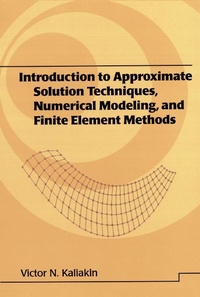
Introduction to Approximate Solution Techniques, Numerical Modeling, and Finite Element Methods
1st Edition
Published on 19. April 2018
664 pages
978-1-4822-7112-6 (ISBN)
Description

Functions as a self-study guide for engineers and as a textbook for nonengineering students and engineering students, emphasizing generic forms of differential equations, applying approximate solution techniques to examples, and progressing to specific physical problems in modular, self-contained chapters that integrate into the text or can stand alone!
This reference/text focuses on classical approximate solution techniques such as the finite difference method, the method of weighted residuals, and variation methods, culminating in an introduction to the finite element method (FEM).
Discusses the general notion of approximate solutions and associated errors!
With 1500 equations and more than 750 references, drawings, and tables, Introduction to Approximate Solution Techniques, Numerical Modeling, and Finite Element Methods:
Describes the approximate solution of ordinary and partial differential equations using the finite difference method
Covers the method of weighted residuals, including specific weighting and trial functions
Considers variational methods
Highlights all aspects associated with the formulation of finite element equations
Outlines meshing of the solution domain, nodal specifications, solution of global equations, solution refinement, and assessment of results
Containing appendices that present concise overviews of topics and serve as rudimentary tutorials for professionals and students without a background in computational mechanics, Introduction to Approximate Solution Techniques, Numerical Modeling, and Finite Element Methods is a blue-chip reference for civil, mechanical, structural, aerospace, and industrial engineers, and a practical text for upper-level undergraduate and graduate students studying approximate solution techniques and the FEM.
This reference/text focuses on classical approximate solution techniques such as the finite difference method, the method of weighted residuals, and variation methods, culminating in an introduction to the finite element method (FEM).
Discusses the general notion of approximate solutions and associated errors!
With 1500 equations and more than 750 references, drawings, and tables, Introduction to Approximate Solution Techniques, Numerical Modeling, and Finite Element Methods:
Describes the approximate solution of ordinary and partial differential equations using the finite difference method
Covers the method of weighted residuals, including specific weighting and trial functions
Considers variational methods
Highlights all aspects associated with the formulation of finite element equations
Outlines meshing of the solution domain, nodal specifications, solution of global equations, solution refinement, and assessment of results
Containing appendices that present concise overviews of topics and serve as rudimentary tutorials for professionals and students without a background in computational mechanics, Introduction to Approximate Solution Techniques, Numerical Modeling, and Finite Element Methods is a blue-chip reference for civil, mechanical, structural, aerospace, and industrial engineers, and a practical text for upper-level undergraduate and graduate students studying approximate solution techniques and the FEM.
More details
Series
Edition
1. Auflage
Language
English
Place of publication
London
United Kingdom
Publishing group
Taylor & Francis Ltd
Target group
College/higher education
File size
378,35 MB
ISBN-13
978-1-4822-7112-6 (9781482271126)
Copyright in bibliographic data and cover images is held by Nielsen Book Services Limited or by the publishers or by their respective licensors: all rights reserved.
Schweitzer Classification
Other editions
Additional editions
Victor N. Kaliakin
Introduction to Approximate Solution Techniques, Numerical Modeling, and Finite Element Methods
Book
09/2001
1st Edition
CRC Press
€275.40
Shipment within 15-20 days
Person
Content
Governing equations and their approximate solution; computer storage and manipulation of numbers; the finite difference method; the method of weighted residuals; variational methods; introduction to the finite element method; development of finite element equations; steps in performing finite element analysis; element interpolation functions; element mapping; finite element analysis of scalar field problems; finite element analysis in linear elastostatics; implementation, modelling, and related issues. Appendices: mathematical potpourri; matrices and linear algebra; some notes on heat flow; local and natural coordinate systems; the patch test; solution of linear systems of equations; notes on integration of finite elements.
