

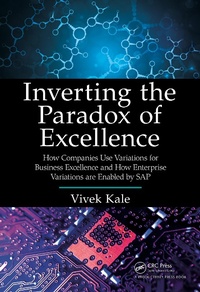
Inverting the Paradox of Excellence
How Companies Use Variations for Business Excellence and How Enterprise Variations Are Enabled by SAP
Published on 14. July 2014
442 pages
978-1-040-08411-3 (ISBN)
Description

Drawing lessons from one of the best models of success, the evolutionary model, this book explains why an organization must actively monitor the market environment and competitors to ascertain excellence and reconfigure and reframe continuously. It introduces the patterns and anti-patterns of excellence and includes detailed case studies based on different variations, including structure variations, shared values variations, and staff variations. The book includes case history segments from Toyota, Acer, eBay, Cisco, Blackberry, Samsung, Volvo, Charles Schwab, McDonalds, Starbucks, Google, Disney, and NUMMI; as well as detailed case histories of GE, IBM, and UPS.
Reviews / Votes
Inverting the Paradox of Excellence is a very comprehensive analysis of why good companies fail; and to maintain excellence, the company must be in a constant state of flux! Very convincingly, Vivek Kale demonstrates that competitiveness is not a state of being but a process of becoming excellent by monitoring and continuously adapting to the changing market realities.-Jagdish N. Sheth, Charles H. Kellstadt Professor of Marketing, Goizueta Business School, Emory University, U.S.A
Vivek Kale offers many invaluable insights in his book, Inverting the Paradox of Excellence. Rather than proposing intuitively appealing prescriptions that can easily lead many firms astray, he advances a much more insightful perspective. That is, leaders must embrace the inherent tensions between stability and change; managing for the short-term and creating the future; as well as leveraging (or exploiting) an existing resource base and exploring for new opportunities. Failure is not to be avoided-it can lead to future success! He combines a sound conceptual rationale with many exciting examples of how to engage and benefit from the 'paradox' that he expertly communicates to the reader.
-Gregory Dess, Professor of Management, University of Texas at Dallas
Vivek Kale has written a 'must-read' book that tackles a challenging subject - what contributes to excellence in an organization and is sustaining. Vivek is very well qualified as an author and cognizant of the difficulty of the formidable task to write this book. He recognizes that previous books on this topic have showcased organizations that have subsequently failed, including bankruptcies. His approach to understand the contributors to business excellence includes a rarely written blend of executive leadership, business architecture, human nature, and technology.
-Gary Cokins, President, Analytics-Based Performance Management LLC; and author of Performance Management - Integrating Strategy Execution, Methodologies, Risk, and Analytics
The book Inverting the Paradox of Excellence offers a compelling look into why even the best companies fail, how the very reasons for their success can also lead to their eventual downfall. This well-researched and enlightening book cites example after example of how companies that maintain excellence have embraced variations as they adapt to a changing market.
-Greg Niemann, author of Big Brown: The Untold Story of UPS
Vivek Kale goes to the heart of the paradoxes of management and business. He draws together many theories and concepts from different disciplines to show how businesses are constantly evolving and changing. Success, as Darwin said, goes to those who can adapt best to their environment. This excellent book shows why adaptation is necessary, and how to do it. Further, taking SAP as a specific example, he shows how enterprise systems enable variations essential for business excellence.-Morgen Witzel, Fellow, Centre for Leadership Studies, University of Exeter; and author of A History of Management Thought
More details
Language
English
Place of publication
London
United Kingdom
Publishing group
Taylor & Francis Ltd
Target group
Professional and scholarly
File size
5,24 MB
ISBN-13
978-1-040-08411-3 (9781040084113)
Copyright in bibliographic data and cover images is held by Nielsen Book Services Limited or by the publishers or by their respective licensors: all rights reserved.
Schweitzer Classification
Other editions
Additional editions
Vivek Kale
Inverting the Paradox of Excellence
How Companies Use Variations for Business Excellence and How Enterprise Variations Are Enabled by SAP
Book
07/2014
1st Edition
CRC Press
€66.00
Shipment within 15-20 days
Person
Vivek Kale has more than two decades of professional IT experience during which he has handled and consulted on various aspects of enterprise-wide information modeling, enterprise architectures, business process re-design, and, e-business architectures. He has been Group CIO of Essar Group, the steel/oil & gas major of India, as well as, Raymond Ltd., the textile & apparel major of India. He is a seasoned practitioner in transforming the business of IT, facilitating business agility and enabling the Process Oriented Enterprise. He is the author of Implementing SAP R/3: The Guide for Business and Technology Managers, Sams (2000), A Guide to Implementing the Oracle Siebel CRM 8.x, McGraw-Hill India (2009) and Guide to Cloud Computing for Business and Technology Managers: From Distributed Computing to Cloudware Applications, Chapman and Hall (2014).
Content
Paradox of Excellence. Introduction. Patterns of Excellence. Antipatterns of Excellence. Evolution of Excellence. Variations and Theories of Excellence. Dimensions of Excellence. Variations and Enterprise Excellence. Sources of Variations. Dimension of Variations. Business Excellence through Variations. General Electric. IBM. UPS. Industry Excellence Through Variations. Automobile Industry. Business Excellence and Sap. Business Excellence at SAP. Understanding SAP ERP. Business Excellence through Variations Using SAP.
