

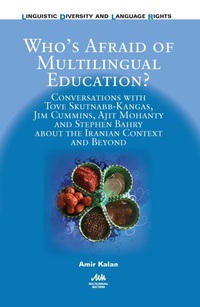
Who's Afraid of Multilingual Education?
Conversations with Tove Skutnabb-Kangas, Jim Cummins, Ajit Mohanty and Stephen Bahry about the Iranian Context and Beyond
Published on 18. August 2016
182 pages
978-1-78309-619-0 (ISBN)
Description

More than 70 languages are spoken in contemporary Iran, yet all governmental correspondence and educational textbooks must be written in Farsi. To date, the Iranian mother tongue debate has remained far from the international scholarly exchanges of ideas about multilingual education. This book bridges that gap using interviews with four prominent academic experts in linguistic human rights, mother tongue education and bilingual and multilingual education. The author examines the arguments for rejecting multilingual education in Iran, and the four interviewees counter those arguments with evidence that mother tongue-based education has resulted in positive outcomes for the speakers of non-dominant language groups and the country itself. It is hoped that this book will engage an international audience with the debate in Iran and show how multilingual education could benefit the country.
Reviews / Votes
Multilingual education has become an important topic of this and the next decade. Amir Kalan has created a book that advances debates and universal ideas about multilingual education. Contextualised in the political, religious and linguistic complexity of Iran, the book is essential reading for anyone interested in the importance of multilingual education, in Iran itself, and in listening to four exceptional scholars. -- Colin Baker, Bangor University, UK A unique and compelling book, offering an impassioned plea by Iranian scholar Kalan for multilingual education in his own country. In conversation with four international lifetime warriors for the rights of children to education in their own language, the author probes the gamut of contentious political, historical, linguistic, cultural, pedagogical, and practical arguments against mother-tongue-based multilingual education, demolishing them one by one. * Nancy H. Hornberger, University of Pennsylvania, USA * Because of the importance of its content and its clearly written style, this book will interest not only educators in the fields of bilingual and multilingual education but also education policymakers. Kalan's work is undoubtedly relevant to classroom teachers because it vividly explains how students' home-language may differ from mainstream classes and how the Iranian education system must change in order to provide equal opportunities for minority groups. -- Laila Aghai, University of North Dakota, USA * Journal of Language, Identity & Education, 2019 * What stands out in this book is the author's commitment to make the perspectives of the minoritized visible to a larger audience. He defines multilingualism from their perspectives to highlight the challenges that ITM languages face at the intersection of language, ideology, practice, and power [...] the takeaways from the book resonate deeply across multilingual contexts. There is something in here for everyone. -- Anuja Sarda and Usree Bhattacharya, University of Georgia, USA * International Journal of Bilingual Education and Bilingualism, 2019 *More details
Series
Language
English
Place of publication
Bristol
United Kingdom
Publishing group
Channel View Publications Ltd
Target group
Professional and scholarly
Product notice
Reflowable
ISBN-13
978-1-78309-619-0 (9781783096190)
Copyright in bibliographic data and cover images is held by Nielsen Book Services Limited or by the publishers or by their respective licensors: all rights reserved.
Schweitzer Classification
Other editions
Additional editions
Amir Kalan
Who's Afraid of Multilingual Education?
Conversations with Tove Skutnabb-Kangas, Jim Cummins, Ajit Mohanty and Stephen Bahry about the Iranian Context and Beyond
Book
08/2016
Multilingual Matters
€136.80
Shipment within 10-20 days
Person
Amir Kalan is a researcher at the Ontario Institute for Studies in Education of the University of Toronto, Canada. His research interests include multilingual education, multiliteracies, second language writing and multilingual text generation.
Content
Acknowledgments
Introduction
1. Mother Tongue-Based Multilingual Education: Legal Frameworks, Theoretical Legacies, and Historical Experiences
A Conversation with Tove Skutnabb-Kangas
2. Multilingual Education: Pedagogy, Power, and Identity
A Conversation with Jim Cummins
3. Mother Tongue-Based Multilingual Education: An Indian Perspective
A Conversation with Ajit Mohanty
4. Multilingual Education in China and Central Asia
A Conversation with Stephen Bahry
5. Who's Afraid of Multilingual Education?
Afterword
References
Introduction
1. Mother Tongue-Based Multilingual Education: Legal Frameworks, Theoretical Legacies, and Historical Experiences
A Conversation with Tove Skutnabb-Kangas
2. Multilingual Education: Pedagogy, Power, and Identity
A Conversation with Jim Cummins
3. Mother Tongue-Based Multilingual Education: An Indian Perspective
A Conversation with Ajit Mohanty
4. Multilingual Education in China and Central Asia
A Conversation with Stephen Bahry
5. Who's Afraid of Multilingual Education?
Afterword
References
