

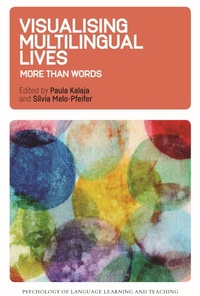
Visualising Multilingual Lives
More Than Words
Published on 8. March 2019
312 pages
978-1-78892-262-3 (ISBN)
Description

Shortlisted for the 2020 BAAL Book Prize
This book brings together empirical studies from around the world to help readers gain a better understanding of multilinguals, ranging from small children to elderly people, and their lives. The chapters focus on the multilingual subjects' identities and the ways in which they are discursively and/or visually constructed, and are split into sections looking specifically at the multilingual self, the multilingual learner and multilingual teacher education. The studies draw on rich visual data, which is analysed for content and/or form and often complemented with other types of data, to investigate how multilinguals make sense of their use and knowledge of more than one language in their specific context. The topic of multilingualism is addressed as subjectively experienced and the book unites the current multilingual, narrative and visual turns in Applied Language Studies. It will be of interest to students and researchers working in the areas of language learning and teaching, teacher education and bi/multilingualism, as well as to those interested in using visual methods and narratives as a means of academic research.
This book brings together empirical studies from around the world to help readers gain a better understanding of multilinguals, ranging from small children to elderly people, and their lives. The chapters focus on the multilingual subjects' identities and the ways in which they are discursively and/or visually constructed, and are split into sections looking specifically at the multilingual self, the multilingual learner and multilingual teacher education. The studies draw on rich visual data, which is analysed for content and/or form and often complemented with other types of data, to investigate how multilinguals make sense of their use and knowledge of more than one language in their specific context. The topic of multilingualism is addressed as subjectively experienced and the book unites the current multilingual, narrative and visual turns in Applied Language Studies. It will be of interest to students and researchers working in the areas of language learning and teaching, teacher education and bi/multilingualism, as well as to those interested in using visual methods and narratives as a means of academic research.
Reviews / Votes
Narrative turns and visual turns. This book will have your head spinning. Filled with innovative methods for studying the multilingual subject that are cutting-edge but intersect with more conventional methods too, this stunning collection looks to the future in applied language studies research. * Gary Barkhuizen, University of Auckland, New Zealand * A path-breaking book for multilingual classrooms in the 21st century! The 15 chapters, expertly edited by Kalaja and Melo-Pfeifer, offer cutting-edge research on multilingual subjects and a range of truly innovative pedagogies for teachers. This book will inspire researchers investigating the role of visual literacies in multilingual education and will transform the experience of teachers committed to a deeper understanding of the multilingual lives of newcomer students and multilingual learners worldwide. This volume is bound to become a major reference in the fields of language education and teacher education. * Christine Helot, University of Strasbourg, France * Visual narratives tap into a new wild world of often unspoken and unexplored emotions, visions and identities relating to languages and this makes the anthology intriguing and thought-provoking throughout. -- Melike Bulut Albaba, Trakya University, Turkey * The Learner Development Journal, Issue 5 *More details
Series
Language
English
Place of publication
Bristol
United Kingdom
Target group
College/higher education
ISBN-13
978-1-78892-262-3 (9781788922623)
Copyright in bibliographic data and cover images is held by Nielsen Book Services Limited or by the publishers or by their respective licensors: all rights reserved.
Schweitzer Classification
Other editions
Additional editions
Book
03/2019
Multilingual Matters
€84.20
Shipment within 3-4 weeks
Persons
Paula Kalaja is Professor Emerita in the Department of Language and Communication Studies at the University of Jyvaeskylae, Finland. Her research interests lie in visual methodologies and foreign language learning and teaching, with a particular interest in beliefs, motivation and identities. She has published widely in the field and is co-author (with Ana Maria F. Barcelos, Mari Aro and Maria Ruohotie-Lyhty) of Beliefs, Agency and Identity in Foreign Language Learning and Teaching (Palgrave, 2016).
Silvia Melo-Pfeifer is Professor in the Department of Education at the University of Hamburg, Germany. She is also a member of CIDTFF (Research Centre 'Didactics and Technology in Education of Trainers') at the University of Aveiro, Portugal. Her research interests include plurilingual and intercultural (online) interaction, pluralistic approaches to languages and cultures, and heritage language education.
Silvia Melo-Pfeifer is Professor in the Department of Education at the University of Hamburg, Germany. She is also a member of CIDTFF (Research Centre 'Didactics and Technology in Education of Trainers') at the University of Aveiro, Portugal. Her research interests include plurilingual and intercultural (online) interaction, pluralistic approaches to languages and cultures, and heritage language education.
Content
Introduction. Paula Kalaja and Silvia Melo-Pfeifer
Part I - The Multilingual Self
Chapter 1. Alice Chik: Becoming and Being Multilingual in Australia
Chapter 2. Nayr Ibrahim: Children's Multimodal Visual Narratives as Possible Sites of Identity Performance
Chapter 3. Silvia Melo-Pfeifer and Alexandra Schmidt: Integration as Portrayed in Visual Narratives by Young Refugees in Germany
Chapter 4. Muriel Molinie: From the Migration Experience to its Visual Narration in International Mobility
Part II - The Multilingual Learner
Chapter 5. Kristiina Skinnari: Looking but not Seeing: The Hazards of a Teacher-Researcher Interpreting Self-portraits of Adolescent English Learners
Chapter 6. Liss Kerstin Sylven: Looking at Language through a Camera Lens
Chapter 7. So-Yeon Ahn: Using Multimodal Analysis to Explore Language Learner Identity Construction
Chapter 8. Vera Lucia Menezes de Oliveira e Paiva and Ronaldo Correa Gomes Junior: Multimodal Language Learning Histories: Images Telling Stories
Chapter 9. Tae Umino and Phil Benson: Study-abroad in Pictures: Photographs as Data in Life-story Research
Part III - Multilingual Teacher Education
Chapter 10. Ana Carolina de Laurentiis Brandao: Imagining L2 Teaching in Brazil: What Stories do Student Teachers Draw?
Chapter 11. Ana Sofia Pinho: Plurilingual Education and the Identity Development of Pre-service English Language Teachers: An Illustrative Example
Chapter 12. Mireia Perez-Peitx, Isabel Civera and Juli Palou: Awareness of Plurilingual Competence in Teacher Education
Chapter 13. Katja Maentylae and Paula Kalaja: "The Class of my Dreams" as Envisioned by Student Teachers of English: What is there to Teach about the Language?
Conclusion. Silvia Melo-Pfeifer and Paula Kalaja: Lessons Learnt With and Through Visual Narratives of Multilingualism as Lived, and a Research Agenda
Part I - The Multilingual Self
Chapter 1. Alice Chik: Becoming and Being Multilingual in Australia
Chapter 2. Nayr Ibrahim: Children's Multimodal Visual Narratives as Possible Sites of Identity Performance
Chapter 3. Silvia Melo-Pfeifer and Alexandra Schmidt: Integration as Portrayed in Visual Narratives by Young Refugees in Germany
Chapter 4. Muriel Molinie: From the Migration Experience to its Visual Narration in International Mobility
Part II - The Multilingual Learner
Chapter 5. Kristiina Skinnari: Looking but not Seeing: The Hazards of a Teacher-Researcher Interpreting Self-portraits of Adolescent English Learners
Chapter 6. Liss Kerstin Sylven: Looking at Language through a Camera Lens
Chapter 7. So-Yeon Ahn: Using Multimodal Analysis to Explore Language Learner Identity Construction
Chapter 8. Vera Lucia Menezes de Oliveira e Paiva and Ronaldo Correa Gomes Junior: Multimodal Language Learning Histories: Images Telling Stories
Chapter 9. Tae Umino and Phil Benson: Study-abroad in Pictures: Photographs as Data in Life-story Research
Part III - Multilingual Teacher Education
Chapter 10. Ana Carolina de Laurentiis Brandao: Imagining L2 Teaching in Brazil: What Stories do Student Teachers Draw?
Chapter 11. Ana Sofia Pinho: Plurilingual Education and the Identity Development of Pre-service English Language Teachers: An Illustrative Example
Chapter 12. Mireia Perez-Peitx, Isabel Civera and Juli Palou: Awareness of Plurilingual Competence in Teacher Education
Chapter 13. Katja Maentylae and Paula Kalaja: "The Class of my Dreams" as Envisioned by Student Teachers of English: What is there to Teach about the Language?
Conclusion. Silvia Melo-Pfeifer and Paula Kalaja: Lessons Learnt With and Through Visual Narratives of Multilingualism as Lived, and a Research Agenda
