

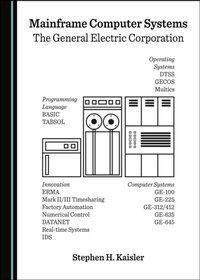
Mainframe Computer Systems
The General Electric Corporation
1st Edition
Published on 22. October 2020
454 pages
978-1-5275-6116-8 (ISBN)
Description

This volume describes General Electric Corporation's venture into developing second and third generation mainframe computer systems.The General Electric Corporation (GE), which began its life as the Edison Electric Co., was long involved in electrical appliances and industrial machines. It was also a founder of the Radio Corporation of America, which eventually became one of its competitors, and developed many electrical systems in order to control different types of industrial machines. Its breakthrough into computing came with its winning bid to provide the computing systems for the Electronic Recording Method of Accounting) system developed for the Bank of America by the Stanford Research Institute. The success of this project led GE to develop the GE-200 series which was the foundation for commercial timesharing. The GE-235 was selected by Dartmouth for its Dartmouth Time Sharing System (DTSS), an innovative academic time-sharing system. BASIC was developed on the GE-235 computer system under DTSS. GE enhanced it to develop its Mark II/III Time Sharing System, apparently the first commercial time sharing service in the world. GE develop the GE-300/-400 systems for industrial process control. The GE-600 series replaced the GE-200 series and demonstrated innovation in time-sharing systems. The GE-645 was selected to host Multics, which was developed by MIT. However, GE felt that it could not compete in computing against IBM, Univac, and other mainframes competitors, so it folded its tent and sold its Computer Division to Honeywell, Inc. Nevertheless, GE will be remembered for many innovations which continue to be used in modern computing systems.
More details
Other editions
Additional editions
Book
12/2020
Cambridge Scholars Publishing
€100.46
Shipment within 15-20 days
Content
- Intro
- Table of Contents
- Acknowledgement
- List of Figures
- List of Tables
- General Electric Co. Computers
- Chapter One
- 1.1 The ERMA Project
- 1.1.1 In the Beginning
- 1.1.2 The Contract
- 1.1.3 Selecting the Vendor
- 1.1.4 Operation
- 1.2 GE-100 System Architecture
- 1.3 GE-100 Peripherals
- 1.4 GE-115
- Chapter Two
- 2.1 GE-205 and GE-210
- 2.1.1 GE-205 Computer System
- 2.1.2 GE-210 Computer System
- 2.2 GE-225
- 2.2.1 GE-225 System Configuration
- 2.2.2 Central Processing Unit
- 2.2.1.1 GE-225 Control Console
- 2.2.1.2 Registers
- 2.2.1.3 Instruction Execution
- 2.2.3 Main Memory
- 2.2.4 Auxiliary Arithmetic Unit
- 2.2.4.1 Operating Modes
- 2.2.4.2 AAU Registers
- 2.2.5 Concurrent Operation
- 2.2.6 Instruction Set
- 2.2.7 Interrupts
- 2.2.7.1 Priority Interrupts
- 2.2.7.2 Automatic Program Interrupt
- 2.2.8 GE 215
- 2.3 GE-225 System Peripherals
- 2.3.1 Paper Tape Reader-Punch
- 2.3.2 Card Reader and Card Punch
- 2.3.3 Controller Selector
- 2.3.4 Magnetic Tape Subsystem
- 2.3.4.1 Magnetic Tape Controller
- 2.3.4.2 MTC Registers
- 2.3.4.3 Magnetic Tape Handler
- 2.4.4.4. Checking Features
- 2.4.4.5 Magnetic Tape Characteristics
- 2.4.4.6 Programming Magnetic Tape Operations
- 2.4.4.7 Tape Movement Instructions
- 2.4.4.8 Tape Interrogation Instructions
- 2.3.5 High Speed Printer
- 2.3.6 Disc Storage Unit
- 2.3.7 Document Sorter
- 2.3.8 DATANET-15
- 2.3.9 Manual Peripheral Switch Control Unit
- 2.4 GE-225 System Software
- 2.4.1 GECOM
- 2.4.2 COBOL
- 2.4.3 ALGOL
- 2.4.4 TABSOL
- 2.4.4.1 Decision Table Basics
- 2.4.4.2 TABSOL Decision Table Preprocessor
- 2.4.4.3 TABSOL Assessment
- 2.4.5 Report Writer
- 2.4.6 FORTRAN II/IV
- 2.4.7 WIZOR
- 2.4.8 General Assembly Program
- 2.4.9 Subroutine Libraries
- 2.4.10 BRIDGE II
- 2.5 GE-235
- 2.5.1 GE-235 Central Processor
- 2.5.2 Storage Section
- 2.5.3 Arithmetic Section
- 2.5.4 Control Section
- 2.5.5 Auxiliary Arithmetic Unit
- 2.5.5.1 Operating Modes
- 2.5.5.2 AAU Registers
- 2.5.6 AAU Instruction Set
- 2.5.6.1 General Instructions
- 2.5.6.2 Arithmetic Operations
- 2.5.6.3 Test and Branch Instructions
- 2.6 Selector Channels
- 2.7 GE-235 Instruction Set
- 2.7.1 Arithmetic Instructions
- 2.7.2 Memory Transfers
- 2.7.3 Shift Instructions
- 2.7.4 Branch Instructions
- 2.7.5 Register Modification
- 2.8 GE-235 Peripherals
- 2.8.1 Punched Card Equipment
- 2.8.2 Magnetic Tape Subsystem
- 2.8.2.1 MTC Error Checking
- 2.8.2.2 MTC Registers
- 2.8.2.3 Control Switches
- 2.8.2.4 Magnetic Tape Handler
- 2.8.2.5 Magnetic Tape
- 2.8.3 Disc Storage Unit
- 2.8.4 Peripheral Switch Console
- 2.9 DATANET Communications Processors
- 2.10 GE-250
- 2.11 GE-265 Time-sharing System
- 2.11.1 Communications Hardware
- 2.11.2 Remote Terminals
- Chapter Three
- 3.1 DN-30 System Architecture
- 3.1.1 Central Processor
- 3.1.2 Main Memory
- 3.1.3 Buffer Selector
- 3.1.4 Bit Buffer Unit Module
- 3.1.5 Character/Word Buffer Unit
- 3.1.6 Computer Interface Unit
- 3.1.7 Page Control Logic Unit
- 3.1.8 System Bus
- 3.1.9 I/O Multiplexor
- 3.2 I/O Channels
- 3.3 DN-30 Operation
- 3.4 DN-30 Instruction Set
- 3.4.1 Load and Store Instructions
- 3.4.2 Arithmetic Instructions
- 3.4.3 Logical Instructions
- 3.4.4 Register Transfer Instructions
- 3.4.5 Branch Instructions
- 3.4.6 Special Instructions
- 3.4.7 Buffer Selector Instructions
- 3.5 DATANET Assessment
- Chapter Four
- 4.1 DN-30 Operation
- 4.2 GE-235 Operation
- 4.3 System Software
- 4.3.1 Concept of Operations
- 4.3.2 DN-30 Executive
- 4.3.2.1 Scheduling
- 4.3.2.2 Job Priority Levels
- 4.3.3 GE-235 Executive
- 4.3.3 Catalogs
- 4.3.4 Editor
- 4.4 GE-265 Assessment
- Chapter Five
- 5.1 GE-312
- 5.1.1 Applications of the GE-312
- 5.1.2 Brief Overview of the GE-312
- 5.2 GE-412
- 5.2.1 GE-412 System Architecture
- 5.2.2. Central Processor Architecture
- 5.2.2.1 Arithmetic Registers
- 5.2.2.2 Control Registers
- 5.2.2.3 Address Modification
- 5.2.2.4 Real-time Clock
- 5.2.2.5 Automatic Program Interrupts
- 5.2.2.6 Variable Timing Control for Programs
- 5.2.2.7 Operator Console
- 5.2.3 Program and Maintenance Console
- 5.2.4 Main Memory
- 5.2.5 Magnetic Drum Storage
- 5.2.6 Peripheral Equipment
- 5.2.6.1 Scanner-Distributor
- 5.2.6.2 Fast Digital Scanner
- 5.2.6.3 Digital Data Accumulator
- 5.2.6.4 Digital-to-Analog Converter
- 5.3 Software Development Aids
- 5.3.1 General Assembly Program
- 5.3.2 The General Compiler
- 5.4 GE-312/412 Instruction Set
- 5.4.1 Data Transfer and Arithmetic Instructions
- 5.4.2 Register Manipulation Instructions
- 5.4.3 Logical Instructions
- 5.4.4 Shift Instructions
- 5.4.5 Unconditional branch Instructions
- 5.4.6 conditional branch Instructions
- 5.4.7 Automatic Address Modification Instruction
- 5.4.8 Real-Time Instructions
- 5.4.9 Magnetic Drum Transfer Instructions
- 5.4.10 Automatic Program Interrupt Instructions
- 5.4.11 Miscellaneous Instructions
- 5.4.12 Unit Record Peripheral I/O Instructions
- 5.4.13 Other Peripherals Instructions
- 5.5 GE-412 System Software
- 5.6 GE-412 Assessment
- Chapter Six
- 6.1 GE-400 Series System Architecture
- 6.1.1 GE-435 Central Processor
- 6.1.2 The Processor Channel
- 6.1.2.1 Processor Status Control Word
- 6.1.2.2 Program Interrupt Words
- 6.1.3 Memory
- 6.1.4 I/O Control Section
- 6.1.4.1 Executing Control Functions
- 6.1.5 Direct Access Package
- 6.1.6 1401 Emulator
- 6.2 System Console and Peripherals
- 6.3 GE-4xx Instruction Set
- 6.3.1 Single Addresses
- 6.3.2 Two Addresses
- 6.3.3 Data Movement
- 6.3.4 Shift Instructions
- 6.3.3 Arithmetic Instructions
- 6.3.4 Compare Instructions
- 6.3.5 Branch Instructions
- 6.3.6 Logic Instructions
- 6.3.7 Fixed Index Word Instructions
- 6.3.8 Accumulator Instructions
- 6.3.9 Special Purpose Instructions
- 6.3.10 Peripheral Instructions
- 6.4 GE-400 Peripherals
- 6.4.1 CR-20 Card Reader
- 6.4.2 CP-10 Card Punch
- 6.4.3 PR-20 Printer
- 6.4.4 Magnetic Tape Subsystems
- 6.4.5 TS-20 Perforated Tape Reader/Punch
- 6.4.6 DS-20 Disc Storage Subsystem
- 6.4.6.1 DSU Controller
- 6.4.6.2 Electronics and File Units
- 6.4.6.3 Programming the DS-20
- 6.4.6.4 Status Data
- 6.4.7 MR-20 Magnetic Record Reader/Sorter
- 6.4.8 Data Communications Units
- 6.5 GE-400 Time-sharing System
- 6.6 GE-400 Series Software
- 6.6.1 Magnetic Tape Processing System
- 6.6.2 Disc Processing System
- 6.6.3 Direct Access Processing System
- 6.6.4 Macro Assembly Program
- 6.6.4.1 Instruction Format
- 6.6.4.2 Assembler Phase I
- 6.7 GE-400 Series Assessment
- Chapter Seven
- 7.1 The GE-600 Genesis
- 7.2 GE-600 System Architecture
- 7.2.1 Memory Module
- 7.2.2 Processor Module
- 7.2.2.1 Registers
- 7.2.2.2 Processor Indicators
- 7.2.2.3 Operation Overlapping
- 7.2.2.4 Memory Protection
- 7.2.2.5 Interrupt Procedure
- 7.2.3 I/O Control Module
- 7.2.3.1 Micro-Program Generator
- 7.2.3.2 I/O Processor (IOP)
- 7.2.4 Peripheral Subsystems
- 7.3 GE-615
- 7.4 GE-625
- 7.5 GE-600 Assessment
- Chapter Eight
- 8.1 GE-635 System Architecture
- 8.1.1 Instruction Fetching
- 8.1.2 Memory Protection
- 8.1.3 Master Mode Operation
- 8.1.4 Interrupt Execution
- 8.1.5 Multiple Adders
- 8.1.6 Faults
- 8.1.6.1 Instruction-Generated Faults
- 8.1.6.2 Program-Generated Faults
- 8.1.6.3 Hardware-Generated Faults
- 8.1.6.4 Manually-Generated Faults
- 8.1.7 Interval Timer
- 8.2 Instruction Set Architecture
- 8.2.1 Address Modification
- 8.2.2 Data Movement Instructions
- 8.2.3 Shifting Instructions
- 8.2.4 Fixed Point Arithmetic Instructions
- 8.2.5 Boolean Instructions
- 8.2.6 Comparison Instructions
- 8.2.7 Floating Point Load and Store
- 8.2.8 Floating Point Arithmetic Operations
- 8.2.9 Transfer of Control
- 8.2.10 Miscellaneous Operations
- 8.2.11 Special Operations
- 8.2.12 Master Mode Operations
- 8.3 I/O Controller
- 8.4 Peripheral Equipment Subsystems
- 8.5 GE-600 Series Assessment
- Chapter Nine
- 9.1 Design Concepts
- 9.2 System Summary
- 9.3 System Controller Module
- 9.3.1 Core Storage
- 9.3.2 Connect Signals
- 9.3.3 Interrupt Cells
- 9.3.4 System Clock
- 9.4 Processor Modules
- 9.4.1 Processor Features
- 9.4.2 Operating Modes
- 9.4.3 Processor Registers
- 9.2.3 GIOC Module
- 9.2.4 Extended Memory Module
- 9.5 Instruction Set
- 9.5.1 Address Modification
- 9.5.2 New Instructions
- 9.6 GE-645 Enhancements
- 9.6.1. I/O System
- 9.6.2 Segmentation and Paging
- 9.6.3 Segmentation
- 9.6.4 Descriptors
- 9.6.5 Base Registers
- 9.6.6 Indirect Transfer to Segments
- 9.6.7 Shared Segments
- 9.6.8 Paging
- 9.6.9 The Segment Descriptor Word
- 9.6.10 Paged Descriptor Segment
- 9.6.11 Associative Memory
- 9.7 New Mode of Procedure Execution
- 9.8 System Console
- 9.9 Generalized I/O Controller
- 9.9.1 GIOC Mailboxes
- 9.9.2 GIOC Control Words
- 9.9.3 Channels
- 9.9.4 Data Channels
- 9.9.5 List Channels
- 9.9.6 Connect Channel
- 9.9.7 Status Channels
- 9.9.8 Adapters
- 9.9.9 Status Events
- 9.9.10 Initializing Data Channel Operation
- 9.10 System Configuration Console
- 9.11 Peripheral Equipment
- 9.11.1 Disc Storage Subsystem
- 9.11.2 Magnetic Drum Storage System
- 9.11.3 Mass Storage Subsystem
- 9.11.4 Magnetic Tape Subsystem
- 9.11.5 Peripheral Switch Console
- 9.11.6 Terminal Equipment
- 9.12 The Multics Operating System
- 9.13 GE-655
- Chapter Ten
- 10.1 User Interaction
- 10.2 DTSS Structure
- 10.3 The End of the First Generation
- 10.4 The Second Generation
- 10.5 DTSS Assessment
- Chapter Eleven
- 11.1 The Goals for BASIC
- 11.2 The Basics of BASIC
- 11.2.1 The First Dartmouth Version
- 11.2.2 Further Versions of BASIC
- 11.3 The Mark II/III Basic Language
- 11.3.1 A Complete BASIC Program
- 11.3.2 Essential BASIC Statements
- 11.3.3 Enhanced BASIC Statements
- 11.4 The Success of BASIC
- 11.5 Assessment of BASIC
- Chapter Twelve
- 12.1 GECOS Structure
- 12.1.1 Input Media Conversion
- 12.1.2 Allocation
- 12.1.3 Monitor
- 12.1.4 Termination
- 12.1.5 Output Media Conversion
- 12.1.6 Roadblock AND FORCED RELINQUISH
- 12.1.7 Dispatcher
- 12.2 GEMME
- 12.2.1 GEMME Calls
- 12.2.2 Requests For Service
- 12.2.3 Multiprogramming
- 12.3 General I/O Supervisor
- 12.3.1 GEINOS
- 12.3.1.1 Data Control Word
- 12.3.1.2 GEINOS Device Commands
- 12.3.1.3 Return Status
- 12.3.2 I/O Operation Execution
- 12.3.2.1 GESYOT
- 12.3.2.2 GEEPR
- 12.3.2.3 GEFALT
- 12.4 GEFLOW
- 12.5 General File Record Control
- 12.6 General Loader
- 12.6.1 Overlays
- 12.7 General Remote Terminal Supervisor
- 12.8 GECOS Control Cards
- 12.9 GECOS Assessment
- Chapter Thirteen
- 13.1 GEM
- 13.1.1 Symbol Types
- 13.1.2 Expressions
- 13.1.3 Address Modification
- 13.1.4 Pseudo-Operations
- 13.1.4.1 Control Pseudo-operations
- 13.1.4.2 Location Counter Pseudo-operations
- 13.1.4.3 Symbol-Defining Pseudo-operations
- 13.1.4.4 Data Generating Pseudo-operations
- 13.1.4.5 Storage Allocation Pseudo-operations
- 13.1.4.6 Conditional Pseudo-operations
- 13.1.4.7 Special Word Pseudo-operations
- 13.1.4.8 Tally Pseudo-operations
- 13.1.4.9 Repeat Pseudo-operations
- 13.2 Integrated Data Store
- 13.2.1 IDS Requirements
- 13.2.2 Data Organization
- 13.2.3 Data and Procedural Language
- 13.2.3.1 Procedural Commands
- 13.2.3.2 IDS Retrieval Rules
- 13.2.4 I/O Controller
- 13.3 IDS Assessment
- Chapter Fourteen
- 14.1 Accessing the Service
- 14.1.1 Signing On
- 14.1.2 Entering a Program
- 14.1.3 Signing Off
- 14.2 Data Files
- 14.3 Program Libraries
- 14.4 System Communication
- 14.5 Time-sharing Applications
- Chapter Fifteen
- Ezercises for the Reader
- Glossary
- References
- Index
