

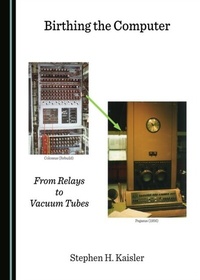
Birthing the Computer
From Relays to Vacuum Tubes
1st Edition
Published on 12. December 2016
375 pages
978-1-4438-9631-3 (ISBN)
Description

Birthing the Computer: From Relays to Vacuum Tubes is the first in a multi-volume series on historical computing machines. This series will span the development of computer systems from the Zuse machines of the early 1930s to about 1995 when microprocessors began to be commoditized. Each volume will focus on a range of technologies, or a class of machines or a particular vendor, and will describe the hardware of the machines and its peripherals, the operating system and system software, and its influence upon programming languages. This volume begins with the Zuse machines which were constructed from relays, but contained the basic elements of a computer system, namely input, computing engine, and output. Early machines from Atanasoff and Berry, Aiken, Stibitz, and IBM are described. The transition from relays to vacuum tubes increased speed and performance significantly, and led to the first true computers in ENIAC, EDSAC, and EDVAC which used paper tape and Williams tubes for I/O and storage. These machines were built by universities.Several early machines were purpose built such as Colossus and BINAC, and created with government support and industrial know-how. By the mid-to-late '50s, computing machines were being built by universities (the SSEM, Whirlwind, and IAS machines), governments (the NBS SEAC and SWAC, and several other machines), and industry (the UNIVAC series and the English Electric DEUCE). Most of these machines were constructed using the von Neumann architecture, and represent an evolution of thinking in how computing machines were to operate along with some innovative ideas in software and programming languages. By the end of the 1950s, the design, development, programming and use of computing machines were in full ferment as many new ideas were proposed, many different machines were designed and some were constructed. Computing machines became a commercial enterprise. Governments receded from building machines to levying requirements and funding construction, while universities continued to explore new architectures, new operating systems, and new programming languages.
More details
Other editions
Additional editions
Book
12/2016
Cambridge Scholars Publishing
€105.41
Shipment within 15-20 days
Content
- Intro
- Contents
- List of Figures
- List of Tables
- Part I
- Chapter One
- 1.1 The Z1
- 1.2 The Z2
- 1.3 The Z3
- 1.3.1 Z3 Architecture
- 1.3.2 Memory
- 1.3.3 Floating Point Registers
- 1.3.4 Input and Output
- 1.3.5 Instruction Execution
- 1.3.6 Instruction Set
- 1.3.7 Programming the Z3
- 1.3.8 Z3 Assessment
- 1.4 The Z4
- 1.4.1 ETH and the Z4
- 1.4.2 The Z5
- 1.5 Plankalkul
- 1.6 The Z11
- 1.7 The Z22
- 1.8 The Z23
- 1.9 The Z31
- 1.10 Assessment of Zuse's Computing Machines
- Chapter Two
- 2.1 ABC System Architecture
- 2.2 The Atanasoff-Mauchly Conflict
- 2.3 The ABC Reconstructed
- 2.4 ABC Assessment
- Chapter Three
- 3.1 Model I: The Complex Numerical Calculator
- 3.2 Model II: The Relay Interpolator
- 3.3 Model III: The Ballistic Computer
- 3.4 Model IV: The Error Detector Mark II
- 3.5 Model V
- 3.6 Model VI
- 3.7 Later BTL Machines
- 3.8 Assessment of Stibitz's Relay Computers
- Chapter Four
- 4.1 Rebuilding Colossus
- 4.2 Colossus Architecture
- 4.3 Colossus and Code Breaking
- 4.4 Assessment of Colossus
- Chapter Five
- 5.1 ASCC System Architecture
- 5.1.1 Automatic Sequence Unit
- 5.1.2 Arithmetic Calculations
- 5.1.3 Interpolators
- 5.1.4 Special Registers
- 5.2 I/O System
- 5.3 Programming the ASCC
- 5.4 ASCC Assessment
- Chapter Six
- 6.1 Mark II
- 6.2 Mark III
- 6.3 Mark IV
- 6.4 Mark Machines Assessment
- Chapter Seven
- 7.1 SSEC System Architecture
- 7.1.1 Electronic Storage Units
- 7.1.2 Relay Storage
- 7.1.3 Tape Storage
- 7.1.4 Dial Storage
- 7.1.5 Pluggable Storage
- 7.1.6 Program Tapes
- 7.2 SSEC Reliability
- 7.3 SSEC Assessment
- Chapter Eight
- Further Reading
- Exercises for the Reader
- Part II
- Chapter Nine
- 9.1 ENIAC System Architecture
- 9.1.1 Accumulators
- 9.1.2 Control Units
- 9.1.3 Master Programmer
- 9.1.4 Arithmetic Units
- 9.1.5 Constant Transmitter
- 9.1.6 Function Table
- 9.1.7 Input/Output Units
- 9.2 Later Modifications
- 9.3 Applying ENIAC
- 9.4 The ENIAC Women
- 9.5 Myths and Stories about ENIAC
- 9.6 Assessment of ENIAC
- Chapter Ten
- 10.1 The Von Neumann Report
- 10.2 The Patent Dispute
- 10.3 The "Real" EDVAC
- 10.4 EDVAC Architecture
- 10.4.1 System Architecture
- 10.4.2 Memory System
- 10.4.3 I/O System
- 10.4.4 The EDVAC Console
- 10.4.5 Debugging Support
- 10.5 EDVAC Instruction Set
- 10.6 Physical Challenges
- 10.7 EDVAC Implementation
- 10.8 EDVAC Software
- 10.9 EDVAC Applications
- 10.9.1 EDVAC Operation
- 10.10 EDVAC Assessment
- Chapter Eleven
- 11.1 EDSAC System Architecture
- 11.2 The EDSAC Order Code
- 11.3 Programming the EDSAC
- 11.3.1 Subroutine Libraries
- 11.3.2 The Travails of Paper Tape
- 11.3.3 An EDSAC Simulator
- 11.4 EDSAC Firsts
- 11.5 EDSAC 2
- 11.6 EDSAC Assessment
- Chapter Twelve
- 12.1 The SSEM Architecture
- 12.2 Assessment of the SSEM
- Chapter Thirteen
- 13.1 System Architecture
- 13.2 Instruction Set
- 13.3 BINAC Assessment
- Chapter Fourteen
- 14.1 Pilot ACE System Architecture
- 14.2 Programming the Pilot ACE
- 14.3 Pilot ACE Assessment
- 14.4 The ACE
- Chapter Fifteen
- 15.1 BRLESC I
- 15.2 BRLESC II
- 15.3 BRLESC Assessment
- Further Reading
- Exercises for the Reader
- Part III
- Chapter Sixteen
- 16.1 ERA 1101 Architecture
- 16.1.1 System Architecture
- 16.1.2 I/O Systems
- 16.1.3 UNIVAC 1101 Instruction Set
- 16.1.4 The Atlas II
- 16.2 UNIVAC 1102
- 16.3 Dissonance at Remington Rand
- 16.4 Assessment of the UNIVAC 1101
- Chapter Seventeen
- 17.1 UNIVAC 1103 System Architecture
- 17.1.1 Control Components
- 17.1.2 Arithmetic Registers
- 17.1.3 Master Clock
- 17.2 Storage
- 17.3 Arithmetic
- 17.4 Instruction Format
- 17.4.1 Transmissive Instructions
- 17.4.2 Replace Instructions
- 17.4.3 Split Instructions
- 17.4.4 Q-Controlled Instructions
- 17.4.5 Sequenced Instructions
- 17.4.6 One-Way Conditional Jump Instructions
- 17.4.7 Two-Way Conditional Jump Instructions
- 17.4.8 One-Way Unconditional Jump Instructions
- 17.4.9 External Equipment Instructions
- 17.4.10 Stop Instructions
- 17.5 I/O Systems
- 17.5.1 I/O Registers
- 17.5.2 Program Interrupts
- 17.6 UNIVAC 1103A
- 17.7 UNIVAC 1104
- 17.8 Assessment of the Early UNIVAC 11xx Machines
- Chapter Eighteen
- 18.1 SEAC
- 18.1.1 SEAC System Architecture
- 18.1.2 Applications
- 18.2 SWAC
- 18.2.1 System Architecture
- 18.2.2 Instruction Set
- 18.2.3 Software
- 18.3 DYSEAC
- 18.4 NBS Computer Assessment
- Chapter Nineteen
- 19.1 Whirlwind System Architecture
- 19.1.1 Arithmetic Unit
- 19.1.2 Registers
- 19.1.3 Magnetic Core Memory
- 19.1.4 Auxiliary Storage
- 19.1.5 I/O System
- 19.2 Whirlwind Instruction Set
- 19.3 Sample Whirlwind Program
- 19.4 Whirlwind Assessment
- Chapter Twenty
- 20.1 IAS System Architecture
- 20.2 IAS Orders
- 20.3 Assessment of the IAS
- Chapter Twenty-One
- 21.1 MANIAC System Architecture
- 21.2 MANIAC Instruction Set
- 21.3 Programming the MANIAC
- 21.4 MANIAC II
- 21.4.1 MANIAC II System Architecture
- 21.4.2 Demand Paging
- 21.4.3 Peripherals
- 21.5 Chess Playing
- 21.6 MANIAC III
- 21.6.1 MANIAC III System Architecture
- 21.6.2 MANIAC III Instruction Set
- 21.7 MANIAC Assessment
- Chapter Twenty-Two
- 22.1 ORDVAC System Architecture
- 22.1.1 Arithmetic and Control Units
- 22.1.2 Memory
- 22.1.3 I/O Devices
- 22.2 Error Checking the ORDVAC
- 22.3 ORDVAC Instruction Set
- 22.4 Assessment of ORDVAC
- Chapter Twenty-Three
- 23.1 UNIVAC I at Lawrence Livermore
- 23.2 Early UNIVAC Orders
- 23.3 UNIVAC I at the Census Bureau
- 23.4 UNIVAC I Architecture
- 23.4.1 UNIVAC I Memory
- 23.4.2 UNIVAC I I/O
- 23.5 UNIVAC I Instruction Set
- 23.6 UNIVAC I and Programming
- 23.7 Remington Rand's Problems
- 23.8 UNIVAC II
- 23.9 UNIVAC III
- 23.10 UNIVAC I-III Assessment
- Chapter Twenty-Four
- 24.1 Basic Architecture
- 24.2 Hardware Configuration
- 24.3 The Control
- 24.4 Instruction Highway
- 24.5 Main Memory
- 24.6 The Magnetic Store
- 24.7 I/O Devices
- 24.8 Instruction Set
- 24.9 UTECOM
- 24.10 EASICODE
- 24.11 Assessment of the DEUCE
- Chapter Twenty-Five
- 25.1 Pegasus Configuration
- 25.1.1 Control Unit
- 25.1.2 The Main Store
- 25.1.3 The Computing Store
- 25.1.4 Control Panel
- 25.1.5 I/O System
- 25.2 Pegasus Instruction Set
- 25.3 Pegasus I at the British Science Museum
- 25.4 Pegasus Assessment
- Chapter Twenty-Six
- 26.1 Ferranti Mark I
- 26.2 Mark I Architecture
- 26.3 Mark I Instruction Set
- 26.3.1 Arithmetic and Logical Orders
- 26.3.2 B-Line Manipulation Orders
- 26.3.3 Control Transfer Orders
- 26.3.4 Peripheral and Miscellaneous Orders
- 26.4 Programming the Ferranti Mark I
- 26.5 Assessment of the Mark I
- Chapter Twenty-Seven
- 27.1 System Architecture
- 27.2 Instruction Set
- 27.3 Mercury Autocode
- 27.4 Mercury Installations
- 27.5 Assessment of the Ferranti Machines
- Chapter Twenty-Eight
- 28.1 The File 0 Machine
- 28.2 The File 1/ File 2 Machines
- 28.3 Arithmetic and Control Unit
- 28.4 I/O Systems
- 28.4.1 I/O Storage
- 28.4.2 Buffer Storage
- 28.4.3 High-Speed Storage
- 28.4.4 Large Capacity Drum
- 28.5 File Computer Operations
- 28.6 File Computer Assessment
- Chapter Twenty-Nine
- 29.1 RAMAC Origins
- 29.2 IBM 305 System Architecture
- 29.2.1 Processing Unit and Main Memory
- 29.2.2 Input Card Reader
- 29.2.3 Output Printer and Punch
- 29.2.4 System Console
- 29.3 Instruction Format
- 29.3.1 Accumulators
- 29.4 Controlling the IBM 305
- 29.5 IBM 350 Disk File
- 29.6 IBM 305 Assessment
- Further Reading
- Exercises for the Reader
- Glossary
- References
- Index
