Alles über E-Books | Antworten auf Fragen rund um E-Books, Kopierschutz und Dateiformate finden Sie in unserem Info- & Hilfebereich.
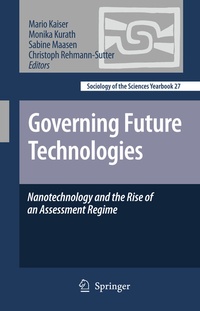
Nanotechnology has been the subject of extensive 'assessment hype,' unlike any previous field of research and development. A multiplicity of stakeholders have started to analyze the implications of nanotechnology: Technology assessment institutions around the world, non-governmental organizations, think tanks, re-insurance companies, and academics from science and technology studies and applied ethics have turned their attention to this growing field's implications. In the course of these assessment efforts, a social phenomenon has emerged - a phenomenon the editors define as assessment regime.
Despite the variety of organizations, methods, and actors involved in the evaluation and regulation of emerging nanotechnologies, the assessment activities comply with an overarching scientific and political imperative: Innovations are only welcome if they are assessed against the criteria of safety, sustainability, desirability, and acceptability. So far, such deliberations and reflections have played only a subordinate role. This book argues that with the rise of the nanotechnology assessment regime, however, things have changed dramatically: Situated at the crossroads of democratizing science and technology, good governance, and the quest for sustainable innovations, the assessment regime has become constitutive for technological development.
The contributions in this book explore and critically analyse nanotechnology's assessment regime: To what extent is it constitutive for technology in general, for nanotechnology in particular? What social conditions render the regime a phenomenon sui generis? And what are its implications for science and society?
Series
Language
Place of publication
Publishing group
Illustrations
File size
ISBN-13
978-90-481-2834-1 (9789048128341)
DOI
10.1007/978-90-481-2834-1
Schweitzer Classification
Going 'Nano': Opportunities and Risks.- Reinventing a Laboratory: Nanotechnology as a Resource for Organizational Change.- Negotiating Nano: From Assessing Risks to Disciplinary Transformations.- "Nanoscience is 100 Years Old." The Defensive Appropriation of the Nanotechnology Discourse within the Disciplinary Boundaries of Crystallography.- Making Sense: Visions, Images, and Video Games.- From Nano-Convergence to NBIC-Convergence: "The Best Way to Predict the Future is to Create it".- Deliberating Visions: The Case of Human Enhancement in the Discourse on Nanotechnology and Convergence.- Visual Dynamics: The Defuturization of the Popular "Nano-Discourse" as an Effect of Increasing Economization.- Digital Matters: Video Games and the Cultural Transcoding of Nanotechnology.- Assessing 'Nano': Repercussions on Research.- Emerging De Facto Agendas Surrounding Nanotechnology: Two Cases Full of Contingencies, Lock-outs, and Lock-ins.- The Risk Debate on Nanoparticles: Contribution to a Normalisation of the Science/Society Relationship?.- Futures Assessed: How Technology Assessment, Ethics and Think Tanks Make Sense of an Unknown Future.- Assessing Dialogue: Governing 'Nano' by ELSI.- Why Enrol Citizens in the Governance of Nanotechnology?.- Toward Anticipatory Governance: The Experience with Nanotechnology.- Which Ethics for (of) the Nanotechnologies?.- Deconstructing the Assessment Regime.- Lure of the "Yes": The Seductive Power of Technoscience.- The Time of Science: Deliberation and the "New Governance" of Nanotechnology.- Converging Technologies - Diverging Reflexivities? Intellectual Work in Knowledge-Risk-Media-Audit Societies.