

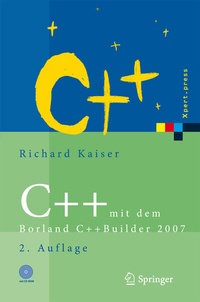
C++ mit dem Borland C++Builder 2007
Einführung in den C++-Standard und die objektorientierte Windows-Programmierung
2nd Edition
Published on 15. October 2007
XLVI, 1184 pages
978-3-540-69773-2 (ISBN)
Description

Dieses Buch verbindet eine systematische Einführung in die Programmiersprache C++ und die Windows-Programmierung mit dem C++Builder (früher von Borland, jetzt von CodeGear). Alle Sprachelemente und Konzepte von Standard-C++ (C-Grundlagen, objektorientierte Programmierung, Exception-Handling, Templates und die STL) werden ausführlich und praxisnah behandelt. Weitere Themen sind objektorientierte Analyse und Design, Templates und ihre Anwendungen am Beispiel der Klassen und Algorithmen der STL. Das Buch eignet sich gleichermaßen zum Selbststudium und als Lehrbuch für Fachhochschulen und Universitäten. Es wendet sich sowohl an Anfänger als auch an erfahrene C++-Programmierer und enthält zahlreiche Beispiele und Übungsaufgaben mit Lösungen.
More details
Other editions
Additional editions
Richard Kaiser
C++ mit dem Borland C++Builder 2007
Einführung in den C++-Standard und die objektorientierte Windows-Programmierung
Book
10/2007
2nd Edition
Springer
€64.99
Shipment within 7-9 days
Person
Content
Die Entwicklungsumgebung.- Komponenten für die Benutzeroberfläche.- Elementare Datentypen und Anweisungen.- Einige Klassen der Standardbibliothek.- Funktionen.- Objektorientierte Programmierung.- Exception-Handling.- Die Bibliothek der visuellen Komponenten (VCL).- Templates und die STL.- Verschiedenes.
