

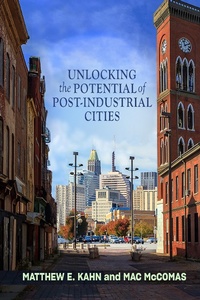
Unlocking the Potential of Post-Industrial Cities
Published on 20. April 2021
168 pages
978-1-4214-4083-5 (ISBN)
Description

How can urban leaders in Baltimore, Cleveland, Detroit, Philadelphia, Pittsburgh, and St. Louis make the smart choices that can lead their city to make a comeback?
The urban centers of New York City, Seattle, and San Francisco have enjoyed tremendous economic success and population growth in recent years. At the same time, cities like Baltimore and Detroit have experienced population loss and economic decline. People living in these cities are not enjoying the American Dream of upward mobility. How can post-industrial cities struggling with crime, pollution, poverty, and economic decline make a comeback?
In Unlocking the Potential of Post-Industrial Cities, Matthew E. Kahn and Mac McComas explore why some people and places thrive during a time of growing economic inequality and polarization-and some don't. They examine six underperforming cities-Baltimore, Cleveland, Detroit, Philadelphia, Pittsburgh, and St. Louis-that have struggled from 1970 to present. Drawing from the field of urban economics, Kahn and McComas ask how the public and private sectors can craft policies and make investments that create safe, green cities where young people reach their full potential. The authors analyze long-run economic and demographic trends. They also highlight recent lessons from urban economics in labor market demand and supply, neighborhood quality of life, and local governance while scrutinizing strategies to lift people out of poverty.
These cities are all at a fork in the road. Depending on choices made today, they could enjoy a significant comeback-but only if local leaders are open to experimentation and innovation while being honest about failure and constructive evaluation. Unlocking the Potential of Post-Industrial Cities provides a roadmap for how urban policy makers, community members, and practitioners in the public and private sector can work together with researchers to discover how all cities can solve the most pressing modern urban challenges.
The urban centers of New York City, Seattle, and San Francisco have enjoyed tremendous economic success and population growth in recent years. At the same time, cities like Baltimore and Detroit have experienced population loss and economic decline. People living in these cities are not enjoying the American Dream of upward mobility. How can post-industrial cities struggling with crime, pollution, poverty, and economic decline make a comeback?
In Unlocking the Potential of Post-Industrial Cities, Matthew E. Kahn and Mac McComas explore why some people and places thrive during a time of growing economic inequality and polarization-and some don't. They examine six underperforming cities-Baltimore, Cleveland, Detroit, Philadelphia, Pittsburgh, and St. Louis-that have struggled from 1970 to present. Drawing from the field of urban economics, Kahn and McComas ask how the public and private sectors can craft policies and make investments that create safe, green cities where young people reach their full potential. The authors analyze long-run economic and demographic trends. They also highlight recent lessons from urban economics in labor market demand and supply, neighborhood quality of life, and local governance while scrutinizing strategies to lift people out of poverty.
These cities are all at a fork in the road. Depending on choices made today, they could enjoy a significant comeback-but only if local leaders are open to experimentation and innovation while being honest about failure and constructive evaluation. Unlocking the Potential of Post-Industrial Cities provides a roadmap for how urban policy makers, community members, and practitioners in the public and private sector can work together with researchers to discover how all cities can solve the most pressing modern urban challenges.
More details
Language
English
Place of publication
Baltimore
United States
Target group
Professional and scholarly
Illustrations
22 Kurvendiagramme
22 Graphs
File size
6,67 MB
ISBN-13
978-1-4214-4083-5 (9781421440835)
DOI
10.1353/book.81052
Copyright in bibliographic data and cover images is held by Nielsen Book Services Limited or by the publishers or by their respective licensors: all rights reserved.
Schweitzer Classification
Other editions
Additional editions
Matthew E. Kahn | Mac McComas
Unlocking the Potential of Post-Industrial Cities
Book
04/2021
Johns Hopkins University Press
€31.70
Article not available at the moment
Persons
Matthew E. Kahn is a Bloomberg Distinguished Professor of Economics and Business at Johns Hopkins University, where he is the director of the 21st Century Cities Initiative. He is the author of Climatopolis: How Our Cities Will Thrive in the Hotter Future and the coauthor of Blue Skies Over Beijing: Economic Growth and the Environment in China. Mac McComas is the senior program manager for Johns Hopkins University's 21st Century Cities Initiative.
Content
Preface
Chapter One. Cities at a Crossroads
Chapter Two. Long-Run Trends in Poverty
Chapter Three. Urban Labor Market Demand
Chapter Four. The Labor Supply of Local Residents
Chapter Five. Urban Neighborhood Quality of Life
Chapter Six. Improving Urban Governance
Chapter Seven. Promising Trends
Chapter Eight. New Knowledge Fuels the Comeback
References
Index
Chapter One. Cities at a Crossroads
Chapter Two. Long-Run Trends in Poverty
Chapter Three. Urban Labor Market Demand
Chapter Four. The Labor Supply of Local Residents
Chapter Five. Urban Neighborhood Quality of Life
Chapter Six. Improving Urban Governance
Chapter Seven. Promising Trends
Chapter Eight. New Knowledge Fuels the Comeback
References
Index
