

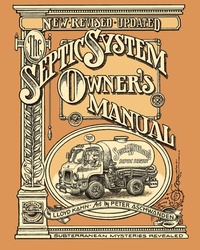
The Septic System Owner's Manual
Description

Learn all about household septic systems?including how to maintain and repair them?whether you're planning to build or already own a home.
More than 28 million households have septic systems, yet few homeowners know how they operate or how to maintain them. The Septic System Owner's Manual describes the conventional gravity-fed septic system, how it works, how it should be treated (what should and should not go down the drain), how it should be maintained, and what to do if things go wrong. Written by Lloyd Kahn, with illustrations by Peter Aschwanden, this is your straightforward, easy-to-understand guide to small-scale residential wastewater disposal.
The Septic System Owner's Manual is perfect for the average homeowner, based on conventional systems, providing practical advice on how to keep these systems up (or should we say down?) and running. You'll also appreciate information on the evolution in composting toilet systems, designs for simple graywater systems, and some typical alternatives to the standard, gravity-fed septic system. There's a chapter with advice to any community that's faced with town-wide septic upgrades and a chapter on the history of waterborne waste disposal.
Homeowners will especially find this book useful in terms of the following:
- Working systems: By understanding septic system principles, you will know how to maximize its useful life.
- Partially failing systems: You may be able to nurse along an ailing system or even bring it back to life.
- Failing systems: You are given a discovery process to search for the problem.
- Alternative systems: You will understand how they work and what purposes they serve.
Get this comprehensive book, and get to know the ins and outs of your septic system. It could save you countless repair bills and countless headaches!
More details
Other editions
Additional editions
Persons
Lloyd Kahn started building more than 50 years ago and has lived in a self-built home ever since. If he'd been able to buy a wonderful, old, good-feeling house, he might have never started building. But it was always cheaper to build than to buy, and by building himself, he could design what he wanted and use materials that he wanted to live with.
Lloyd set off to learn the art of building in 1960. He liked the whole process immensely. Ideally he'd have worked with a master carpenter long enough to learn the basics, but there was never time. He learned from friends and books and by blundering his way into a process that required a certain amount of competence. His perspective was that of a novice, a homeowner, rather than a pro. As he learned, he felt that he could tell others how to build?or at least get them started on the path to creating their own homes.
Through the years, he's personally gone from post and beam to geodesic domes to stud-frame construction. It's been a constant learning process, and this has led him into investigating many methods of construction. For five years in the late '60s to early '70s, he built geodesic domes. He got into book publishing by producing Domebook One in 1970 and Domebook 2 in 1971.
He gave up on domes (as homes) and published his company's namesake Shelter in 1973. Since then, Shelter Publications has produced books on a variety of subjects and returned to its roots with Home Work in 2004, The Barefoot Architect and Builders of the Pacific Coast in 2008, Tiny Homes in 2012, and more.
Building is Lloyd's favorite subject. Even in this day and age, building a house with one's own hands can save a ton of money and?if you follow it through?you can get what you want in a home.
Peter Aschwanden (1942?2005) was an artist and illustrator, based in New Mexico. He is perhaps best known as the illustrator (under the name Junipero Scopulorum) of the 1969 book How to Keep Your Volkswagen Alive: A Manual of Step-by-Step Procedures for the Compleat Idiot, written by John Muir. Aschwanden died of cancer in 2005, at the age of 63.
Content
What It's About
1. The Tank
2. The Drainfield
3. The Soil
4. Down the Drain
5. Septic System Maintenance
6. Red Alert!
7. Graywater Systems
8. Composting Toilet Systems
9. Advanced Systems
10. Excessive Engineering and Regulatory Overkill
11. A Tale of Two Sewers
12. Small Town Septic System Upgrades
13. A Brief History of Wastewater Disposal
Appendix
Index
