

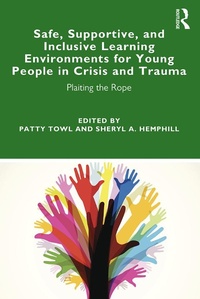
Safe, Supportive, and Inclusive Learning Environments for Young People in Crisis and Trauma
Plaiting the Rope
1st Edition
Published on 2. June 2020
244 pages
978-1-000-01614-7 (ISBN)
Description

Children and young people from diverse populations are statistically more at risk of exclusion, however education providers can make a difference to all children and young persons' learning outcomes no matter what their personal circumstances. To achieve this, not only must educators form closer and more authentic relationships with these children and their communities, but the governments that fund learning environments must also be prepared to provide adequate resourcing and training opportunities.
Safe, Supportive, and Inclusive Learning Environments for Young People in Crisis and Trauma addresses both the general and specific issues that may prevent children and young people from diverse populations from being safe, supported, and included in learning environments. Some chapters focus on general factors that contribute to both inclusion and exclusion at early childhood and in formal school environments, while others present research-based best practice and practical advice to enable good education outcomes for indigenous, migrant, and LGBTQI children and those who experience mental health problems, drug misuse, and abuse. Lastly, the book includes information about how to negotiate and set up programmes that have been shown to be effective with communities that differ from the dominant culture.
This book provides practitioners in education, health, and social work with information and practical advice on how to retain all children and young people in early childhood, formal school education, and tertiary settings.
Safe, Supportive, and Inclusive Learning Environments for Young People in Crisis and Trauma addresses both the general and specific issues that may prevent children and young people from diverse populations from being safe, supported, and included in learning environments. Some chapters focus on general factors that contribute to both inclusion and exclusion at early childhood and in formal school environments, while others present research-based best practice and practical advice to enable good education outcomes for indigenous, migrant, and LGBTQI children and those who experience mental health problems, drug misuse, and abuse. Lastly, the book includes information about how to negotiate and set up programmes that have been shown to be effective with communities that differ from the dominant culture.
This book provides practitioners in education, health, and social work with information and practical advice on how to retain all children and young people in early childhood, formal school education, and tertiary settings.
More details
Edition
1. Auflage
Language
English
Place of publication
London
United Kingdom
Publishing group
Taylor & Francis Ltd
Target group
College/higher education
Illustrations
2 Tables, black and white; 15 Line drawings, black and white; 2 Halftones, black and white; 17 Illustrations, black and white
ISBN-13
978-1-000-01614-7 (9781000016147)
Copyright in bibliographic data and cover images is held by Nielsen Book Services Limited or by the publishers or by their respective licensors: all rights reserved.
Schweitzer Classification
Other editions
Additional editions
Patty Towl | Sheryl A. Hemphill
Safe, Supportive, and Inclusive Learning Environments for Young People in Crisis and Trauma
Plaiting the Rope
Book
05/2020
1st Edition
Routledge
€60.30
Shipment within 15-20 days
Patty Towl | Sheryl A. Hemphill
Safe, Supportive, and Inclusive Learning Environments for Young People in Crisis and Trauma
Plaiting the Rope
Book
05/2020
1st Edition
Routledge
€179.51
Shipment within 15-20 days
Person
Patty Towl is a retired high school principal and special needs teacher who works with children and young people with behavioural and learning needs. She has expertise and experience in resolving the issues that contribute to school exclusion.
Sheryl A. Hemphill is a freelance writer, presenter, and researcher, with over 25 years of research experience on the factors that influence children and young people's development, including school factors. She has published internationally on the development of antisocial and related behaviours in young people, as well as the impact of school exclusion on students.
Sheryl A. Hemphill is a freelance writer, presenter, and researcher, with over 25 years of research experience on the factors that influence children and young people's development, including school factors. She has published internationally on the development of antisocial and related behaviours in young people, as well as the impact of school exclusion on students.
Content
Foreword: Australian Contexts The Honourable Alistair Bothwick Nicholson: AO RFD QC
Foreword: Aotearoa New Zealand Context Paula Tesoriero, Member of the New Zealand Order of Merit
Preface
List of Contributors
Part One: Diversity in Education Contexts
Chapter 1: Complex Trauma and the Teacher: Relationships and Learning Anne Southall
Chapter 2: Weaving Success for All Children: Relational and Inclusive Teaching Practices in Early Childhood Education Janis Carroll-Lind, Gwen Davitt and Teresa Pleace-Robertson
Chapter 3: Demographic and Socioeconomic Predictors of School Suspension: A Longitudinal Study in Victoria, Australia and Washington States, United States Sheryl A. Hemphill, Stephanie M. Plenty, Lyndal Bond, Todd I. Herrenkohl, John W. Toumbourou and Richard F. Catalano
Chapter 4: When Things at School are Out of Sync: The Bittersweet Paradox of Suspension and Student Belonging Sharon du Plessis-Schneider
Chapter 5: "I dropped out early": School Disengagement and Exclusion Among Young People Experiencing Homelessness Jessica A. Heerde, Maria Pallotta-Chiarolli and Arno Parolini
Chapter 6: LGBTI Inclusion in Australia and Aotearoa New Zealand Schools: Policies and Practices Tiffany Jones
Chapter 7: High School Students at Risk of Exclusion: Systemic Approaches to Reducing Risk Factors and Strengthening Protective Factors Adrian B. Kelly, Bosco Rowland, Rebecca A. Kuhn, Andrew W. Munnings and John W. Toumbourou
Chapter 8: Taura Whiri a Whanaungatanga Manaakitanga me Kotahitanga kia awhi te Tamaiti Rotu Mihaka together with Geraldine Koopu
Chapter 9: How We Speak Matters Donald McMenamin
Chapter 10: Educating Aimee: Walking the Road from Inclusion to Belonging Patty Towl
Part Two: Practical and Positive Outcomes for Diverse School Populations
Chapter 11: Pioneering Narratives in Maori Immersion Education Una Pania Matthews
Chapter 12 Engaging African-Australian Students and Families in Education Georgia Birch
Chapter 13: Working Together to Prepare Young New Zealanders for a World Where Alcohol and Other Drugs Exist Ben Birks Ang
Chapter 14: A Multi-Tiered Strategy to Treat Trauma and Build Social Emotional Skills Among Court-Involved, At-Risk, Female Students Beverly A. Baroni, Lori Vanderwill and Angelique Day
Chapter 15: Strengthening Pathways into Higher Education with Remote Indigenous Communities in Australia: Lessons from the Whole of Community Engagement Initiative James A. Smith, Terry Moore, Kim Robertson, Cat Street, Allison Stewart, Donna Stephens, Aurelie Girard, Dean Yibarbuk and Benjamin Christie
Chapter 16: Looking Upstream to Improve the Wellbeing of Youth who are Alienated from Mainstream Education in Aotearoa New Zealand Pat Bullen, Kelsey L. Deane, Kiri Wilder and Sabrina Zoutenbier
Conclusions Patty Towl and Sheryl A. Hemphill
Foreword: Aotearoa New Zealand Context Paula Tesoriero, Member of the New Zealand Order of Merit
Preface
List of Contributors
Part One: Diversity in Education Contexts
Chapter 1: Complex Trauma and the Teacher: Relationships and Learning Anne Southall
Chapter 2: Weaving Success for All Children: Relational and Inclusive Teaching Practices in Early Childhood Education Janis Carroll-Lind, Gwen Davitt and Teresa Pleace-Robertson
Chapter 3: Demographic and Socioeconomic Predictors of School Suspension: A Longitudinal Study in Victoria, Australia and Washington States, United States Sheryl A. Hemphill, Stephanie M. Plenty, Lyndal Bond, Todd I. Herrenkohl, John W. Toumbourou and Richard F. Catalano
Chapter 4: When Things at School are Out of Sync: The Bittersweet Paradox of Suspension and Student Belonging Sharon du Plessis-Schneider
Chapter 5: "I dropped out early": School Disengagement and Exclusion Among Young People Experiencing Homelessness Jessica A. Heerde, Maria Pallotta-Chiarolli and Arno Parolini
Chapter 6: LGBTI Inclusion in Australia and Aotearoa New Zealand Schools: Policies and Practices Tiffany Jones
Chapter 7: High School Students at Risk of Exclusion: Systemic Approaches to Reducing Risk Factors and Strengthening Protective Factors Adrian B. Kelly, Bosco Rowland, Rebecca A. Kuhn, Andrew W. Munnings and John W. Toumbourou
Chapter 8: Taura Whiri a Whanaungatanga Manaakitanga me Kotahitanga kia awhi te Tamaiti Rotu Mihaka together with Geraldine Koopu
Chapter 9: How We Speak Matters Donald McMenamin
Chapter 10: Educating Aimee: Walking the Road from Inclusion to Belonging Patty Towl
Part Two: Practical and Positive Outcomes for Diverse School Populations
Chapter 11: Pioneering Narratives in Maori Immersion Education Una Pania Matthews
Chapter 12 Engaging African-Australian Students and Families in Education Georgia Birch
Chapter 13: Working Together to Prepare Young New Zealanders for a World Where Alcohol and Other Drugs Exist Ben Birks Ang
Chapter 14: A Multi-Tiered Strategy to Treat Trauma and Build Social Emotional Skills Among Court-Involved, At-Risk, Female Students Beverly A. Baroni, Lori Vanderwill and Angelique Day
Chapter 15: Strengthening Pathways into Higher Education with Remote Indigenous Communities in Australia: Lessons from the Whole of Community Engagement Initiative James A. Smith, Terry Moore, Kim Robertson, Cat Street, Allison Stewart, Donna Stephens, Aurelie Girard, Dean Yibarbuk and Benjamin Christie
Chapter 16: Looking Upstream to Improve the Wellbeing of Youth who are Alienated from Mainstream Education in Aotearoa New Zealand Pat Bullen, Kelsey L. Deane, Kiri Wilder and Sabrina Zoutenbier
Conclusions Patty Towl and Sheryl A. Hemphill
