

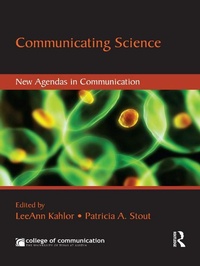
Communicating Science
New Agendas in Communication
1st Edition
Published on 13. November 2009
288 pages
978-1-135-26980-7 (ISBN)
Description

This volume explores the evolution of science communication, addressing key issues and offering substance for future study. Harnessing the energies of junior scholars on the forefront of science communication, this work pushes the boundaries of research forward, allowing scholars to sample the multiple paradigms and agendas that will play a role in shaping the future of science communication. Editors LeeAnn Kahlor and Patricia Stout challenge their readers to channel the energy within these chapters to build or continue to build their own research agendas as all scholars work together - across disciplines - to address questions of public understanding of science and communicating science.
These chapters are intended to inspire still more research questions, to help aspiring science communication scholars locate their own creative and original research programs, and to help veteran science communication scholars expand their existing programs such that they can more actively build interdisciplinary bridges. Crossing methodological boundaries, work from quantitative and qualitative scholars, social scientists and rhetoricians is represented here.
This volume is developed for practitioners and scholars alike - for anyone who is concerned about or interested in the future of science and how communication is shaping and will continue to shape that future. In its progressive pursuit of interdisciplinary research streams - of thinking outside methodological and theoretical boxes - this book inspires science communication scholars at all levels to set a new standard for collaboration not just for science communication, but for communication research in general.
These chapters are intended to inspire still more research questions, to help aspiring science communication scholars locate their own creative and original research programs, and to help veteran science communication scholars expand their existing programs such that they can more actively build interdisciplinary bridges. Crossing methodological boundaries, work from quantitative and qualitative scholars, social scientists and rhetoricians is represented here.
This volume is developed for practitioners and scholars alike - for anyone who is concerned about or interested in the future of science and how communication is shaping and will continue to shape that future. In its progressive pursuit of interdisciplinary research streams - of thinking outside methodological and theoretical boxes - this book inspires science communication scholars at all levels to set a new standard for collaboration not just for science communication, but for communication research in general.
More details
Series
Edition
1. Auflage
Language
English
Place of publication
London
United Kingdom
Publishing group
Taylor & Francis Ltd
Target group
College/higher education
Illustrations
7 s/w Tabellen
7 Tables, black and white
File size
3,69 MB
ISBN-13
978-1-135-26980-7 (9781135269807)
Copyright in bibliographic data and cover images is held by Nielsen Book Services Limited or by the publishers or by their respective licensors: all rights reserved.
Schweitzer Classification
Other editions
Additional editions
Book
09/2009
1st Edition
Routledge
€208.00
Shipment within 15-20 days
Book
09/2009
1st Edition
Routledge
€63.50
Shipment within 15-20 days
Persons
LeeAnn Kahlor (Ph.D., University of Wisconsin-Madison) is an assistant professor in the Department of Advertising and Public Relations at the University of Texas at Austin where she teaches courses in public relations and science and health communication. She is affiliated with UT's Center for Women's and Gender Studies and the university's Environmental Sciences Institute. Her work has appeared in Science Communication, Public Understanding of Science, Health Communication, Risk Analysis, Communication Research, Human Communication Research, Media Psychology and the Journal of Broadcast and Electronic Media.
Patricia A. Stout (Ph.D., University of Illinois Urbana-Champaign) is Professor and John P. McGovern Regents Professor in Health and Medical Science Communication in the Department of Advertising at the University of Texas at Austin. She teaches courses in persuasive communication and health communication. Stout is former co-director of the Center for Health Promotion Research (CHPR) in the School of Nursing at UT Austin.
Patricia A. Stout (Ph.D., University of Illinois Urbana-Champaign) is Professor and John P. McGovern Regents Professor in Health and Medical Science Communication in the Department of Advertising at the University of Texas at Austin. She teaches courses in persuasive communication and health communication. Stout is former co-director of the Center for Health Promotion Research (CHPR) in the School of Nursing at UT Austin.
Content
Preface: S. Dunwoody
Introduction: L. Kahlor & P. Stout.
Part I - Merging Theory and Practice: Models and Frameworks
1. A Critical Appraisal of Models of Public Understanding of Science: Using Practice to Inform Theory D. Brossard & B. Lewenstein
2. Integrating Temporally Oriented Social Science Models with Community-Based Social Marketing to Influence Environmental Behaviors
B. Shaw
3. Framing Science: A New Paradigm in Public Engagement
M. Nisbet
Part II: Characterization and Meaning-Making in Science
4. Moral Development Framing in Environmental Justice News Coverage
K. A. Swain
5. Expanding Our Notions of Scientific Argument: A Case Study of Native Americans in Public Hearings
D. Endres
6. Competing Characters in Science-Based Controversy: The Case of Dr. Bernard Fisher
L. Keraenen
7. Exemplary Objects: Articulation and the organization of scientific materiality, sociality and rhetoric
J. Lynch
Part III - Affect: Trust and Hostility
8. Understanding Public Response to Technology Advocacy Campaigns: A Persuasion Knowledge Approach
J. Sinclair & B. Miller
9. Focusing on Fairness in Science and Risk Communication
J. Besley and K. McComas
10. Hostile Media Perception in Science Communication
K.S. Kim and D.R. Roskos-Ewoldson
Part IV: Into the Future
11. Bridging the Paradigm Gap: An Interdisciplinary Approach Science Communication Class
A. Pearce, A. Romero and J. B. Zibluk
12. Closing Chapter...
P. Stout & L. Kahlor
Introduction: L. Kahlor & P. Stout.
Part I - Merging Theory and Practice: Models and Frameworks
1. A Critical Appraisal of Models of Public Understanding of Science: Using Practice to Inform Theory D. Brossard & B. Lewenstein
2. Integrating Temporally Oriented Social Science Models with Community-Based Social Marketing to Influence Environmental Behaviors
B. Shaw
3. Framing Science: A New Paradigm in Public Engagement
M. Nisbet
Part II: Characterization and Meaning-Making in Science
4. Moral Development Framing in Environmental Justice News Coverage
K. A. Swain
5. Expanding Our Notions of Scientific Argument: A Case Study of Native Americans in Public Hearings
D. Endres
6. Competing Characters in Science-Based Controversy: The Case of Dr. Bernard Fisher
L. Keraenen
7. Exemplary Objects: Articulation and the organization of scientific materiality, sociality and rhetoric
J. Lynch
Part III - Affect: Trust and Hostility
8. Understanding Public Response to Technology Advocacy Campaigns: A Persuasion Knowledge Approach
J. Sinclair & B. Miller
9. Focusing on Fairness in Science and Risk Communication
J. Besley and K. McComas
10. Hostile Media Perception in Science Communication
K.S. Kim and D.R. Roskos-Ewoldson
Part IV: Into the Future
11. Bridging the Paradigm Gap: An Interdisciplinary Approach Science Communication Class
A. Pearce, A. Romero and J. B. Zibluk
12. Closing Chapter...
P. Stout & L. Kahlor
