

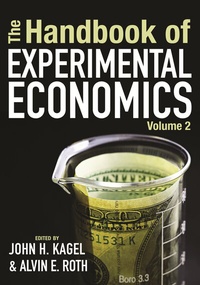
The Handbook of Experimental Economics, Volume 2
The Handbook of Experimental Economics
1st Edition
Published on 24. October 2016
776 pages
978-1-4008-8317-2 (ISBN)
Description

No detailed description available for "The Handbook of Experimental Economics, Volume 2".
All prices
More details
Other editions
Additional editions
John H. Kagel | Alvin E. Roth
The Handbook of Experimental Economics, Volume 2
Book
05/2020
Princeton University Press
€69.00
Shipment within 10-20 days
John H. Kagel | Alvin E. Roth
The Handbook of Experimental Economics, Volume 2
Book
10/2016
Princeton University Press
€94.50
Available immediately
Persons
John H. Kagel is University Chaired Professor of Applied Economics and director of the Economics Laboratory at Ohio State University. Alvin E. Roth, co-winner of the 2012 Nobel Prize in economics, is the Craig and Susan McCaw Professor of Economics at Stanford University and the George Gund Professor of Economics and Business Administration Emeritus at Harvard University. They are the editors of The Handbook of Experimental Economics (Princeton).
Content
- Cover
- Title
- Copyright
- CONTENTS
- Preface
- Chapter 1 Macroeconomics: A Survey of Laboratory Research
- 1. Introduction: Laboratory Macroeconomics
- 2. Dynamic, Intertemporal Optimization
- 2.1. Optimal Consumption/Savings Decisions
- 2.2. Exponential Discounting and Infinite Horizons
- 2.3. Exponential or Hyperbolic Discounting?
- 2.4. Expectation Formation
- 3. Coordination Problems
- 3.1. Poverty Traps
- 3.2. Bank Runs
- 3.3. Resolving Coordination Problems: Sunspots
- 3.4. Resolving Coordination Problems: The Global Game Approach
- 4. Fields in Macroeconomics
- 4.1. Monetary Economics
- 4.2. Labor Economics
- 4.3. International Economics
- 4.4. Multisectoral Macroeconomics
- 5. Macroeconomic Policies
- 5.1. Ricardian Equivalence
- 5.2. Commitment versus Discretion
- 5.3. Monetary Policy
- 5.4. Fiscal and Tax Policies
- 6. Conclusions
- Acknowledgments
- Notes
- References
- Chapter 2 Using Experimental Methods to Understand Why and How We Give to Charity
- 1. Introduction
- 2. Preferences for Giving
- 2.1. Is Giving Rational?
- 2.2. Motives
- 3. Fundraising
- 3.1. Announcements: Sequential and Dynamic Giving
- 3.2. Lotteries
- 3.3. Auctions
- 3.4. Rebates and Matches
- 4. Conclusion
- Notes
- References
- Chapter 3 Neuroeconomics
- INTRODUCTION
- 1. Neurobiological Foundations
- 1.1. The Cellular Structure of the Brain
- 1.2. From Neurons to Networks
- 1.3. Summary of Neurobiology
- 2. Functional MRI: A Window into the Working Brain
- 2.1. Functional MRI and the BOLD Signal
- 2.2. Design Considerations
- 2.3. Image Analysis
- 2.4. Summary of Functional MRI
- 3. Risky Choice
- 3.1. Statistical Moments
- 3.2. Prospect Theory
- 3.3. Causal Manipulations
- 3.4. Logical Rationality and Biological Adaptation
- 3.5. Summary of Risky Choice
- 4. Intertemporal Choice and Self-regulation
- 4.1. Empirical Regularities
- 4.2. Multiple-Self Models with Selves That Have Overlapping Periods of Control
- 4.3. Multiple-Self Models with Selves That Have Nonoverlapping Periods of Control
- 4.4. Unitary-Self Models
- 4.5. Theoretical Summary
- 5. The Neural Circuitry of Social Preferences
- 5.1. Social Preferences and Reward Circuitry
- 5.2. Do Activations in Reward Circuitry Predict Choices?
- 5.3. The Role of the Prefrontal Cortex in Decisions Involving Social Preferences
- 5.4. Summary
- 6. Strategic Thinking
- 6.1. Strategic Awareness
- 6.2. Beliefs, Iterated Beliefs, and Strategic Choice
- 6.3. Learning
- 6.4. Strategic Teaching and Influence Value
- 6.5. Discussion of Strategic Neuroscience
- 6.6. Summary
- 7. Conclusion
- Acknowledgments
- Notes
- References
- Chapter 4 Other-Regarding Preferences: A Selective Survey of Experimental Results
- INTRODUCTION
- I. Where Things Stood Circa 1995
- II. Models of Other-Regarding Preferences, Theory, and Tests
- A. Outcome-Based Social Preference Models
- B. Some Initial Tests of the Bolton-Ockenfels and Fehr-Schmidt Models
- C. Social Preferences versus Difference Aversion
- D. Models Incorporating Reciprocity/Intentions of Proposers
- E. Other-Regarding Behavior and Utility Maximization
- F. Learning
- III. Other-Regarding Behavior, Applications, and Regularities
- A. The Investment/Trust Game
- B. Results from Multilateral Bargaining Experiments
- C. A Second Look at Dictator Games
- D. Procedural Fairness
- E. Diffusion of Responsibility
- F. Group Identity and Social Preferences
- G. Generalizability
- IV. Gift Exchange Experiments
- A. An Initial Series of Experiments
- B. Incomplete Contracts
- C. Wage Rigidity
- D. The Effect of Cognitive Ability and the Big Five Personality Characteristics in Other-Regarding Behavior
- E. Why Does Gift Exchange Occur?
- F. Laboratory versus Field Settings and Real Effort
- G. Summary
- V. Conclusions
- Acknowledgments
- Notes
- References
- Chapter 5 Experiments in Market Design
- 1. Introduction
- 2. Some Early Design Experiments: Allocation of Airport Slots
- 3. FCC Spectrum Auctions
- 4. Other Auctions
- 4.1. eBay Auctions
- 4.2. A Poorly Designed Auction (for Medicare Supplies)
- 5. Labor Market Clearinghouses
- 5.1. Designing Labor Markets for Doctors
- 5.2. Matching without a Clearinghouse: The Market for Economists, and Online Dating
- 6. Course Allocation
- 7. Conclusions
- Notes
- References
- Chapter 6 Experiments in Political Economy
- 1. Introduction and Overview
- 1.1. Methodology: Relationship to Experimental Economics
- 1.2. Chapter Road Map
- 2. Experiments in Committee Bargaining
- 2.1. Unstructured Committee Bargaining
- 2.2. Committee Bargaining with a Fixed Extensive Form Structure
- 3. Elections and Candidate Competition
- 3.1. The Spatial Model of Competitive Elections and the Median Voter Theorem
- 3.2. Multicandidate Elections
- 3.3. Candidate Competition with Valence
- 4. Voter Turnout
- 4.1. Instrumental Voting Experiments
- 4.2. The Effects of Beliefs, Communication, and Information on Turnout
- 4.3. Expressive Voting Experiments
- 5. Information Aggregation in Committees
- 5.1. Condorcet Jury Experiments
- 5.2. The Swing Voter's Curse
- 6. Voting Mechanisms that Reflect Preference Intensity
- 6.1. Mechanisms Where a Budget of Votes Can Be Allocated Across Issues
- 6.2. Vote Trading and Vote Markets
- 7. Where Do We Go From Here?
- Acknowledgments
- Notes
- References
- Chapter 7 Experimental Economics across Subject Populations
- I. Introduction
- II. Infrahumans
- II.A. Methodological Notes
- III. Children
- III.A. Methodological Notes
- IV. Token Economies
- IV.A. Methodological Notes
- V. Elderly
- V.A. Methodological Notes
- VI. Highly Demographically Varied (Representative) Sample
- VI.A. Methodological Notes
- VII. Subjects with Relevant Task Experience
- VII.A. Methodological Notes
- VIII. Discussion
- VIII.A. Individual Choice
- VIII.B. Games
- IX. Conclusion
- Acknowledgments
- Notes
- References
- Chapter 8 Gender
- I. Introduction
- II. Gender Differences in Competitiveness
- II.A. Do Women Shy Away from Competition?
- II.B. Replication and Robustness of Women Shying Away from Competition
- II.C. Reducing the Gender Gap in Tournament Entry
- II.D. Performance in Tournaments
- II.E. Field Experiments on Gender Differences in Competitiveness
- II.F. External Relevance of Competitiveness
- III. Gender Differences in Selecting Challenging Tasks and Speaking Up
- III.A. Gender Differences in Task Choice
- III.B. Gender Differences in Speaking up
- IV. Altruism and Cooperation
- IV.A. Dictator-Style Games
- IV.B. Field Evidence and External Relevance of Gender Differences in Giving
- IV.C. Prisoner's Dilemma and Public Good Games
- IV.D. New Directions
- IV.E. Conclusions
- V. Risk
- V.A. Early Work and Surveys by Psychologists
- V.B. Early and Most Commonly Used Elicitation Methods in Economics
- V.C. Early Economic Surveys
- V.D. Recent Economic Surveys and Meta-Analyses on Specific Elicitation Tasks
- V.E. Stability of Risk Preferences and Their External Relevance
- V.F. An Example of a Careful Control for Risk Aversion
- V.G. Conclusions
- VI. Conclusions
- Acknowledgments
- Notes
- References
- Chapter 9 Auctions: A Survey of Experimental Research
- INTRODUCTION
- I. Single-Unit Private Value Auctions
- 1.1. Bidding above the RNNE in First-Price Private Value Auctions
- 1.2. Bidding above the RNNE and Regret Theory
- 1.3. Using Experimental Data to Corroborate Maintained Hypotheses in Empirical Applications to Field Data
- 1.4. Second-Price Private Value Auctions
- 1.5. Asymmetric Private Value Auctions
- 1.6. Sequential Auctions
- 1.7. Procurement Auctions
- 1.8. Cash-Balance Effects and the Role of Outside Earnings On Bids
- 1.9. An Unresolved Methodological Issue
- II. Single-Unit Common Value Auctions
- 2.1. English Auctions
- 2.2. Auctions with Insider Information
- 2.3. Common Value Auctions with an Advantaged Bidder
- 2.4. New Results in the Takeover Game: Theory and Experiments
- 2.5. Additional Common Value Auction Results
- 2.6. Is the Winner's Curse Confined to College Sophomores?
- III. Multiunit-Demand Auctions
- 3.1. Auctions with Homogeneous Goods-Uniform Price and Vickrey Auctions
- 3.2. More on Multiunit-Demand Vickrey Auctions
- 3.3. Auctions with Synergies
- 3.4. Sequential Auctions with Multiunit-Demand Bidders
- IV. Additional Topics
- 4.1. Collusion in Auctions
- 4.2. Bidder's Choice Auctions: Creating Competition Out of Thin Air
- 4.3. Internet Auctions
- 4.4. Entry into Auctions
- V. Summary and Conclusions
- Acknowledgments
- Notes
- References
- Chapter 10 Learning and the Economics of Small Decisions
- INTRODUCTION
- 1. The Basic Properties of Decisions from Experience
- 1.1. Six Basic Regularities and a Model
- 1.2. The Effect of Limited Feedback
- 1.3. Two Choice-Prediction Competitions
- 2. Dynamic Environments
- 2.1. The Partial Reinforcement Extinction Effect and Reinforcement Schedules
- 2.2. Spontaneous Alternation, the Gambler Fallacy, and Response to Patterns
- 2.3. Negative and Positive Transfer
- 2.4. The Effect of Delay and Melioration
- 2.5. Models of Learning in Dynamic Settings
- 3. Multiple Alternatives and Additional Stimuli
- 3.1. Successive Approximations, Hill Climbing, and the Neighborhood Effect
- 3.2. Learned Helplessness
- 3.3. Multiple Alternatives with Complete Feedback
- 3.4. The Effect of Additional Stimuli (Beyond Clicking)
- 4. Social Interactions and Learning in Games
- 4.1. Social Interactions Given Limited Prior Information
- 4.2. Learning in Constant-Sum Games with Unique Mixed-Strategy Equilibrium
- 4.3. Cooperation, Coordination, and Reciprocation
- 4.4. Fairness and Inequity Aversion
- 4.5. Summary and Alternative Approaches
- 5. Applications and the Economics of Small Decisions
- 5.1. The Negative Effect of Punishments
- 5.2. The Enforcement of Safety Rules
- 5.3. Cheating in Exams
- 5.4. Broken Windows Theory, Quality of Life, and Safety Climate
- 5.5. Hand Washing
- 5.6. The Effect of the Timing of Warning Signs
- 5.7. Safety Devices and the Buying-Using Gap
- 5.8. The Effect of Rare Terrorist Attacks
- 5.9. Emphasis-Change Training, Flight School, and Basketball
- 5.10. The Pat-on-the-Back Paradox
- 5.11. Gambling and the Medium-Prize Paradox
- 5.12. The Evolution of Social Groups
- 5.13. Product Updating
- 5.14. Unemployment
- 5.15. Interpersonal Conflicts and the Description-Experience Gap
- 5.16. Implications for Financial Decisions
- 5.17. Summary and the Innovations-Discoveries Gap
- 6. Conclusion
- Acknowledgments
- Notes
- References
- Editors and Contributors
- Illustration Credits
- Name Index
- Subject Index
