

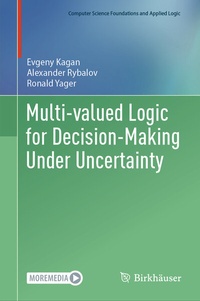
Multi-valued Logic for Decision-Making Under Uncertainty
Description

Multi-valued and fuzzy logics provide mathematical and computational tools for handling imperfect information and decision-making with rational collective reasoning and irrational individual judgements.
The suggested implementation of multi-valued logics is based on the uninorm and absorbing norm with generating functions defined by probability distributions. Natural extensions of these logics result in non-commutative and non-distributive logics. In addition to Boolean truth values, these logics handle subjective truth and false values and model irrational decisions. Dynamics of decision-making are specified by the subjective Markov process and learning - by neural network with extended Tsetlin neurons. Application of the suggested methods is illustrated by modelling of irrational economic decisions and biased reasoning in the wisdom-of-the-crowd method, and by control of mobile robots and navigation of their groups.
Topics and features:
- Bridges the gap between fuzzy and probability methods
- Includes examples in the field of machine-learning and robots' control
- Defines formal models of subjective judgements and decision-making
- Presents practical techniques for solving non-probabilistic decision-making problems
- Initiates further research in non-commutative and non-distributive logics
The book forms a basis for theoretical studies and practice of decision-making under uncertainty and will be useful for computer scientists and mathematicians interested in multi-valued and fuzzy logic, as well as for engineers working in the field of data mining and data analysis.
More details
Other editions
Additional editions
Persons
Dr. Evgeny Kagan is with the Faculty of Engineering, Ariel University, Israel.
Dr. Alexander Rybalov is with the LAMBDA Laboratory, Tel-Aviv University, Israel.
Prof. Ronald Yager is with the Machine Learning Institute, Yona College, New York, USA.
Content
1. Introduction.- 2. Background.- 3. Probability-generated multi-valued logic.- 4. Muli-valued logic algebra of subjective trusts.- 5. Algebra with non-commutative norms.- 6. Implementation of subjective trusts in control.
