

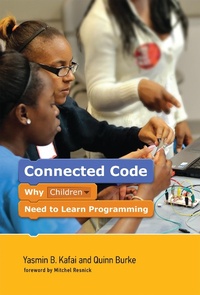
Connected Code
Description

Coding, once considered an arcane craft practiced by solitary techies, is now recognized by educators and theorists as a crucial skill, even a new literacy, for all children. Programming is often promoted in K-12 schools as a way to encourage "computational thinking”—which has now become the umbrella term for understanding what computer science has to contribute to reasoning and communicating in an ever-increasingly digital world.
In Connected Code, Yasmin Kafai and Quinn Burke argue that although computational thinking represents an excellent starting point, the broader conception of "computational participation” better captures the twenty-first-century reality. Computational participation moves beyond the individual to focus on wider social networks and a DIY culture of digital "making.”
Kafai and Burke describe contemporary examples of computational participation: students who code not for the sake of coding but to create games, stories, and animations to share; the emergence of youth programming communities; the practices and ethical challenges of remixing (rather than starting from scratch); and the move beyond stationary screens to programmable toys, tools, and textiles.
More details
Other editions
Additional editions
Persons
Quinn Burke is a Senior Research Scientist in the Learning Sciences at Digital Promise. Quinn's research examines the effectiveness of different coding activities for introducing computer science and computational thinking to students. Quinn's research has been supported by a number of state and federal grants. Previously, Quinn taught at the college and high school levels.
Mitchel Resnick, an expert in educational technologies, is Professor of Learning Research at the MIT Media Lab.His research group develops the Scratch programming software and online community, the world's largest coding platform for kids. He has worked closely with the LEGO company on educational ideas and products, such as the LEGO Mindstorms robotics kits, and he cofounded the Computer Clubhouse project, an international network of after-school learning centers for youth from low-income communities.
