
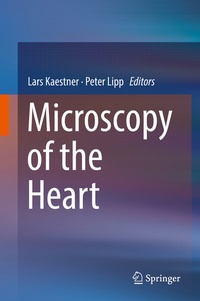
Microscopy of the Heart
Description
Alles über E-Books | Antworten auf Fragen rund um E-Books, Kopierschutz und Dateiformate finden Sie in unserem Info- & Hilfebereich.
This book provides in depths information on different microscopy approaches and supplies the reader with methods how to untangle highly complex processes involved in physiological and pathophysiological cardiac signaling. Microscopy approaches have established themselves as the quasi gold standard that enables us to appreciate the underlying mechanisms of physiological and pathophysiological cardiac signaling. This book presents the most important microscopy techniques from the level of individual molecule e.g. Förster-Resonance Energy Transfer (FRET), up to cellular and tissue imaging, e.g. electron microscopy (TEM) or light sheet microscopy. The book is intended for graduate students and postdocs in cardiovascular research, imaging and cell biology, pre-clinical and clinical researchers in cardiovascular sciences as well as decision makers of the pharmaceutical industry.
More details
Other editions
Additional editions
Persons
Peter Lipp is Professor and Head of the Institute for Molecular Cell Biology, Saarland University, in Homburg, Germany. The main focus of his institute lies on studying basic cellular mechanisms of the heart in its clinical context, with the aim to develop new therapies and treatment strategies.

Content
System requirements
File format: PDF
Copy protection: Watermark-DRM (Digital Rights Management)
System requirements:
- Computer (Windows; MacOS X; Linux): Use the free software Adobe Reader, Adobe Digital Editions, or any other PDF viewer of your choice (see eBook Help).
- Tablet/Smartphone (Android; iOS): Install the free app Adobe Digital Editions or another reading app for eBooks, e.g., PocketBook (see eBook Help).
- E-reader: Bookeen, Kobo, Pocketbook, Sony, Tolino and many more (only limited: Kindle).
The file format PDF always displays a book page identically on any hardware. This makes PDF suitable for complex layouts such as those used in textbooks and reference books (images, tables, columns, footnotes). Unfortunately, on the small screens of e-readers or smartphones, PDFs are rather annoying, requiring too much scrolling.
This eBook uses Watermark-DRM, a „soft” copy protection. This means that there are no technical restrictions to prevent illegal distribution. However, there is a personalised watermark embedded in the eBook that can be used to identify the purchaser of the eBook in the event of misuse and to provide evidence for legal purposes.
For more information, see our eBook Help page.