

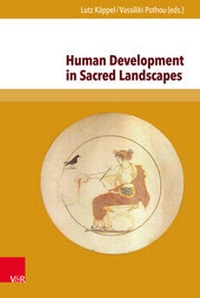
Human Development in Sacred Landscapes
Between Ritual Tradition, Creativity and Emotionality
1st Edition
Published on 17. June 2015
252 pages
978-3-8470-0252-9 (ISBN)
Description

The conference was focused on the identification and interpretation of sacred areas principally - but not exclusively - in the ancient Greek world and in the study of Greek religious ideas or religious practice. For example: what did ancient Greece, from the Mesolithic onwards, look like, if it is possible to identify sacred areas on a landscape scale, like ancient Delos or modern Mount Athos, and if the sacred landscapes were differing from the countryside. Another paper offered a new understanding of the role of astronomical observations in the Delphic and Spartan landscapes, the performance of the religious sites in the Spartan sanctuary of Artemis Orthia and the operation of the Delphic oracle. Most of the contributions were directly connected with the cult of Apollo and the history and tradition of the famous sanctuary of Delphi. A different paper examined the treatment of Apollo's journey from Delos to Delphi described in the Homeric Hymn to Apollo. According to a further contributor the network formed by connections between sanctuaries was looser than political federation, but helps to explain why panhellenic sanctuaries were so central to the articulation of Greek identity.
The conference was focused on the identification and interpretation of sacred areas principally - but not exclusively - in the ancient Greek world and in the study of Greek religious ideas or religious practice. For example: what did ancient Greece, from the Mesolithic onwards, look like, if it is possible to identify sacred areas on a landscape scale, like ancient Delos or modern Mount Athos, and if the sacred landscapes were differing from the countryside. Another paper offered a new understanding of the role of astronomical observations in the Delphic and Spartan landscapes, the performance of the religious sites in the Spartan sanctuary of Artemis Orthia and the operation of the Delphic oracle. Most of the contributions were directly connected with the cult of Apollo and the history and tradition of the famous sanctuary of Delphi. A different paper examined the treatment of Apollo's journey from Delos to Delphi described in the Homeric Hymn to Apollo. According to a further contributor the network formed by connections between sanctuaries was looser than political federation, but helps to explain why panhellenic sanctuaries were so central to the articulation of Greek identity.
"Holy Landscape" is a term frequently used to describe a multidimensional phenomenon. What this actually comprises is hard to define. Precisely this question is addressed in this volume. The "holy landscape" depends on people's Weltanschauung and is influenced by their respective culture and ethos. It is not just a question of religious buildings and rituals, nor is a mere matter of explicating terms such as "pure" and "impure", magic and myths; it is about an expressive space in which the "ceremony and mood of rites and cults" take place.The contributions also deal with the emergence and continuing development of the term "holy landscape" and the changing expressions of religious mood.
The conference was focused on the identification and interpretation of sacred areas principally - but not exclusively - in the ancient Greek world and in the study of Greek religious ideas or religious practice. For example: what did ancient Greece, from the Mesolithic onwards, look like, if it is possible to identify sacred areas on a landscape scale, like ancient Delos or modern Mount Athos, and if the sacred landscapes were differing from the countryside. Another paper offered a new understanding of the role of astronomical observations in the Delphic and Spartan landscapes, the performance of the religious sites in the Spartan sanctuary of Artemis Orthia and the operation of the Delphic oracle. Most of the contributions were directly connected with the cult of Apollo and the history and tradition of the famous sanctuary of Delphi. A different paper examined the treatment of Apollo's journey from Delos to Delphi described in the Homeric Hymn to Apollo. According to a further contributor the network formed by connections between sanctuaries was looser than political federation, but helps to explain why panhellenic sanctuaries were so central to the articulation of Greek identity.
"Holy Landscape" is a term frequently used to describe a multidimensional phenomenon. What this actually comprises is hard to define. Precisely this question is addressed in this volume. The "holy landscape" depends on people's Weltanschauung and is influenced by their respective culture and ethos. It is not just a question of religious buildings and rituals, nor is a mere matter of explicating terms such as "pure" and "impure", magic and myths; it is about an expressive space in which the "ceremony and mood of rites and cults" take place.The contributions also deal with the emergence and continuing development of the term "holy landscape" and the changing expressions of religious mood.
More details
Other editions
Additional editions
Lutz Käppel | Vassiliki Pothou
Human Development in Sacred Landscapes
Between Ritual Tradition, Creativity and Emotionality
Book
06/2015
1st Edition
Brill Deutschland
€55.00
Shipment within 7-9 days
Persons
Editor
L. Käppel is Professor of Greek Literature at the University of Kiel. Since 2011 he is speaker of the University's research focus "Societal, Environmental, Cultural Change".
Vassiliki Pothou is Lecturer of Classics and she has worked and teached at the Universities of Regensburg and Kiel.
Contributions
Dr. Vassiliki Pothou studierte Klassische Philologie in Athen und Paris (Sorbonne bzw. École normale supérieure/Centre d'études anciennes). Ihre Arbeitssschwerpunkte sind Thukydides und Flavius Josephus. Nach einem mehrjährigen Forschungsaufenthalt als Humboldt-Stipendiatin an der Universität Regensburg ist sie derzeit an der Universität Kiel tätig. Dr. Vassiliki Pothou studied Classics in Athens and Paris (École normale supérieure/Centre d'études anciennes). Her research focus is on Thucydides and Flavius Josephus.
L. Käppel is Professor of Greek Literature at the University of Kiel. Since 2011 he is speaker of the University's research focus "Societal, Environmental, Cultural Change".
Content
- Intro
- Title Page
- Copyright
- Table of Contents
- Body
- Acknowledgements
- Lutz Käppel and Vassiliki Pothou: Prologos - Prefatory Note
- I The subject
- II Human Development in Landscapes
- III Why in Delphi?
- IV The Volume
- Bettina Schulz Paulsson: Memory in Stone: Ritual Landscapes and Concepts of Monumentality in Prehistoric Societies
- Sacred natural landscapes versus rituals covering social space
- Rocks, forms, landscapes
- Ritual and social space on the archipelagos of Malta and Orkney
- On the significance of monuments
- Conclusion
- Bibliography
- Oliver Rackham: Greek Landscapes: Profane and Sacred
- What makes a sacred landscape?
- Landscapes of Ancient Greece
- Some sacred landscapes
- Sacred landscapes of Ancient Greece
- Bibliography
- Lukas Thommen: Sacred Groves: Nature between Religion, Philosophy and Politics
- Bibliography
- Susan Guettel Cole: Under the Open Sky: Imagining the Dionysian Landscape
- Bibliography
- Efrosyni Boutsikas: Landscape and the Cosmos in the Apolline Rites of Delphi, Delos and Dreros
- Delphi
- Attica and Boeotia
- Delos
- Crete
- Conclusion
- Bibliography
- Jeremy McInerney: From Delos to Delphi: How Apollo comes Home
- Bibliography
- Sarah Hitch: Barren Landscapes and Sacrificial Offerings in the Homeric Hymn to Apollo
- Bibliography
- Mercedes Aguirre Castro: Landscape and Females in the Odyssey: Calypso, Circe and Nausicaa
- Bibliography
- Richard Buxton: An Ogre in Three Landscapes: Cyclops in Homer, Euripides and Theokritos
- Bibliography
- Lutz Käppel: Landscape and the Magic of Music in Pindar's Twelfth Pythian Ode
- Bibliography
- Text, Scholia, Lexicon
- Commentaries
- Literature with special reference to Pythian 12
- Commentary of Theon Pap. Oxy. 2536
- James Roy: The Distribution of Cult in the Landscape of Eleia
- Bibliography
- Vassiliki Pothou: Newborn Babies and Newborn Islands: Insularity and Politics
- Asylum for the desperate Oiniadai
- Self-determination
- Newborn babies and newborn islands
- Connectivity between Island and Continent
- Redistribution
- Rebellion
- Epilogue
- Bibliography
- Hamish Forbes: A Greek Landscape with God and his Saints: A Case Study from the Nineteenth and Twentieth Centuries AD
- Introduction: mise en scène
- Methana: a very brief and partial history
- Churches and their place in landscapes
- Village churches and the landscape of kinship
- The supernatural in the foundation of the settlement pattern
- Extra-mural churches in the landscape
- The dead in the landscape
- Discussion and conclusion
- Bibliography
- Michael Teichmann: The Role of Archaeological Museums in Greece for Contemporary Societies - Approaches and Perspectives
- Introduction
- Approaching the problem: Archaeology and the public - Ways of communication
- Case studies
- Conclusion
- Acknowledgements
- Addendum
- Bibliography
- List of Contributors
- Index locorum
- Index rerum et nominum
- Index verborum graecorum potiorum
