

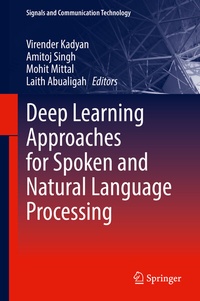
Deep Learning Approaches for Spoken and Natural Language Processing
Description

- Discusses current research challenges and future perspective about how deep learning techniques can be applied to improve NLP and speech processing applications;
- Presents and escalates the research trends and future direction of language and speech processing;
- Includes theoretical research, experimental results, and applications of deep learning.
More details
Other editions
Additional editions
Persons
Dr Virender Kadyan is currently working as an Assistant Professor-SG in department of Informatics, School of Computer Science, University of Petroleum and Energy Studies, Dehradun, Uttrakhand, India. He has completed his PhD and MTech from Chitkara University Punjab in 2018 and Kurkshetra University, Kurukshetra in 2013. Earlier he lead Centre for Excellence in Speech and Multimodal Laboratory for 4. 5 years where he guided PhD and ME Scholars. He worked as Co-PI in IEEE funded project. He has filled 13+ patents and out of these 2 patents were granted, along with 4 were published on various technical domains. With 7+ years of experience he has published 26+ research paper in national/international conferences/journals to his credit. He has won internal project award in 2018 and invited at UN Head quarter for his innovation. His research interest includes Automatic Speech recognition, and speaker identification & verification.
Dr. Amitoj Singh is working as Assistant Professor in the department of Computational Sceinces, MRSPTU, Bathinda, Punjab, India. He is Masters and Doctorate in Computer Science. His research interests include Software Devleopment Methodologies, Automatic speech recognition and Machine Learning. With over 12 years of teaching/research experience, 40+national/International papers 06+, and presented more than 35 papers at national and international conferences. He has been granted Major Research grant by IEEE US to develop language resources for auditory impaired persons. He is actively working in the field of Punjabi speech recognition. He has developed braille slate for blind people and won some hackathons/competitions. His team has also developed sign language application in Punjabi language for preschool hearing impaired kids and their parents for learning Punjabi Sign language.
Mohit Mittal is post-doctoral researcher at Department of Information Science and Technology in Kyoto Sangyo University, Kyoto, Japan. He received his PhD from GKV, Uttarakhand, India, 2018. He received his B.Tech and M.Tech in Computer Science and Engineering from Guru Nanak Dev University, Amritsar in 2010 and 2011 respectively. He has published more than 45 research papers in various international journals and conferences. His area of research is wireless sensor network, artificial intelligence, NLP, Data Mining and Machine learning.
Laith Abualigah is an Assistant Professor at the Computer Science Department, Amman Arab University, Jordan. He received his first degree from Al-Albayt University, Computer Information System, Jordan, in 2011. He earned a Master's degree from Al-Albayt University, Computer Science, Jordan, in 2014. He received the Ph.D. degree from the School of Computer Science in Universiti Sains Malaysia (USM), Malaysia in 2018. His main research interests focus on Bio-inspired Computing, Artificial Intelligence, Metaheuristic Modeling, and Optimization Algorithms, Evolutionary Computations, Information Retrieval, Feature Selection, Combinatorial Problems, Optimization, Advanced Machine Learning, Big data, and Natural Language Processing.
