

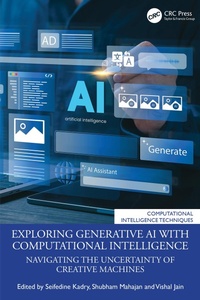
Exploring Generative AI with Computational Intelligence
Navigating the Uncertainty of Creative Machines
Published on 13. November 2025
322 pages
978-1-040-60112-9 (ISBN)
Description

This book demystifies the concept of AI-driven creativity with an in-depth understanding of the underlying principles, algorithms, and applications of generative AI. It begins with a coverage of AI fundamentals, followed by a technical discussion including detailed explanations of model architectures, training processes, and optimisation techniques. It explores case studies showcasing how generative AI is reshaping industries such as entertainment, marketing, design, and healthcare. The book also tackles ethical considerations, addressing issues related to bias, transparency, and responsible AI development.
Features:
Provides deep understanding of generative AI, including in-depth coverage of various generative models such as GANs, VAEs, and RNNs.
Includes practical, real-world examples of how generative AI is applied in different industries.
Dedicates significant attention to ethical considerations.
Equips readers with the knowledge and tools to build, train, and deploy their own generative AI systems.
Offers thorough explanations of AI algorithms, neural network architectures, and training processes.
This book is aimed at graduate students and researchers in computer engineering, AI and ML.
Features:
Provides deep understanding of generative AI, including in-depth coverage of various generative models such as GANs, VAEs, and RNNs.
Includes practical, real-world examples of how generative AI is applied in different industries.
Dedicates significant attention to ethical considerations.
Equips readers with the knowledge and tools to build, train, and deploy their own generative AI systems.
Offers thorough explanations of AI algorithms, neural network architectures, and training processes.
This book is aimed at graduate students and researchers in computer engineering, AI and ML.
More details
Series
Language
English
Place of publication
London
United Kingdom
Publishing group
Taylor & Francis Ltd
Target group
College/higher education
Professional and scholarly
Product notice
Reflowable
Illustrations
27 Tables, black and white; 72 Line drawings, black and white; 11 Halftones, black and white; 83 Illustrations, black and white
File size
11,31 MB
ISBN-13
978-1-040-60112-9 (9781040601129)
Copyright in bibliographic data and cover images is held by Nielsen Book Services Limited or by the publishers or by their respective licensors: all rights reserved.
Schweitzer Classification
Other editions
Additional editions
Seifedine Kadry | Shubham Mahajan | Vishal Jain
Exploring Generative AI with Computational Intelligence
Navigating the Uncertainty of Creative Machines
Book
11/2025
1st Edition
CRC Press
€177.60
Shipment within 15-20 days

Seifedine Kadry | Shubham Mahajan | Vishal Jain
Exploring Generative AI with Computational Intelligence
Navigating the Uncertainty of Creative Machines
Book
11/2025
1st Edition
CRC Press
€77.40
Shipment within 10-20 days
Persons
Seifedine Nimer Kadry holds a Bachelor degree in 1999 from Lebanese University, MS degree in 2002 from Reims University (France) and EPFL (Lausanne), PhD in 2007 from Blaise Pascal University (France), HDR degree in 2017 from Rouen University. At present, his research focuses on Data Science, education using technology, system prognostics, stochastic systems, and applied mathematics. He is currently working as a Full Professor of data science at Lebanese American University in Lebanon and Noroff University College in Norway. He is an ABET program evaluator for computing, and ABET program evaluator for Engineering Tech. He has served in the Editorial Board of numerous journals in several publishers while he has been editor of several books. He has taken various roles in the organization committee in numerous conferences.
Shubham Mahajan, a distinguished member of prestigious organizations, boasts an impressive academic and professional background. He earned his B.Tech. degree from Baba Ghulam Shah Badshah University, his M.Tech. degree from Chandigarh University, his Ph.D. degree from Shri Mata Vaishno Devi University (SMVDU) in Katra, India. Currently, he serves as an Assistant Professor at Amity University, Haryana. Dr. Mahajan has a remarkable track record in the field of artificial intelligence and image processing, holding an impressive portfolio of eighteen Indian patents, as well as one Australian and one German patent. His contributions to the field are further evidenced by his extensive publication record, which includes over 92 articles published in peer-reviewed journals and conferences and 8 edited books. His research interests span a wide array of topics, encompassing image processing, video compression, image segmentation, fuzzy entropy, nature-inspired computing methods, optimization, data mining, machine learning, robotics, and optical communication. Notably, his dedication and expertise have earned him the 'Best Research Paper Award' from ICRIC 2019.
Vishal Jain is presently working as Professor at the Department of Computer Science and Engineering, School of Engineering and Technology, Sharda University, Greater Noida, India. Before that, he worked for several years as an Associate Professor at Bharati Vidyapeeth's Institute of Computer Applications and Management (BVICAM), New Delhi. He has more than 18 years of experience in the academics. He has earned degrees: Ph.D (CSE), M.Tech (CSE), MBA (HR), MCA, MCP, and CCNA. He has more than 2500 research citations with Google Scholar (h-index score 24 and i-10 index 55) and has authored more than 150 research papers in professional journals and conferences. He has authored and edited more than 60 books (most of them are indexed at the Scopus) with various reputed publishers, including Taylor and Francis Group. He has more than 250 Scopus publications. His research areas include machine learning, information retrieval, semantic web, ontology engineering, data mining, ad hoc networks, sensor networks and network security. He received a Young Active Member Award for the year 2012-13 from the Computer Society of India, and Best Faculty Award for the year 2017 and Best Researcher Award for the year 2019 from BVICAM, New Delhi.
Shubham Mahajan, a distinguished member of prestigious organizations, boasts an impressive academic and professional background. He earned his B.Tech. degree from Baba Ghulam Shah Badshah University, his M.Tech. degree from Chandigarh University, his Ph.D. degree from Shri Mata Vaishno Devi University (SMVDU) in Katra, India. Currently, he serves as an Assistant Professor at Amity University, Haryana. Dr. Mahajan has a remarkable track record in the field of artificial intelligence and image processing, holding an impressive portfolio of eighteen Indian patents, as well as one Australian and one German patent. His contributions to the field are further evidenced by his extensive publication record, which includes over 92 articles published in peer-reviewed journals and conferences and 8 edited books. His research interests span a wide array of topics, encompassing image processing, video compression, image segmentation, fuzzy entropy, nature-inspired computing methods, optimization, data mining, machine learning, robotics, and optical communication. Notably, his dedication and expertise have earned him the 'Best Research Paper Award' from ICRIC 2019.
Vishal Jain is presently working as Professor at the Department of Computer Science and Engineering, School of Engineering and Technology, Sharda University, Greater Noida, India. Before that, he worked for several years as an Associate Professor at Bharati Vidyapeeth's Institute of Computer Applications and Management (BVICAM), New Delhi. He has more than 18 years of experience in the academics. He has earned degrees: Ph.D (CSE), M.Tech (CSE), MBA (HR), MCA, MCP, and CCNA. He has more than 2500 research citations with Google Scholar (h-index score 24 and i-10 index 55) and has authored more than 150 research papers in professional journals and conferences. He has authored and edited more than 60 books (most of them are indexed at the Scopus) with various reputed publishers, including Taylor and Francis Group. He has more than 250 Scopus publications. His research areas include machine learning, information retrieval, semantic web, ontology engineering, data mining, ad hoc networks, sensor networks and network security. He received a Young Active Member Award for the year 2012-13 from the Computer Society of India, and Best Faculty Award for the year 2017 and Best Researcher Award for the year 2019 from BVICAM, New Delhi.
Content
1. Exploring the Synergies and Challenges of Generative AI through the Lens of Computational Intelligence
2. The Evolution of Generative AI: From Rule-Based Systems to Neural Networks
3. AI-Driven Decision-Making for Sustainable Water Quality Management: A Fuzzy Multi-Criteria Approach to Handling Uncertainty
4. From Logic to Learning: The Evolution of Generative AI From Rules To Neural Creativity
5. Generative AI Architectures, Applications and Future Scopes in Industry
6. Societal Impact and Cultural Implications
7. An Enhancing Athletic Performance Through Wearable Technology Using Gen AI with Computational Intelligence
8. Generative AI Techniques and Computational Intelligence Functioning on Text-to-Image/Visual Content Generation
9. Revolutionizing Multimodal Language Translation: Generative AI Empowered LLM and NLP Solutions for Seamless Voice, Text and Communication Integration
10. Can Generative AIable to Cause Evolution in the Animals: An Inspiration Study from 2024 The Wild Robot Movie
11. Innovative Solutions to Complex Problems - Leveraging Computational Intelligence Techniques for Driving Advancements in AI
12. Research Frontiers and Open Challenges
13. Advancing Training Methodologies for Generative Artificial Intelligence (AI): Optimization Techniques, Challenges, and Future Directions
14. Exploring of Generative Artificial Intelligence for Transformative Healthcare Applications
2. The Evolution of Generative AI: From Rule-Based Systems to Neural Networks
3. AI-Driven Decision-Making for Sustainable Water Quality Management: A Fuzzy Multi-Criteria Approach to Handling Uncertainty
4. From Logic to Learning: The Evolution of Generative AI From Rules To Neural Creativity
5. Generative AI Architectures, Applications and Future Scopes in Industry
6. Societal Impact and Cultural Implications
7. An Enhancing Athletic Performance Through Wearable Technology Using Gen AI with Computational Intelligence
8. Generative AI Techniques and Computational Intelligence Functioning on Text-to-Image/Visual Content Generation
9. Revolutionizing Multimodal Language Translation: Generative AI Empowered LLM and NLP Solutions for Seamless Voice, Text and Communication Integration
10. Can Generative AIable to Cause Evolution in the Animals: An Inspiration Study from 2024 The Wild Robot Movie
11. Innovative Solutions to Complex Problems - Leveraging Computational Intelligence Techniques for Driving Advancements in AI
12. Research Frontiers and Open Challenges
13. Advancing Training Methodologies for Generative Artificial Intelligence (AI): Optimization Techniques, Challenges, and Future Directions
14. Exploring of Generative Artificial Intelligence for Transformative Healthcare Applications
