

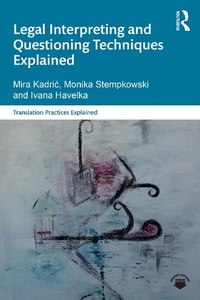
Legal Interpreting and Questioning Techniques Explained
1st Edition
Published on 31. May 2024
128 pages
978-1-040-00680-1 (ISBN)
Description

Language and law are closely linked, and language is fundamental to the application of the law. Legal, criminalistic, translational and psychological aspects of communication come together in interpreted questioning (hearings, interrogations, interviews) and must be taken into account, especially since the way in which the questioning outcomes are evaluated can have far-reaching legal consequences. Building on empirical studies and practice, this accessible text provides a transdisciplinary examination of questioning methods and strategies. The institutional framework conditions of a questioning situation are examined in the context of transdisciplinary cooperation.
This book also addresses the increasing use of technology and hybrid forms of translation and interpreting in the legal system, and shows different ways in which interpreters co-construct information. Chapters include summaries of key concepts and definitions, examples from existing literature combined with practical experience and the results of surveys conducted by the authors, as well as further reading and non-language-specific study activities. Activities include role plays on thematic scenarios involving different actors in criminal proceedings and discussion groups to enable reflection on ethical issues and discursive challenges.
This is a vital text for both advanced students and professionals in interpreting studies and criminology.
This book also addresses the increasing use of technology and hybrid forms of translation and interpreting in the legal system, and shows different ways in which interpreters co-construct information. Chapters include summaries of key concepts and definitions, examples from existing literature combined with practical experience and the results of surveys conducted by the authors, as well as further reading and non-language-specific study activities. Activities include role plays on thematic scenarios involving different actors in criminal proceedings and discussion groups to enable reflection on ethical issues and discursive challenges.
This is a vital text for both advanced students and professionals in interpreting studies and criminology.
More details
Series
Edition
1. Auflage
Language
English
Place of publication
London
United Kingdom
Publishing group
Taylor & Francis Ltd
Target group
College/higher education
Professional and scholarly
Illustrations
13 Halftones, black and white; 13 Illustrations, black and white
ISBN-13
978-1-040-00680-1 (9781040006801)
Copyright in bibliographic data and cover images is held by Nielsen Book Services Limited or by the publishers or by their respective licensors: all rights reserved.
Schweitzer Classification
Other editions
Additional editions
Mira Kadric | Monika Stempkowski | Ivana Havelka
Legal Interpreting and Questioning Techniques Explained
Book
05/2024
1st Edition
Routledge
€205.60
Shipment within 10-20 days
Mira Kadric | Monika Stempkowski | Ivana Havelka
Legal Interpreting and Questioning Techniques Explained
Book
05/2024
1st Edition
Routledge
€60.50
Shipment within 10-20 days

Book
05/2024
Taylor & Francis
Unfortunately, price unknown
Available (delivery time upon request)
Persons
Mira Kadric is professor for Interpreting Studies and Didactics of Translation at the University of Vienna, Austria. Her research focuses especially on empirical work on interpreting, drawing on her experience as an interpreter for the courts, public services and political institutions.
Monika Stempkowski is a postdoctoral researcher at the University of Vienna, Austria. Her research focuses on questions of legal psychology, mentally ill perpetrators, illicit drugs and prison studies. She is registered as a clinical and health psychologist and as a certified mediator.
Ivana Havelka is a postdoctoral researcher at the University of Vienna, Austria. Her research interests include dialogue interpreting and technology-mediated interpreting, with a focus on legal contexts. She has over a decade of experience as a court interpreter in Austria.
Monika Stempkowski is a postdoctoral researcher at the University of Vienna, Austria. Her research focuses on questions of legal psychology, mentally ill perpetrators, illicit drugs and prison studies. She is registered as a clinical and health psychologist and as a certified mediator.
Ivana Havelka is a postdoctoral researcher at the University of Vienna, Austria. Her research interests include dialogue interpreting and technology-mediated interpreting, with a focus on legal contexts. She has over a decade of experience as a court interpreter in Austria.
Content
Contents
List of figures
Acknowledgements
List of abbreviations
Introduction
1 Questioning and interpreting as special forms of communication
2 Institutional safeguards of rights
3 Interpreting as part of communication in legal settings and at public authorities
4 Psychology of (interpreted) communication
5 Questioning and interpreting techniques
6. Cultures of communication and interpreting with a focus on evidence gathering
7 Hybridity of communication as a challenge for interpersonal communication
Conclusion: Questioning and interpreting as two sides of the same communication coin
Glossary
List of figures
Acknowledgements
List of abbreviations
Introduction
1 Questioning and interpreting as special forms of communication
2 Institutional safeguards of rights
3 Interpreting as part of communication in legal settings and at public authorities
4 Psychology of (interpreted) communication
5 Questioning and interpreting techniques
6. Cultures of communication and interpreting with a focus on evidence gathering
7 Hybridity of communication as a challenge for interpersonal communication
Conclusion: Questioning and interpreting as two sides of the same communication coin
Glossary
