

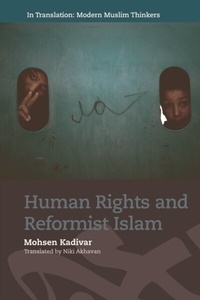
Human Rights and Reformist Islam
Description

Published in Association with the Aga Khan University Institute for the Study of Muslim Civilisations
Translates the influential collection Haqq al-nas, which argues for the compatibility of human rights and Islam
- Written by an original and prolific intellectual of the Iranian reform movement
- Adds an extensive new introduction and annotations throughout the text from Mohsen Kadivar bringing the work up-to-date and placing it in its academic and public contexts
- Includes a preface by Professor Mirjam Künkler explaining the importance of the translation and the value of its contribution to current scholarly debate
- Critically compares Mohsen Kadivar's approach to Islam and human rights with those of five leading contemporary scholars: Mahmoud M. Taha, Abdullahi A. an-Na'im, Ann E. Mayer, Mohammad M. Shabestari and Abdulaziz A. Sachedina
- Includes a glossary of key terminology
Human Rights and Reformist Islam critiques traditional Islamic approaches to the question of compatibility between human rights and Islam, and argues instead for their reconciliation from the perspective of a reformist Islam. The book focuses on six controversial case studies: religious discrimination; gender discrimination; slavery; freedom of religion; punishment of apostasy; and arbitrary or harsh punishments.
Explaining the strengths of structural ijtihad, Mohsen Kadivar's approach is based on the rational classification of Islamic teachings as temporal or permanent on the one hand, and four criteria of being Islamic on the other: reasonableness, justice, morality and efficiency. In the book, all of the verses and Hadith that are problematic in relation to human rights are abrogated rationally according to these criteria. The result is a powerful, solutions-based argument based on reformist Islam - providing a scholarly bridge between modernity and Islamic tradition in relation to human rights.
More details
Other editions
Additional editions
Persons
Content
- Intro
- Acknowledgements
- Foreword by Mirjam Ku¨nkler
- Preface to the English Translation
- Introduction to the 2008 Edition
- Section One: The Bases for Discussions on Islam and Human Rights
- 1 From Traditional Islam to End-oriented Islam
- 2 The Principles of Compatibility between Islam and Modernity
- 3 An Introduction to the Public and Private Debate in Islamic Culture
- Section Two: Islam and Human Rights
- 4 Imam Sajjad and the Rights of Mankind
- 5 Human Rights and Reformist Islam
- 6 Questions and Answers about Human Rights and Reformist Islam
- 7 Human Rights, Secularism and Religion
- Section Three: Freedoms of Belief, Religion and Politics
- 8 The Freedom of Belief and Religion in Islam and Human Rights Documents
- 9 The Rights of the Political Opposition in an Islamic Society
- Section Four: Women's Rights
- 10 Reformist Islam and Women's Rights
- 11 Women's Rights in the Hereafter: A Qur?anic Theological Study
- Section Five: Other Debates in Human Rights
- 12 The Issue of Slavery in Contemporary Islam
- 13 The Rights of Non-Muslims in Contemporary Islam
- 14 Social Security in Islamic Teachings
- Bibliography
- Glossary
- Index
