

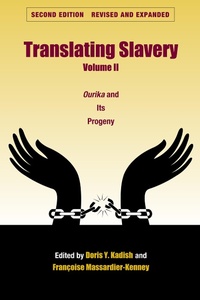
Translating Slavery, Volume 2
Description

The second volume of this revised and expanded edition of Translating Slavery
Translating Slavery explores the complex interrelationships that exist between translation, gender, and race by focusing on antislavery writing by or about French women in the French revolutionary period. Now in two volumes, Translating Slavery closely examines what happens when translators translate literary works that address issues of gender and race. The volumes explore the theoretical, linguistic, and literary complexities involved when white writers, especially women, took up their pens to denounce the injustices to which blacks were subjected under slavery.
Volume 1, Gender and Race in French Abolitionist Writing, 1780-1830, highlights key issues in the theory and practice of translation by providing essays on the factors involved in translating gender and race, as well as works in translation.
Volume 2, Ourika and Its Progeny, contains the original translation of Claire de Duras's Ourika as well as a series of original critical essays by twenty-first-century scholars. First published anonymously in 1823, Ourika signifies an important shift from nineteenth-century notions of race, nationality, and kinship toward the identity politics of today. Editors Kadish and Massardier-Kenney and their contributors review the impact of the novel and abolitionist narrative, poetry, and theater in the context of translation studies.
This revised and expanded edition of Translating Slavery will appeal to scholars and students interested in race and gender studies, French literature and history, comparative literature, and translation studies.
More details
Other editions
Additional editions
Persons
Doris Y. Kadish, Distinguished Research Professor of French and Women's Studies at the University of Georgia, continues to promote the emerging field of French slavery studies. Her publications include Slavery in the Caribbean Francophone World: Distant Voices, Forgotten Acts, Forged Identities and editions of Sopie Doin's La Famille noire and Charlotte Dard's La Chaumière africaine. She is also the coeditor/translator of Marceline Desbordes-Valmore's Sarah and Charles de Rémusat's L'Habitation de Saint-Domingue.
Françoise Massardier-Kenney is a professor of French and director of the Institute for Applied Linguistics at Kent State University. She is the editor of the American Translators Association Scholarly Series and coeditor of the journal George Sand Studies. Her publications include the monograph Gender in the Fiction of George Sand and translations of Sand's Valvèdre and Antoine Berman's Toward a Translation Criticism: John Donne (The Kent State University Press, 2009).
Content
- Intro
- Halftitle Page
- Title Page
- Copyright Page
- Contents
- Preface Doris Y. Kadish
- Part One: Novel
- 1. Claire de Duras, Ourika Françoise Massardier-Kenney and Claire Salardenne
- 2. Mme M. A. Dudon, The New Ourika, or The Advantages of Education (Conclusion) Françoise Massardier-Kenney
- Part Two: Poetry
- 3. Pierre-Ange Vieillard, "Ourika: Elegiac Stanzas" Norman R. Shapiro
- 4. Gaspard de Pons, "Ourika the African" Norman R. Shapiro
- 5. Delphine Gay, "Ourika Elegy" Norman R. Shapiro
- Part Three: Theater
- 6. Jean-Toussaint Merle and Frédéric de Courcy, Ourika, or The African Orphan Girl Norman R. Shapiro
- 7. Mélesville (Anne-Honoré-Joseph Duveyrier) and Pierre-Frédéric-Adolphe Carmouche, Ourika, or The Little Black Girl Norman R. Shapiro
- Part Four: Essays
- 8. Françoise Massardier-Kenney, Duras, Racism, and Class
- 9. Doris Y. Kadish, Ourika's Three Versions: A Comparison
- 10. Barbara T. Cooper, Staging Ourika and the Spectacle of Difference
- Appendixes: French Texts
- A. Claire de Duras, Ourika
- B. Pierre-Ange Vieillard, "Ourika, stances élégiaques"
- C. Gaspard de Pons, "Ourika l'Africaine"
- D. Delphine Gay, "Ourika élégie"
- Notes
- Selected Bibliography
- Index
