

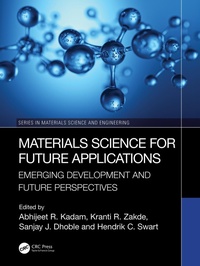
Materials Science for Future Applications
Emerging Development and Future Perspectives
1st Edition
Published on 20. June 2025
422 pages
978-1-040-34326-5 (ISBN)
Description

Materials Science for Future Applications: Emerging Development and Future Perspectives offers an overview of the materials used for progressive energy systems, such as solar cells, luminescent energy, sensors and detectors and energy storage devices. Today's worldwide energy and materials production is going through important changes, which are developing novel prospects. These developments and innovative technologies are changing the way energy is manufactured, transported and spent.
The materials emphasis in this book conveys a new perspective and highlights the many challenges that are often overlooked in other literature. An understanding of these challenges can be critical when working with new energy material technologies. Particular devotion is given to the key materials and their conversion productivity, extensive duration of permanency, materials expenses and energy materials sustainability.
Materials Science for Future Applications offers a comprehensive introduction for students and researchers, in both academia and industry, who are interested in understanding the properties of emerging materials and their challenges.
The materials emphasis in this book conveys a new perspective and highlights the many challenges that are often overlooked in other literature. An understanding of these challenges can be critical when working with new energy material technologies. Particular devotion is given to the key materials and their conversion productivity, extensive duration of permanency, materials expenses and energy materials sustainability.
Materials Science for Future Applications offers a comprehensive introduction for students and researchers, in both academia and industry, who are interested in understanding the properties of emerging materials and their challenges.
More details
Series
Edition
1. Auflage
Language
English
Place of publication
London
United Kingdom
Publishing group
Taylor & Francis Ltd
Target group
College/higher education
Professional and scholarly
Illustrations
19 Tables, black and white; 36 Line drawings, color; 82 Line drawings, black and white; 15 Halftones, color; 17 Halftones, black and white; 51 Illustrations, color; 99 Illustrations, black and white
File size
142,17 MB
ISBN-13
978-1-040-34326-5 (9781040343265)
Copyright in bibliographic data and cover images is held by Nielsen Book Services Limited or by the publishers or by their respective licensors: all rights reserved.
Schweitzer Classification
Other editions
Additional editions
Abhijeet R. Kadam | Kranti Zakde | Sanjay J. Dhoble
Materials Science for Future Applications
Emerging Development and Future Perspectives
Book
06/2025
1st Edition
CRC Press
€278.50
Shipment within 10-20 days
Persons
Dr. Abhijeet R. Kadam (M.S.C, PHD) is an assistant professor in the Department of Physics, CSMSS, Chh. Shahu College of Engineering, Chhatrapati Sambhajinagar. His areas of interest include photoluminescence, material science, nanomaterial synthesis, thermoluminescence dosimetry, photovoltaic efficiency enhancement, Mercury extraction etc. During his research, he has published 10 patents and multiple book chapters in reputed international publications, including with CRC Press. Dr. Kadam published 54 research papers out of which 52 papers are in Scopus indexed journal. He is also life member of Indian Science Congress Association.
Dr. Kranti R. Zakde is currently an Associate Professor in the Faculty of Basic and Applied Sciences, MGM University of Chhatrapati Sambhajinagar, Maharashtra state, India. She has teaching experience of more than 18 years in the areas of Engineering and Technology, Basic and Applied Sciences etc. Subjects taught include Properties of matter, Research Methodology in Physics, Vibrations and Optics, Engineering Physics, Applied Physics etc. Currently, she is the Head of the Department of Physics, School of Basic and Applied Sciences, MGM University. She has presented many research papers related to self-similarity and fractal character, green synthesis of ferrite nanoparticles, superparamagnetic ferrite nanoparticles etc. at international and national levels. The author has participated in more than 30 national and international conferences. She has also published papers in International Journals and a number of conference proceedings. Her current research focus is in the area of Sensor Technology and Material Science.
Prof. Sanjay J. Dhoble is presently working as a Professor in the Department of Physics, Rashtrasant Tukadoji Maharaj Nagpur University, Nagpur, India. He has about 31 years of teaching at undergraduate and post graduate level and 30 years research experience. Dr. Dhoble stands among the "Top 2% Scientists in the World" in the prestigious list published by a team of scientists in US' Stanford University, in one of the highly rated journals, PLOS Biology. Best Research Award-2016, for the outstanding contribution in the field of research and related extenuation activity for the University. He is also a recipient of India's Top Faculty Research Award-2018 by Careers 360, for the top ten researchers in India in Physics. During his research career, he has worked on the synthesis and characterization of solid-state lighting materials and phosphors for solar cell efficiency enhancement, as well as development of radiation dosimetry phosphors and biosynthesis of nanoparticle and their applications. He is also a Fellow of the Luminescence Society of India (LSI) and Fellow of Maharashtra Academic of Sciences (MASc). Luminescence.
Hendrik C Swart is a B1 NRF rated researcher (Internationally acclaimed researchers) and currently a senior professor in the Department of Physics at the University of the Free State. He has led research in the area of the degradation of phosphors for field emission displays, as well as developing materials for nano solid-state lighting. He has been key in the development of processes to synthesise and deposit thin films of various types of semiconductor nano-particles. His research led to the establishment of a strong group working on luminescent materials and to the establishment of several smaller groups all over South Africa. He has more than 830 publications in international peer reviewed journals, 119 peer reviewed conference proceedings and editor/author or co-editor/author of 80 book chapters and or books with more than 21400 cited author references. He is also the recipient of numerous awards in his field.
Dr. Kranti R. Zakde is currently an Associate Professor in the Faculty of Basic and Applied Sciences, MGM University of Chhatrapati Sambhajinagar, Maharashtra state, India. She has teaching experience of more than 18 years in the areas of Engineering and Technology, Basic and Applied Sciences etc. Subjects taught include Properties of matter, Research Methodology in Physics, Vibrations and Optics, Engineering Physics, Applied Physics etc. Currently, she is the Head of the Department of Physics, School of Basic and Applied Sciences, MGM University. She has presented many research papers related to self-similarity and fractal character, green synthesis of ferrite nanoparticles, superparamagnetic ferrite nanoparticles etc. at international and national levels. The author has participated in more than 30 national and international conferences. She has also published papers in International Journals and a number of conference proceedings. Her current research focus is in the area of Sensor Technology and Material Science.
Prof. Sanjay J. Dhoble is presently working as a Professor in the Department of Physics, Rashtrasant Tukadoji Maharaj Nagpur University, Nagpur, India. He has about 31 years of teaching at undergraduate and post graduate level and 30 years research experience. Dr. Dhoble stands among the "Top 2% Scientists in the World" in the prestigious list published by a team of scientists in US' Stanford University, in one of the highly rated journals, PLOS Biology. Best Research Award-2016, for the outstanding contribution in the field of research and related extenuation activity for the University. He is also a recipient of India's Top Faculty Research Award-2018 by Careers 360, for the top ten researchers in India in Physics. During his research career, he has worked on the synthesis and characterization of solid-state lighting materials and phosphors for solar cell efficiency enhancement, as well as development of radiation dosimetry phosphors and biosynthesis of nanoparticle and their applications. He is also a Fellow of the Luminescence Society of India (LSI) and Fellow of Maharashtra Academic of Sciences (MASc). Luminescence.
Hendrik C Swart is a B1 NRF rated researcher (Internationally acclaimed researchers) and currently a senior professor in the Department of Physics at the University of the Free State. He has led research in the area of the degradation of phosphors for field emission displays, as well as developing materials for nano solid-state lighting. He has been key in the development of processes to synthesise and deposit thin films of various types of semiconductor nano-particles. His research led to the establishment of a strong group working on luminescent materials and to the establishment of several smaller groups all over South Africa. He has more than 830 publications in international peer reviewed journals, 119 peer reviewed conference proceedings and editor/author or co-editor/author of 80 book chapters and or books with more than 21400 cited author references. He is also the recipient of numerous awards in his field.
Content
1 Synthesis and Luminescence spectroscopic characterization of color tuning inorganic LED phosphors
2 Lanthanide-doped Nanomaterials for Latent Fingerprint Visualization and Anti-counterfeiting
3 Material Science for Plant cultivation technologies
4 Rare Earth Ions Doped Luminescent Materials for Optical Thermometry
5 Nanomaterial Based White-Light-Emitting-Diodes
6 Effects of Swift Heavy Ions Beam on Physical and Chemical Properties of Advanced Materials
7 Conducting Polymer based sensing devices and its application
8 Metal-Organic Frameworks for Gas Sensing Application
9 LED Sensors - An insight and development of light sensor
10 Revolutionary Material: Graphene for Gas Sensing
11 Recent Advances in perovskite solar cells
12 Thin Film Solar Cells: A Bright Future for Renewable Energy
13 Downshifting compatible materials for present and future generation solar cells
14 Energy storage systems: a synergetic approach
15 Zinc Oxide-based Nanostructured Materials for Energy Storage Applications
16 EDLC Supercapacitors: Electrochemical Fundamentals and Applications
17 Hybrid Supercapacitors: Bridging the Gap between Batteries and Capacitors
18 Pseudocapacitors Redefining Energy Storage for Advance Applications
19 Synthesis of Zinc Oxide nanoparticles and their biological applications
20 Glassy dynamics in supercooled aqueous solutions of carbohydrates
21 Selenium based nanoparticles and their application in biomedicine
22 Nanomaterials for Antibacterial and Antifungal Activity: Recent Advances and Applications
23 Advances in Magnetic Materials: Exploring the Properties and Applications of Spinel Ferrites
24 Emerging Trends and Future Prospects in Magnetic Nanomaterials Research
25 Nanostructured versatile noble metal-magnetic materials for advance applications
26 On the Synthesis and Multifaceted Characterization of High Entropy Spinel Ferrites for Emerging Applications
2 Lanthanide-doped Nanomaterials for Latent Fingerprint Visualization and Anti-counterfeiting
3 Material Science for Plant cultivation technologies
4 Rare Earth Ions Doped Luminescent Materials for Optical Thermometry
5 Nanomaterial Based White-Light-Emitting-Diodes
6 Effects of Swift Heavy Ions Beam on Physical and Chemical Properties of Advanced Materials
7 Conducting Polymer based sensing devices and its application
8 Metal-Organic Frameworks for Gas Sensing Application
9 LED Sensors - An insight and development of light sensor
10 Revolutionary Material: Graphene for Gas Sensing
11 Recent Advances in perovskite solar cells
12 Thin Film Solar Cells: A Bright Future for Renewable Energy
13 Downshifting compatible materials for present and future generation solar cells
14 Energy storage systems: a synergetic approach
15 Zinc Oxide-based Nanostructured Materials for Energy Storage Applications
16 EDLC Supercapacitors: Electrochemical Fundamentals and Applications
17 Hybrid Supercapacitors: Bridging the Gap between Batteries and Capacitors
18 Pseudocapacitors Redefining Energy Storage for Advance Applications
19 Synthesis of Zinc Oxide nanoparticles and their biological applications
20 Glassy dynamics in supercooled aqueous solutions of carbohydrates
21 Selenium based nanoparticles and their application in biomedicine
22 Nanomaterials for Antibacterial and Antifungal Activity: Recent Advances and Applications
23 Advances in Magnetic Materials: Exploring the Properties and Applications of Spinel Ferrites
24 Emerging Trends and Future Prospects in Magnetic Nanomaterials Research
25 Nanostructured versatile noble metal-magnetic materials for advance applications
26 On the Synthesis and Multifaceted Characterization of High Entropy Spinel Ferrites for Emerging Applications
