

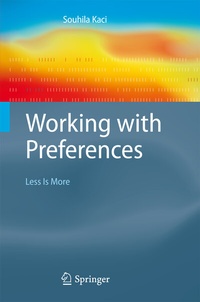
Working with Preferences: Less Is More
Description

Preferences are useful in many real-life problems, guiding human decision making from early childhood up to complex professional and organizational decisions. In artificial intelligence specifically, preferences is a relatively new topic of relevance to nonmonotonic reasoning, multiagent systems, constraint satisfaction, decision making, social choice theory and decision-theoretic planning
The first part of this book deals with preference representation, with specific chapters dedicated to representation languages, nonmonotonic logics of preferences, conditional preference networks, positive and negative preferences, and the study of preferences in cognitive psychology. The second part of the book deals with reasoning with preferences, and includes chapters dedicated to preference-based argumentation, preferences database queries, and rank-ordering outcomes and intervals. The author concludes by examining forthcoming research perspectives.
This is inherently a multidisciplinary topic and this book will be of interest to computer scientists, economists, operations researchers, mathematicians, logicians, philosophers and psychologists.
Reviews / Votes
From the reviews:
"In the area of artificial intelligence and cognition, several theories have been developed concerning preferences. The theories represent various ways to model or mathematically represent preferences, and various ways of reasoning using these representations of preferences. The area is currently undergoing considerable research. This book provides an overview of many of these theories and includes a chapter on the psychology of preferences. Subsequent chapters discuss reasoning in database queries, argumentation theory, temporal reasoning, and multiple criteria. ... The theories are illustrated with practical examples, and some of the relations are shown with diagrams. Professionals who need to develop solutions involving preferences will be able to utilize the theories. The book works as a survey book on preferences or as a useful textbook for a graduate-level course on preferences." Maulik A. Dave, ACM Computing Reviews, May 2012
"The book will interest readers who want to have a fairly comprehensive presentation of the various frameworks that deal with expressing preferences. Every chapter ends with a good bibliography, which facilitates access to the literature. . Every definition and every algorithm is illustrated by a simple but well chosen example that usually captures well enough the notion or the algorithm . ." (Éric Martin, Zentralblatt MATH, Vol. 1239, 2012)
More details
Other editions
Additional editions
Person
The author received her Habilitation à diriger des recherches for her work on this subject from the Centre de Recherche en Informatique de Lens, Université d'Artois; she has given seminars and tutorials on this topic at related conferences and workshops.
Content
Preferences Modeling.- Preferences Representation Languages.- Making Hidden Priorities Explicit.- What Psychology Has to Say About Preferences.- Preferences in Argumentation Theory.- Preferences in Database Queries.- Preferences Aggregation, Conclusion and Perspectives.- Bibliography.
