

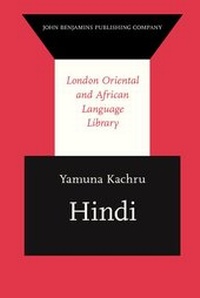
Hindi
1st Edition
Published on 31. October 2006
XXI, 309 pages
978-90-272-9314-5 (ISBN)
Description

This book presents the structure of Hindi keeping in view the sociolinguistic context of language use. It includes descriptions of sounds, devices of word formation, rules of phrase and sentence construction and conventions of language use in spoken and written texts incorporating the insights gained by application of recent linguistic theories. The account presented here, however, is free from abstruse technical vocabulary and modes of presentation that aim at justifying a particular linguistic model. This volume is primarily designed as a source of reference for linguists and educators who want to be better informed about the forms and functions of Hindi, and a resource for students and teachers of Hindi.
Hindi, the official language of the Republic of India, is the second most widely spoken language with approximately three hundred and fifty million speakers. In its diasporic contexts, it is spoken in Africa, Australia, Europe, Fiji, Guyana, Surinam, Trinidad, United Arab Emirates, United Kingdom and United States. An Indo-European language by genetic affiliation, Hindi shares many characteristics with Austro-Asiatic, Dravidian, and Sino-Tibetan languages of the subcontinent. In addition, Hindi has assimilated features of Arabic, Persian and English in a variety of its functionally determined styles.
Hindi, the official language of the Republic of India, is the second most widely spoken language with approximately three hundred and fifty million speakers. In its diasporic contexts, it is spoken in Africa, Australia, Europe, Fiji, Guyana, Surinam, Trinidad, United Arab Emirates, United Kingdom and United States. An Indo-European language by genetic affiliation, Hindi shares many characteristics with Austro-Asiatic, Dravidian, and Sino-Tibetan languages of the subcontinent. In addition, Hindi has assimilated features of Arabic, Persian and English in a variety of its functionally determined styles.
More details
Other editions
Additional editions
Person
Content
- HINDI
- Editorial page
- Title page
- LCC data
- In memoriam
- Contents
- Preface
- Symbols and Abbreviations
- 1. Introduction
- 1.0. Historical Background
- 1.1. Status
- Notes
- 2. Sound System
- 2.0. Hindi Sounds
- 2.1. Vowels
- 2.2. Consonants
- 2.3. Consonant Clusters
- 2.4. Pronunciation
- 2.5. Stress
- 2.6. Syllables
- 2.7. Morphophonemic Alternations
- 2.8. Intonation
- Notes
- 3. Devanagari Script
- 3.0. Devanagari
- 3.1. Vowels
- 3.2. Syllabary: Consonants
- Note
- 4. Parts of Speech
- 4.0. Parts of Speech
- 4.1. Noun
- 4.2. Determiner
- 4.3. Pronoun
- 4.4. Adjective
- 4.5. Verb
- 4.6. Adverb
- 4.7. Postposition
- 4.8. Conjunction
- 4.9. Particle
- 4.10. Interjection
- Notes
- 5. Word Formation
- 5.0. Formation of Words
- 5.1. Derivation of Nouns
- 5.2. Derivation of Adjectives
- 5.3. Derivation of Verbs
- 5.4. Reduplication
- 6. The Noun Phrase
- 6.0. The Noun Phrase
- 6.1. Simple Noun Phrase
- 6.2. Complex Noun Phrase
- 6.3. Relative Clause and Participle
- 7. Verb and Verb Phrase
- 7.0. The Verb
- 7.1. Object
- 7.2. Complement
- 7.3. The Verb Phrase
- Notes
- 8. Syntax: Simple Sentence
- 8.0. Sentence Structure
- 8.1. Word Order
- 8.2. Agreement
- 8.3. Simple Sentence
- 8.4. Voice
- 8.5. Mood
- 8.6. Types of Simple Sentences
- 8.7. Constructions (prayog) in Active
- Notes
- 9. Syntax: Complex and Compound Sentences
- 9.0. Complex Sentences
- 9.1. Complement Clause
- 9.2. Correlative Constructions
- 9.3. Participial Constructions
- 9.4. Conditional Clause
- 9.5. Compound Sentence
- 10. Information Structure
- 10.0. Information Structure
- 10.1. Theme
- 10.2. Focus
- Notes
- 11. Discourse Structure
- 11.0. Sentence vs. Discourse
- 11.1. Cohesive Devices
- 11.2. Politeness
- 11.3. Choice of Code(s)
- 11.4. Discourse Markers
- 11.5. Interjections
- 11.6. Speaking
- 11.7. Writing
- Notes
- Appendix 1
- Chapter 1
- Chapter 11
- Appendix 2
- References
- Select Bibliography
- Index
- The series London Oriental and African Language Library
