

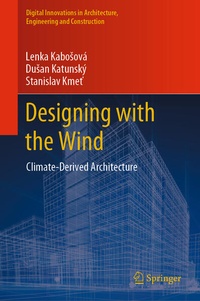
Designing with the Wind
Description

This book explores wind-adaptive architectural design blending the parametric design with digital simulations and suggests a novel approach for specific, even extreme conditions, as the first step in creating architecture that can act in response to the nature around. The chapters propose an urban and architectural design that emerges from the specific wind microclimate of the design site and responds to the changes in the ambient wind conditions. The book looks closely at A) the interdisciplinary wind-driven design method for architects, engineers, and urbanists employing open-source software for CFD analysis and B) the tensegrity-membrane adaptive building façades. The main questions the authors try to answer are: How does the wind-driven methodology enhance the wind comfort around buildings? How can it contribute to the reduction of wind surface loads acting on buildings?
More details
Other editions
Additional editions
Persons
Ing.arch. Lenka Kabosová, Ph.D., is an architect and a researcher, focusing her research on exploring climate-oriented, wind-driven architectural design combining a parametric design approach with digital simulations to propose novel ways of designing for specific, even extreme wind conditions. Throughout the doctoral studies, fruitful research cooperations with various architectural universities and research institutions in several European countries have led to publications in indexed journals and long-term collaboration. In 2019, her Ph.D. thesis was awarded the first prize among the selected doctoral students from all 9 Faculties of the Technical University in Kosice.
Prof. Ing. Dusan Katunský, C.Sc., is a recognized researcher in building physics and vice dean for science and research at the Faculty of Civil Engineering of the Technical University in Kosice. He was the head of the Institute of Architectural Engineering and the Institute of Building Technology before. His research focuses on building physics, including heat and moisture analysis, aerodynamics, hydrodynamics, and acoustics. He has been leading and mentoring many successful Ph.D. candidates from home and abroad. He is the author of several well-cited and recognized scientific papers in indexed international journals. He is a reviewer for publishers such as Elsevier and Thomson Reuters. He acts as the editor-in-chief for the University's Selected Scientific Papers - Journal of Civil Engineering, which has been issued for 16 years. He is a qualified expert in construction and has completed several expert assessments for practice, courts, the police, and the prosecutor's office.
Prof. Ing. Stanislav Kmet, Dr.Sc., Dr.h.c., prof.h.c., is a renowned researcher in Structural Engineering and rector of the Technical University of Kosice. His professional background is in the theory, design, and experimental research of large-span adaptive cable, membrane, and tensegrity systems with the application of artificial intelligence methods. His research interests are probabilistic reliability analysis, advanced time-dependent nonlinear mathematically physical computational methods, elastic-plastic and rheological models, simulations, and behavioral modelings' of structures and structural members subjected to static and dynamic load effects. He lectures as an invited speaker at foreign universities, conferences, symposiums, and seminars.
